
Khofifah Receives Moroccan Award and Speaks About Women’s Leadership
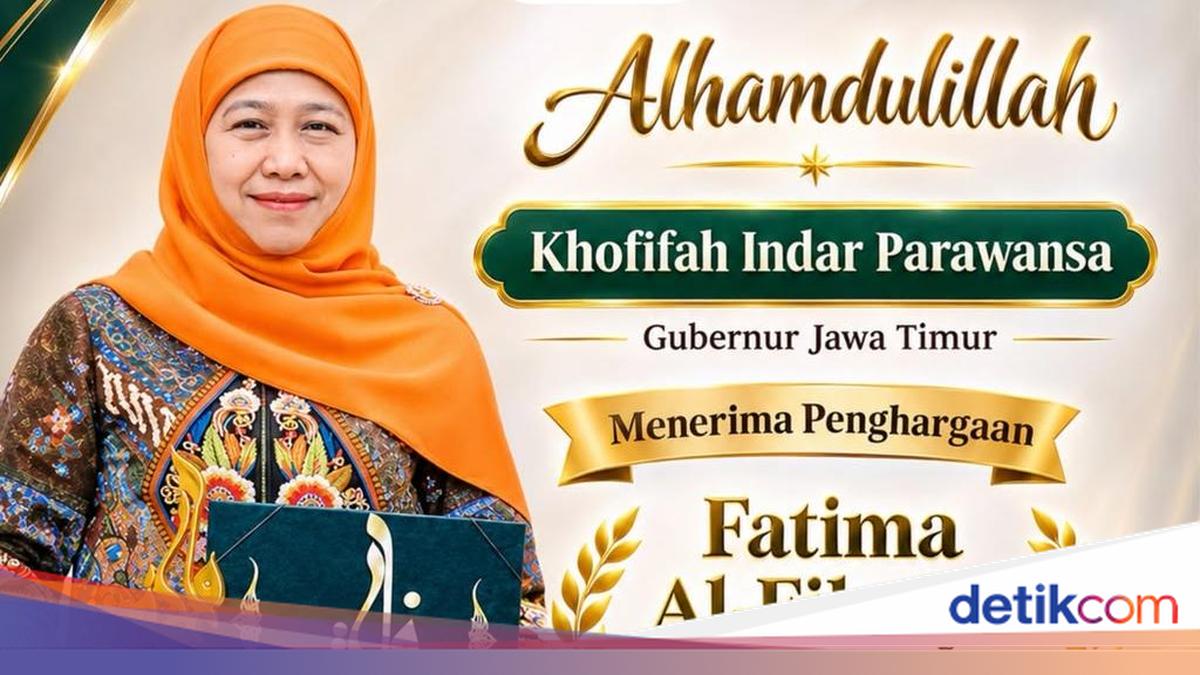
East Java Governor Khofifah Indar Parawansa has received the 2026 Fatima Al-Fihriya Award for her work in women’s leadership and social empowerment. The award is presented to women who have made tangible contributions to education, humanitarian work and community empowerment.
The sixth edition of the award, held in Indonesia in 2026, was organised in partnership by the Muslimat NU Association of Professors, the East Java Provincial Government, Programme MED 21, the Association de Soutien au Programme MED 21 and Maulana Malik Ibrahim State Islamic University in Malang. Four other women received awards alongside Khofifah: Sinta Nuriyah Wahid, Indonesia’s first lady from 1999 to 2001 and a member of the Presidential Advisory Council; Halimah Yacob, President of Singapore from 2017 to 2023; Moroccan politician Bassima Hakkaoui; and Tunisian politician Neziha Labidi.
Sinta Nuriyah Wahid was recognised for her dedication to humanitarian advocacy and gender equality. Halimah Yacob was honoured for her work in women’s leadership, social justice and governance.
Bassima Hakkaoui was recognised for her contribution to women’s empowerment and social policy, while Neziha Labidi was honoured for her service to the rights of women and children and to family development.
Khofifah expressed gratitude for the award and dedicated the honour to women and volunteers who have served their communities.
“I am grateful and honoured to receive this award. I dedicate this honour to the women of East Java and Indonesia, Muslimat NU cadres, members of other women’s organisations, and social volunteers,” Khofifah said in a written statement on Monday (9 November 2026).
“Thank you for your service in supporting families, helping children continue their education and being there for people in need. May the spirit of Fatima al-Fihriya continue to open doors to knowledge and opportunity for women everywhere,” she added.
Khofifah also spoke of Fatima al-Fihriya’s example. According to historical accounts, more than a thousand years ago Fatima endowed her wealth to establish the al-Qarawiyyin Mosque in Fez, Morocco. It later developed into a centre of learning and one of the world’s oldest universities.
“More than 1,000 years ago, Fatima al-Fihriya endowed her wealth to build a mosque. When the Prophet Muhammad (peace be upon him) migrated to the city of Yathrib, the first building erected there was also a mosque,” Khofifah said.
For Khofifah, the story shows that care expressed through concrete action can have a lasting impact.
“Her concern arose from the needs of the people around her. Its benefits were later felt by seekers of knowledge, long after her lifetime,” Khofifah said.
“That is where I see the meaning of women’s leadership. When entrusted with responsibility, we have the opportunity to clear a path for other women to learn, become independent and help determine decisions that affect their lives,” she added.
Khofifah said her experience serving with Muslimat NU had taught her the importance of leadership rooted in local communities. Muslimat NU cadres know the families they support. They understand who struggles to access healthcare, whose children need help to stay in school and who requires economic empowerment assistance.
“Residents’ trust grows because the cadres are present and listen. From them I have learnt that listening attentively is an important part of leadership,” Khofifah said.
That experience informed Khofifah’s work in a range of roles, from serving as a member of the Indonesian House of Representatives to becoming state minister for women’s empowerment, social affairs minister and East Java governor.
“In every role, I have carried one question with me: can the opportunities we create genuinely be accessed by those who need them most?” she said.
In East Java, one women’s empowerment initiative is the Kewirausahaan Inklusif Produktif Perempuan Tangguh Mandiri Jawa Timur Sejahtera (KIP Putri Jawara) programme. It provides business capital to women facing economic constraints, including those who are the main breadwinners in their families.
Khofifah stressed that women should be involved from the planning stage of empowerment programmes, and that their experiences and needs should inform policies so they are better targeted.
“Women’s participation as decision-makers shows that women have bargaining power in many areas,” she said.
Khofifah also underlined the importance of collaboration among government, universities and community organisations to ensure that services and empowerment programmes reach those who need them. She said the government must check directly how programmes are being implemented and what benefits people are experiencing.
“It is not enough to rely only on reports from regional government agencies to know whether a programme is running and whether people are actually benefiting from the services,” she said.
Khofifah therefore champions the principle of ‘No One Left Behind’. It requires all parties to make an active effort to reach women facing greater barriers, including people with disabilities and those living in remote areas.
According to Khofifah, the success of women’s empowerment can be seen in wider opportunities to gain an education, work, achieve economic independence and participate in decisions affecting their lives.
At the end of her speech, Khofifah said she hoped the award would provide a forum for women leaders from different countries to share experiences and strengthen collaboration. Such cooperation, she said, should widen access to education, support women in building businesses and ensure women’s experiences are considered when public policy is formulated.
“From the service of these remarkable women, we can learn how women’s leadership opens up opportunities for others,” she said.
“Through this award, may more women have the opportunity to develop their potential, broaden their contribution and play a part in community development,” she concluded.
Muhammad Al Arabi bin Athiyyah, representing the award-giving institution Forum Azzahra for Moroccan Women and serving as chair of the Mediterranean Programme 21 Association in Tunisia, praised Khofifah for supporting and facilitating the Sixth Fatima Al-Fihriya Awards 2026 in Indonesia. He said he hoped the award would encourage women around the world to continue their work and make a tangible contribution to society.
“Thank you to Ms Khofifah for providing the facilities to hold the Sixth Fatima Al-Fihriya Awards 2026. May this inspire women throughout the world,” Muhammad said.
“This award represents a woman’s struggle to establish a university. I hope events like this can be held again to recognise remarkable women who have worked to contribute to education and humanitarian causes around the world,” he concluded.
Those also attending included Minister of Women’s Empowerment and Child Protection Arifatul Choiri Fauzi, Indonesian Deputy Foreign Minister Anis Matta, Muslimat NU Association of Professors chair Amany Lubis, East Java’s regional leadership forum and provincial government agency heads.
Source: jawawa.id (https://jawawa.id/newsitem/khofifah-receives-moroccan-award-and-speaks-about-womens-leadership-1794196261)
Originally published by detikcom (https://news.detik.com/berita/d-8744400/khofifah-terima-penghargaan-dari-maroko-bicara-kepemimpinan-perempuan), translated from Indonesian