
Khofifah pushes for farmland protection in step with industrialisation
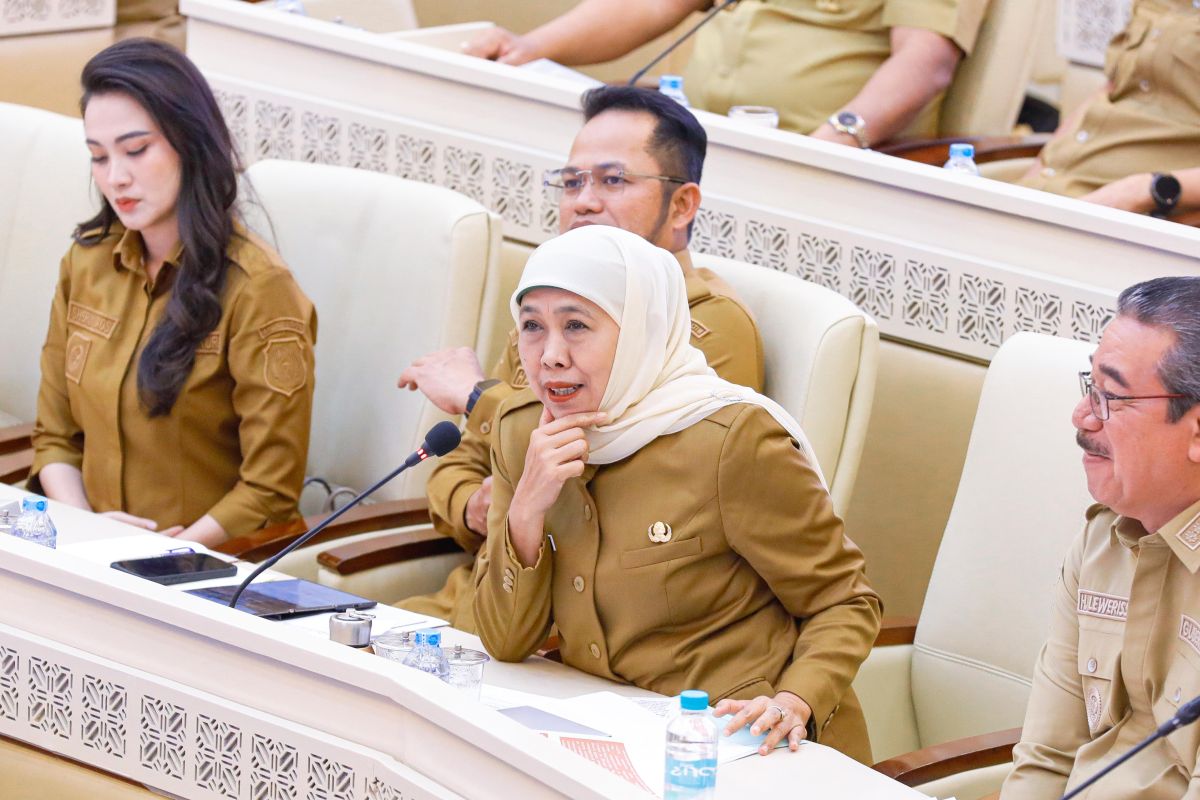
Surabaya (ANTARA) - East Java Governor Khofifah Indar Parawansa has pushed for farmland protection to continue in step with the needs of industrialisation, speaking at a working meeting and hearing with Commission II of the House of Representatives (DPR RI) in Jakarta on Tuesday.
“The position of protected paddy fields and the achievement of LP2B proposals cannot be generalised. East Java is the nation’s food barn. Investment for industrialisation must still be built in line with all the potential that exists,” Khofifah said in a statement received in Surabaya, East Java.
According to her, East Java holds a strategic position as one of the nation’s food barns as well as a region with a strong manufacturing base.
Data from the East Java Provincial Government shows that protected paddy fields (LBS) in the province reached 1,206,474.15 hectares in 2025, or around 25.12 percent of East Java’s total area.
Meanwhile, regency and city proposals for Sustainable Food Agricultural Land (LP2B) reached 1,053,781.72 hectares, or 87.34 percent of the LBS.
That achievement exceeds the minimum target of 87 percent set under Presidential Regulation Number 12 of 2025 on the National Medium-Term Development Plan (RPJMN).
“In aggregate, East Java has surpassed the 87 percent LP2B target in accordance with the mandate of Presidential Regulation Number 12 of 2025 on the RPJMN,” Khofifah said.
She said the achievement demonstrated East Java’s commitment to safeguarding food security sustainability. However, farmland protection must also be aligned with development and industrialisation needs.
Khofifah noted that East Java’s manufacturing industry currently contributes around 36 percent, higher than the national target of a 30 percent manufacturing contribution by 2045.
“Therefore, we must continue to build alignment between industrialisation, especially manufacturing, and the protection of agricultural land,” she said.
At the forum, Khofifah also conveyed the results of a coordination meeting between the East Java Provincial Government and the Minister of Agrarian Affairs and Spatial Planning/Head of the National Land Agency (ATR/BPN) on 11 September 2026.
According to her, problems remain in the designation of LP2B, including mismatches between LP2B designations in regency and city spatial plans (RTRW) and actual conditions on the ground.
“There are still plots already included in LP2B which had in fact changed function before designation. Conversely, there is productive land not yet included in LP2B because the database and designation are not fully accurate,” Khofifah revealed.
In addition, the integration of LP2B into RTRW and Detailed Spatial Plans (RDTR) is not yet fully aligned hierarchically. For this reason, the East Java Provincial Government is seeking support from the central government and Commission II of the DPR RI to accelerate the integration process.
Khofifah also submitted a number of policy notes to the ATR/BPN Minister, including strengthening the involvement of the Ministry of Agriculture in LP2B designation and supervision, and resolving the overlap between Protected Paddy Fields (LSD) and forest areas.
She also requested clarity on the mechanism for space-utilisation permits already issued where the location is later included in an LP2B proposal, as well as stronger cross-ministerial and cross-agency synergy in selecting locations for national priority projects.
According to Khofifah, productive farmland within LP2B proposals can also be optimised to support economic strengthening and food security, including through the Red and White Village Cooperatives and People’s Schools, while remaining mindful of land suitability and productivity.
“We are looking for a format in which the three million houses can also be maximised, food security can still be maximised, and we can also maximise the red and white cooperatives and people’s schools,” she said.
She added the need for joint arrangements on mechanisms for incentives, disincentives and sanctions for violations involving the conversion of LP2B land in the regions.