
Khofifah Outlines Education Transformation and Regional Innovation in East Java
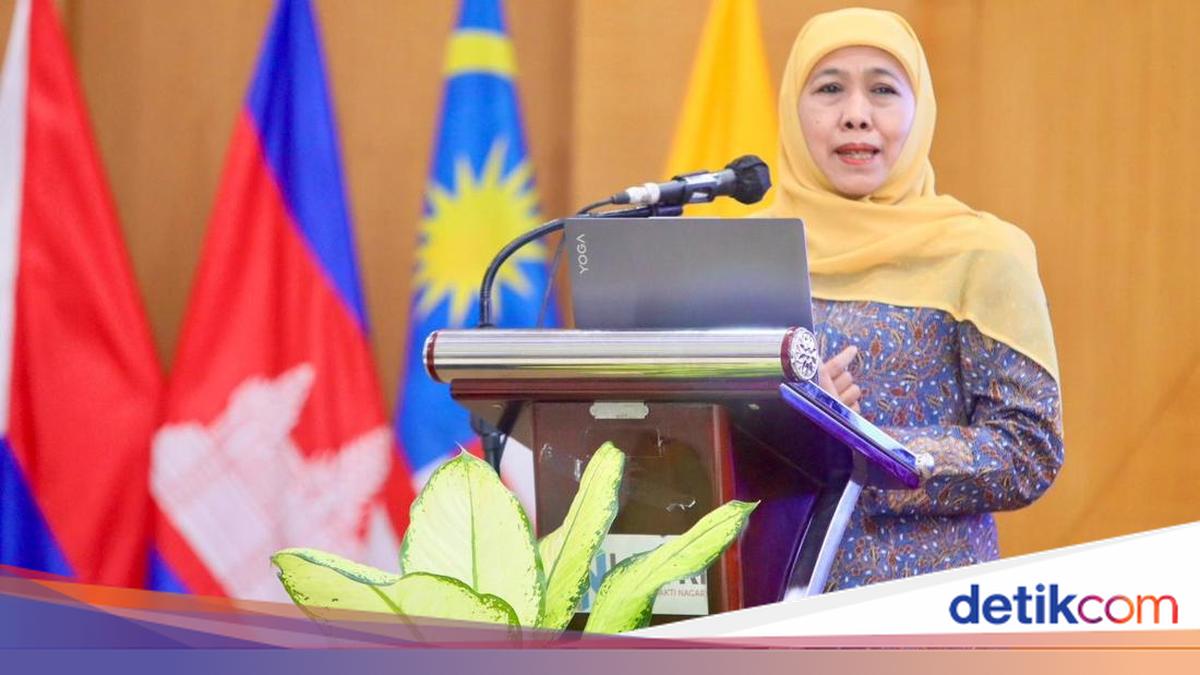
The Governor of East Java, Khofifah Indar Parawansa, has presented the East Java Provincial Government’s experience in driving educational transformation and fostering regional innovation. She shared these insights before hundreds of participants of the Basic Training (Latsar) for Civil Servant Candidates (CPNS) for the 2026 cohorts.
The event, held at the Centre for Learning and Strategy of Government Management Policy (Pusjar SKMP) of the National Institute of Public Administration (LAN RI) in Makassar, was attended by 163 participants, most of whom were young lecturers from various universities in Makassar.
During the activity, Governor Khofifah served as a keynote speaker, delivering material on educational transformation, government innovation, and the strategic role of civil servants in realising a ‘Developed Indonesia’ and ‘Golden Indonesia 2045’.
Khofifah asserted that human resource development must be the top priority in regional development. According to her, educational transformation is not merely focused on improving school quality, but more importantly, on building superior, adaptive individuals capable of meeting modern challenges.
Addressing the prospective civil servants, Khofifah emphasised that state civil apparatus (ASN) hold a strategic role as engines of change, rather than just executors of government policy.
“ASN are not merely policy executors, but drivers of change that determine Indonesia’s future. A leader is not measured by the number of programmes, but by the magnitude of benefits felt by the community,” Khofifah stated in a written release on Friday.
Khofifah explained that the vision of Golden Indonesia 2045 can only be realised if all regions are able to improve the quality of their human resources. Therefore, regional development must serve as the primary foundation for national progress.
She emphasised that regions are not merely objects of development, but subjects of development with a significant role in determining the nation’s success. She noted that education is the most effective instrument to break the cycle of poverty and serves as the greatest investment in preparing future generations.
“Everywhere, the formula to break the cycle of poverty is through education; therefore, education must be a reinforcement for policymakers and the greatest investment for a nation in welcoming Golden Indonesia 2045,” she explained.
Khofifah continued, stating that educational transformation is not just about increasing achievements, but about human resources growing, developing, and progressing together to achieve shared prosperity.
“I frequently convey the principle of ‘no one left behind, no people left behind’. This is not solely for the SDGs, but because we ought to grow, develop, and progress together to ultimately achieve prosperity together,” Khofifah messaged.
Based on this conviction, East Java has achieved various milestones, including ranking first as the province with the highest number of national SNBP (Student Selection Based on Merit) admissions for seven consecutive years from 2020 to 2026.
The East Java Provincial Government, supported by public and private high schools and universities, maintains a strong commitment to education, demonstrated through the provision of educational scholarships.
In 2026, it was recorded that 81,131 students from private high schools and 62,000 new students from private higher education institutions received scholarships. The number of participating private schools also increased by 18.84 per cent, from 1,772 to 2,106 schools.
“We want every child in East Java to have an equal opportunity to obtain a quality education. I believe this extraordinary partnership exists only in East Java,” she said.
Beyond producing academically capable graduates, the East Java Provincial Government is committed to producing graduates who can directly impact the economy, particularly through the strength of impactful vocational education.
Various flagship programmes have been implemented, such as Artificial Intelligence (AI) for students, digital learning, the East Java Information Education System (EJIES), and the development of cadet schools in East Java.
“East Java continues to encourage schools to be more than just places for learning, but also spaces for students to create and innovate to meet the needs of the labour market,” she said.
“We need competence that matches market demands, not just diplomas. Currently, the focus is more on certification, as certificates provide a clearer picture of an individual’s competence,” she added.
Concluding her presentation, Khofifah reminded that Indonesia is currently experiencing a demographic bonus that must be utilised effectively. She urged all training participants to continuously enhance their capacity to become adaptive and innovative future leaders.
Meanwhile, the Head of Pusjar SKMP LAN RI Makassar expressed appreciation for Governor Khofifah’s willingness to share her experiences. He noted that the best practices implemented by the East Java Provincial Government could serve as valuable references for prospective civil servants in building innovative and impactful governance.
“East Java, with its tagline ‘New Gateway to the Nusantara’, is undoubtedly one of the best provinces in Indonesia. We hope Governor Khofifah’s presence provides real and much-needed input for all participants,” he concluded.