
Khofifah calls on public to intensify mangrove planting movement
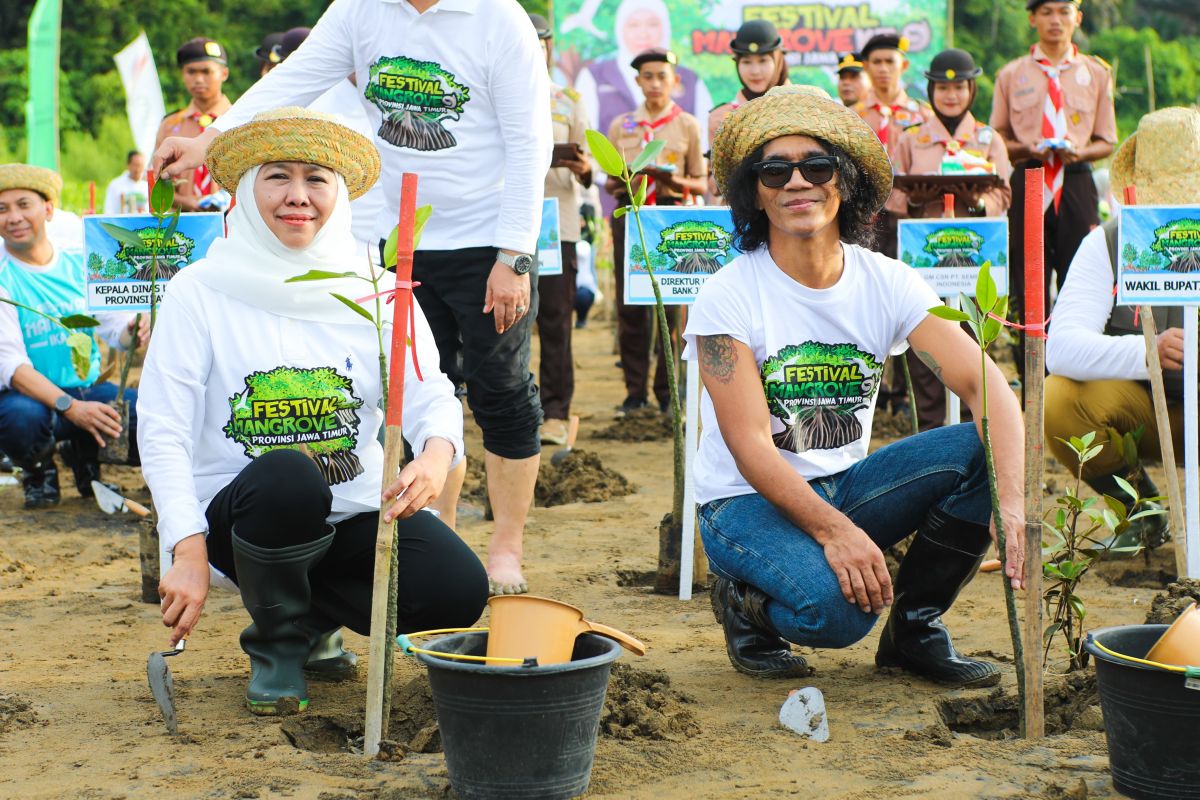
East Java Governor Khofifah Indar Parawansa has called on all elements of society to intensify the mangrove planting movement to strengthen coastal ecosystem protection while enhancing the environmental and economic resilience of coastal communities in a sustainable manner. “Protecting mangroves means protecting the coastline, safeguarding biodiversity, strengthening the resilience of coastal communities, and securing the future of our children and grandchildren. Therefore, mangrove protection must become a collective movement that is carried out consistently and sustainably,” Khofifah stated during the commemoration of World Mangrove Day 2026, according to a statement received in Surabaya on Sunday. Khofifah said mangroves play a strategic role in tackling climate change, as they are capable of protecting coastal areas from abrasion, high waves, and seawater intrusion, as well as absorbing and storing large amounts of carbon. Beyond their ecological benefits, she noted, mangroves serve as a habitat for various aquatic biota such as fish, shrimp, crabs, shellfish, and numerous bird species, thereby supporting the livelihoods of coastal communities. The East Java Provincial Government continues to strengthen the rehabilitation of mangrove areas. Based on the National Mangrove Map, the mangrove area in East Java increased from 27,221 hectares in 2021 to 31,067 hectares in 2025, equivalent to 47.85 percent of the total mangrove area on Java Island. “This achievement is not merely a figure. It is the result of collaborative work between the government, coastal communities, academics, environmental groups, the business sector, and various stakeholders who have together planted, nurtured, and protected mangroves,” she said. Khofifah emphasised that the success of mangrove rehabilitation should not be measured solely by the number of seedlings planted, but also by the survival rate and the benefits provided to both the environment and the community. She therefore encouraged district and city governments across East Java, educational institutions, communities, businesses, and coastal residents to expand the planting and maintenance movement. “Planting is the initial step. Afterwards, mangroves must be cared for, protected, and ensured to grow well. The success of rehabilitation is not only counted by how many seedlings are planted, but by how many survive and provide benefits to the environment and society,” she said. She also pushed for the development of mangrove areas integrated with education, research, ecotourism, and community economic empowerment so that environmental conservation goes hand in hand with improving the welfare of coastal residents.