
Khofifah asserts East Java is a key player in the national halal supply chain
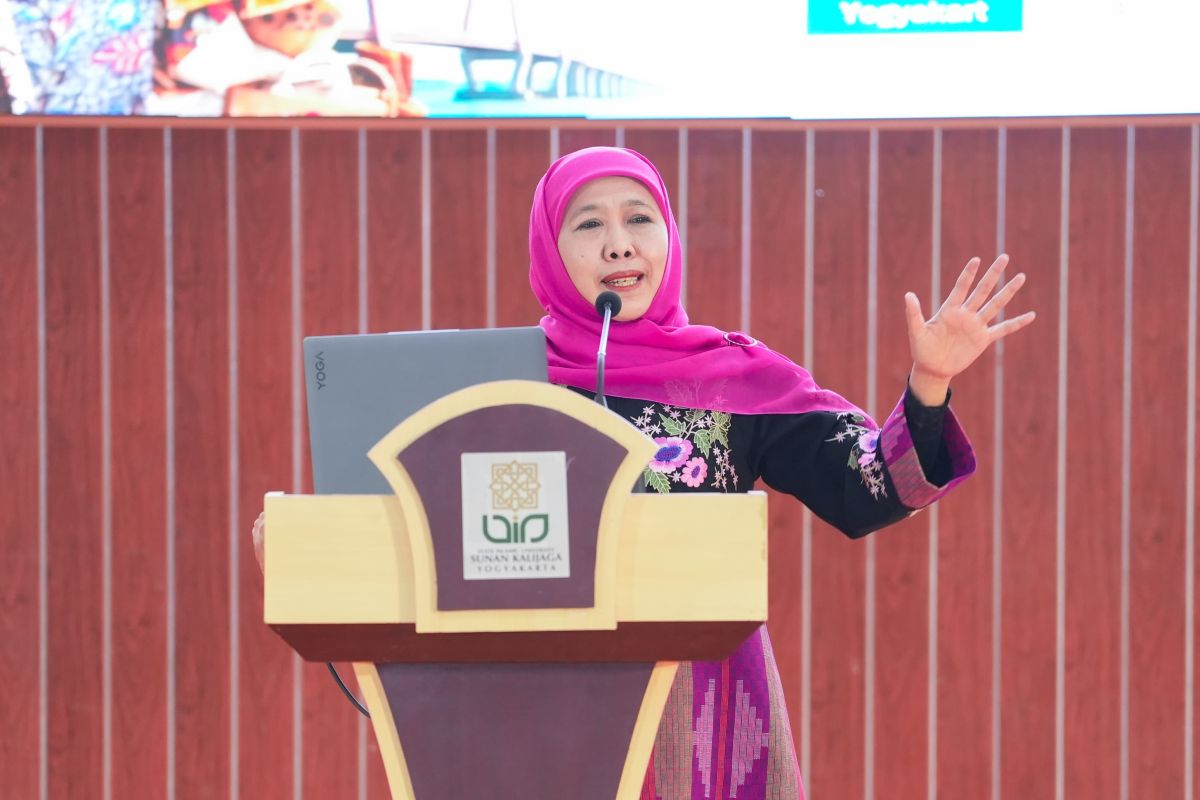
Surabaya (ANTARA) - East Java Governor Khofifah Indar Parawansa has asserted that East Java is a primary player in the national halal value chain, supported by the strength of Islamic boarding schools (pesantren), SMEs, manufacturing industries, and extensive logistics connectivity.
“Halal is no longer just about product certification. Halal has evolved into a lifestyle ecosystem and an industry of the future. This is a massive opportunity that Indonesia, including East Java, must utilise to take a more strategic role in the global halal value chain,” said Khordifah, while serving as the keynote speaker at the Java Halal Ecosystem 2026 Regional Economic Forum at Sunan Kalijaga State Islamic University, Yogyakarta, on Thursday.
According to Khofifah, halal is no longer viewed solely as an aspect of Sharia compliance, but has developed into a lifestyle and a future industry with significant global economic value. Halal products have also become a new standard in international trade, synonymous with quality, safety, hygiene, product traceability, and sustainability.
Based on the State of the Global Islamic Economy (SGIE) 2025/2026 report, Indonesia ranks first in the world in the Muslim fashion sector, third in the halal food, media, and recreation sectors, and fourth in the halal pharmaceutical and cosmetics sectors.
“We must not merely be a market. East Java possesses significant capital to become a major player in the global halal industry, ranging from the strength of pesantren and SMEs to industry and logistics connectivity that reaches both national and global markets,” she stated.
Khofifah explained that East Java holds a strategic position as the ‘New Gateway of the Archipelago’ (Gerbang Baru Nusantara), with the Port of Tanjung Perak serving 24 of the 41 national sea toll routes. This position is supported by 12 toll road sections, two Special Economic Zones, 13 industrial estates, one halal industrial zone, 37 ports, and seven airports. In the first quarter of 2026, East Java’s economy grew by 5.96% (yoy), higher than the national average of 5.61%.
In developing the Sharia economy, the East Java Provincial Government is strengthening the halal ecosystem through the Halal Industrial Park Sidoarjo (HIPS) and the empowerment of 7,425 Islamic boarding schools. Approximately 1,420 pesantren are running the ‘One Pesantren One Product’ (OPOP) programme, and 3,966 pesantren have undergone digitalisation.
Throughout 2025, eight Sharia business incubation programmes reached 2,492 entrepreneurs, while halal certification facilitation resulted in 552,943 businesses and 1.41 million halal-certified products. The number of halal businesses in East Java also increased by 42.59% compared to the previous year, with halal export values reaching 3.222 billion USD.
Khofifah emphasised that these achievements are the result of pentahelix collaboration and serve as the foundation for East Java to continue strengthening its competitiveness while supporting Indonesia’s ambition to become a global halal economic hub.