
KH Ma’ruf Amin: Financial Hijrah is Not Merely a Trend but a Necessity
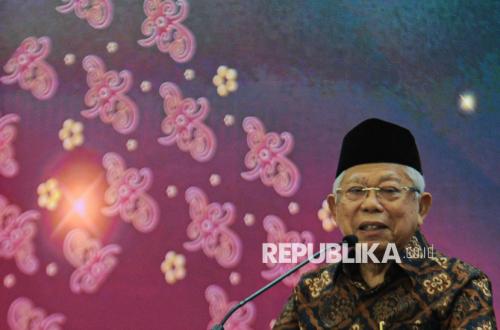
Vice President of the Republic of Indonesia (RI) Ma’ruf Amin has conveyed the need for society to undertake financial hijrah to sharia banking as a collective movement to create a sharia economic system. The financial hijrah movement is deemed not merely a trend, but a historical necessity.
“When speaking of financial hijrah, we are not merely talking about switching financial products; we are discussing a shift in perspective, a shift in system, even a shift in civilisation. A hijrah from a system that is not entirely just to a system that is more equitable, more ethical, and brings greater benefit,” said Ma’ruf at the ‘Financial Hijrah’ event titled ‘Sharia Banking as a Solution for Inclusive and Sustainable Finance’, held online by the Indonesian Banking Development Institute (LPPI) on Friday (10/4/2026).
Ma’ruf explained that Indonesia has enormous potential in developing sharia economy and finance. This is because Indonesia is the country with the largest Muslim population in the world and possesses abundant natural resources, including mineral mining, maritime, agriculture, plantations, and various other aspects.
“However, we must be honest that the level of inclusion and penetration of sharia finance is still not commensurate with the potential we have. This indicates a gap between normative awareness and practical implementation, even though economic issues are not just about numbers, but also about values,” he stated.
Furthermore, Ma’ruf elaborated on the importance of financial hijrah steps in this era. He mentioned that scholars have provided profound guidance on how to build an economic system, and that economic corruption is the beginning of social corruption.
For example, Imam Al-Ghazali explained that riba is not just a legal violation, but a destroyer of muamalah systems and a crusher of justice. Al-Ghazali emphasised that when money is treated as a commodity without real activity, hard work loses value, justice disappears from transactions, and inequality becomes inevitable.
“Isn’t this what we witness today? An economy that grows high, but inequality is also high. Profits increase, but blessings decrease. Therefore, financial hijrah is an effort to restore the spirit of justice in the economy,” he asserted.
The scholar Ibn Taimiyah also emphasised that Allah will uphold a just state even if it is infidel, and will not uphold a tyrannical state even if it is Muslim. This is an important principle in social life today, that justice is a condition for the sustainability of a system, while tyranny is the cause of destruction.
“We know that riba, gharar, and maysir are forms of economic tyranny, so when we build our sharia finance, we are not just building a symbol of Islam, but also building the foundation of justice itself,” he explained.
Ma’ruf continued, the scholar Ibn Khaldun also explained value-based economy as the foundation of civilisation, while tyranny is a sign of civilisational destruction. Ibn Khaldun further emphasised that economic activities must be based on real work, and that wealth must not be obtained without productive contribution.
“What Ibn Khaldun meant centuries ago, today we know as the real economy or productivity, where all that has become a principle in sharia finance,” he asserted.
Another scholar quoted by Ma’ruf is Wahbah az-Zuhaili, who emphasised that sharia finance is a global alternative system. The sharia financial system is not only for Muslims, but a universal solution to modern economic crises. Az-Zuhaili views that global financial crises are often triggered by excessive speculation, derivative instruments without underlying assets, and unclear contracts.
“Isn’t that what happens repeatedly in crisis after crisis? Therefore, sharia finance is not merely an ideological choice, but also a rational answer to the failure of the conventional system,” he said.
Ma’ruf explained that in Islam, the economy is not merely a worldly activity, but part of worship. Every transaction will be held accountable in the hereafter. Quoting Imam Al-Qarafi, the basic principle in muamalah is to realise justice and eliminate tyranny.
“Thus, when we choose the sharia financial system, in essence we are choosing values, choosing sides, and choosing whether we want to be just or tyrannical. History has taught us that tyrannical systems will collapse and just systems will endure,” said Ma’ruf.
“Therefore, financial hijrah is not merely a trend; it is a historical necessity or dharuriyah,” he continued.