
Key to Food Self-Sufficiency: How to Get the Young Generation to Become Farmers
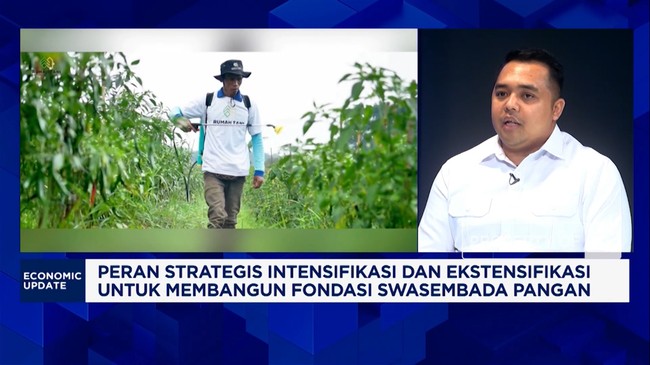
Indonesia continues to record growth in food commodity trends, driven by factors such as infrastructure, government policy, and climate patterns in 2024 and 2025. Bahtiar, Managing Director of Rumah Tani, stated that this productivity is a measure for Indonesia’s progress towards food self-sufficiency. However, he noted that farmer welfare is also essential. “Although data shows the Farmer Exchange Rate has increased, we must examine this more deeply. Which farmers have seen an increase? In our view, the increase has occurred among those who have received government intervention, namely corn and rice farmers. This is indeed a good improvement,” Bahtiar explained during the CNBC Indonesia Economic Update 2026 on Tuesday (23/6/2026).
According to Bahtiar, when farmers receive adequate welfare, they will automatically replant or recultivate their fields. Currently, the farming profession is dominated by the generation aged over 45 years. “Perhaps around 15% are young farmers. I see that these young farmers are experiencing demotivation,” he clarified. On the other hand, Bahtiar noted that young farmers often receive encouragement from their families to seek a new livelihood in big cities and leave the farming profession behind. “This is a consequence of their parents’ experience of not achieving prosperity. Therefore, if we talk about encouraging young people to become farmers, I think the first step is to create prosperous conditions for the current generation of parent farmers,” he added.
To boost the younger generation’s interest in farming, motivation is needed. They require concrete examples of success in the agricultural sector. “Thus, we must demonstrate that the agricultural ecosystem is successful and can be publicised to young people as a viable solution,” he said. “We see that in several regions, our farmers’ incomes are above the regional minimum wage because their earnings are indeed higher,” Bahtiar added. To this end, Rumah Tani provides various coaching programmes to improve farmer welfare, including education on farming techniques, market access, and financial literacy. Bahtiar mentioned that his company provides marketing and purchasing certainty, allowing farmers to maintain their agricultural processes from the planting season onwards. “When parents enter our ecosystem, we provide market certainty and their welfare increases, their children become farmers and also become our partners,” he said.
Currently, Rumah Tani has 27,400 registered farmers spread across Sumatra, Java, and Bali. The company has supply chain strength with a presence in 13 wholesale markets across these islands. “Of our total 27,400 farmers, almost 30% are young farmers, still very young, aged 21 or 22 years. They choose to become farmers and even form their own communities,” he added. Bahtiar believes the younger generation of farmers has a positive outlook, particularly because they can leverage technology to assist in farming activities. “They are quicker to access information on farming methods, post-harvest processes, and so on,” he revealed. Furthermore, Rumah Tani is currently building around 2,000 outlets for vegetable commodities, which are expected to expand the market for its member farmers. “This allows us to recruit more farmers because the current interest is quite high. Nearly hundreds of farmers want to join Rumah Tani,” Bahtiar concluded.