
Key Points of the Revised Indonesian Police Law Newly Ratified by the DPR
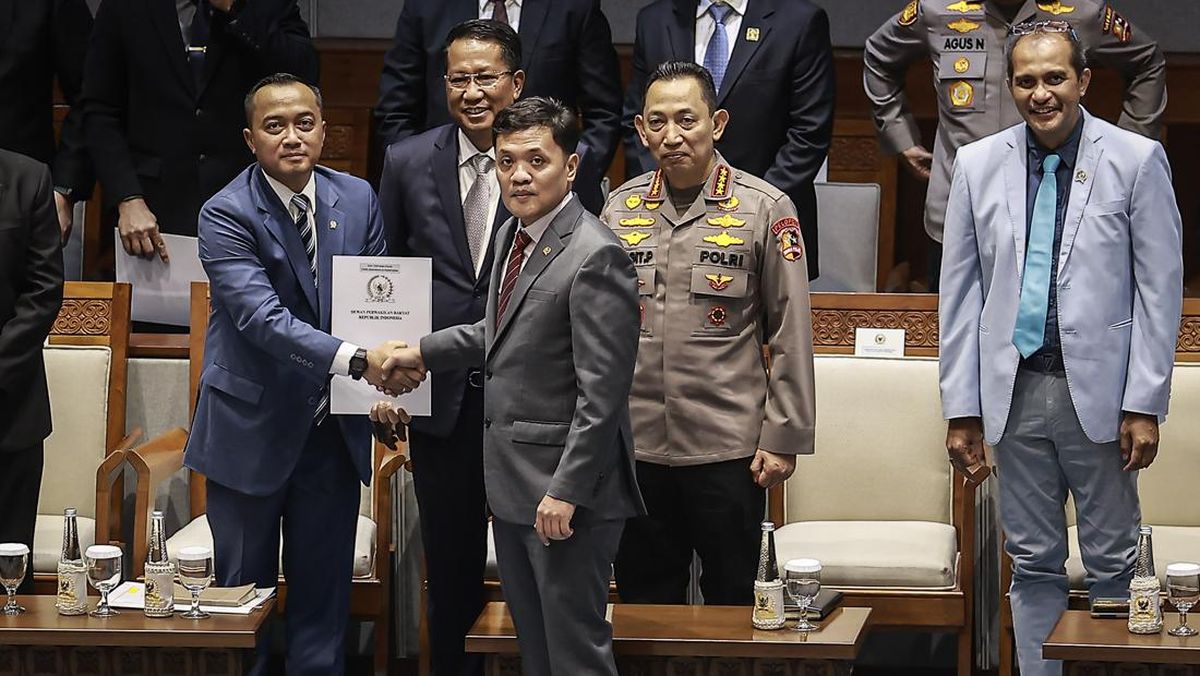
The DPR has officially ratified the third revision of Law Number 2 of 2002 concerning the Indonesian National Police (Polri) during the 21st plenary meeting of the 2025-2026 session on Tuesday (9/5). The deliberation of the Polri Bill in Commission III of the DPR was conducted swiftly after the Presidential Letter was sent last week. Although Commission III held several hearing meetings with experts and students, the DPR and the government only held two joint deliberation sessions. The final plenary meeting was even held moments before the ratification plenary. Eight factions unanimously agreed to bring the Polri Bill to the plenary session for ratification. The bill deliberation saw virtually no significant debate, with factions agreeing on several key changes, ranging from the retirement age and strengthening of the National Police Commission (Kompolnas) to the term of office of the National Police Chief. The ratification plenary meeting was chaired by Deputy Speaker of the DPR Sufmi Dasco Ahmad and attended by National Police Chief General Listyo Sigit Prabowo. The following are crucial points in the Polri Bill based on the final draft.
Social security and pensions: The DPR and the government have clarified provisions regarding various rights and social security for Polri members, as stipulated in Article 26, paragraphs 1, 2, and 3. The previous law did not detail the list of social security benefits. The new law now includes a detailed list, ranging from health and work accident insurance to death benefits, old-age security, and pensions.
The placement of Polri in civilian institutions: A significant change was made regarding the placement of active police officers in civilian institutions under Article 28A. Under the new law, active officers can hold civilian posts as long as the role is related to police duties and there is a request from the relevant ministry or agency. The explanatory section divides these duties into three categories: maintenance, protection and community service, and law enforcement. Specifically, for protection and community service roles, police officers can even occupy managerial positions in three institutions: the Witness and Victim Protection Agency, the Food and Drug Supervisory Agency, and the National Nutrition Agency.
Retirement age: The new law alters the retirement age provisions for police ranks from enlisted (tamtama) and non-commissioned officers (bintara) to commissioned officers (perwira), as regulated in Article 30. Previously, the maximum retirement age was 58, extendable to 60 for those with special expertise. Now, the retirement age is 59 for enlisted and non-commissioned officers, 60 for commissioned officers, and for high-ranking four-star generals or the National Police Chief, the term can be extended according to the President’s needs.
Strengthening of the National Police Commission (Kompolnas): The new law amends several provisions concerning the position and authority of Kompolnas as regulated in Articles 37-39. Article 39B now stipulates that Kompolnas members are appointed and dismissed by the President, with its Chair and Vice Chair chosen and confirmed by the President, to whom the commission reports. Article 38 also adds several new functions and authorities for Kompolnas, including providing input to the President on building organisational culture and police performance, offering advice on education curricula, and giving recommendations on the formation of the police professional code of ethics as well as building integrity and professionalism.