
Key Points of the 2027 State Budget Draft Ahead of DPR Ratification
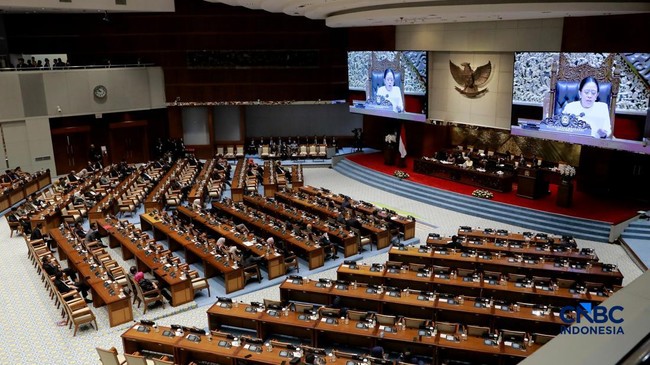
The Indonesian House of Representatives (DPR RI) is scheduled to ratify the 2027 State Budget Draft (RAPBN) into the 2027 State Budget Law during a Plenary Session today, Tuesday (29/09/2026).
The ratification of the 2027 State Budget follows the final stage after the government and the DPR Budget Committee (Banggar) agreed on the assumptions and the structure of the 2027 State Budget Bill (RUU APBN) last Thursday (24/09/2026).
“Do we agree with the results of our meeting today and shall we proceed to Level II of the Plenary Session on Tuesday, 29 September 2026, for approval and ratification?” asked the Chairman of the DPR Budget Committee, Said Abdullah.
“Agreed,” responded the participants of the Budget Committee meeting.
From the Level I discussions in the Budget Committee, the DPR and the government agreed on the following macroeconomic indicators:
Economic growth: 6.0%
Inflation rate: 2.5%
Rupiah exchange rate: Rp17,500/US$1
10-year Government Securities (SBN) interest rate: 6.9%
Indonesian crude oil price: US$75 per barrel
Oil lifting: 612,500 barrels per day
Gas lifting: 954,000 barrels of oil equivalent per day
On the other hand, the 2027 State Budget Draft was prepared while maintaining the fiscal deficit as initially proposed in the financial note, at Rp671.16 trillion, or equivalent to 2.4% of Gross Domestic Product (GDP).
Although the deficit target remains the same, there are changes regarding the targets for state revenue and expenditure. Specifically for state revenue, the latest agreement between the government and the DPR Budget Committee is valued at Rp3,435.10 trillion, up from the initial proposal of Rp3.426,03 trillion.
For state expenditure, the target has also changed to Rp4,106.26 trillion, from the original proposal of Rp4,097.19 trillion.
Below are the details of the 2027 RAPBN structure agreed upon by the DPR Budget Committee and the government:
State Revenue: Rp3,435.10 trillion
Tax Revenue: Rp2,911.95 trillion (previously Rp2,907.95 trillion)
Taxes: Rp2,593.35 trillion (previously Rp2,591.35 trillion)
Customs and Excise: Rp318.6 trillion (previously Rp316.6 trillion)
Non-Tax State Revenue (PNBP): Rp522.48 trillion (previously Rp517.41 trillion)
Grant Revenue: Remains at Rp666.3 trillion, unchanged from the initial proposal
State Expenditure: Rp4,106.26 trillion
Central Government Expenditure: Rp3,371.26 trillion (from an initial proposal of Rp3,362.19 trillion)
Ministry/Agency Expenditure: Rp1,556.89 trillion (previously Rp1,504.74 trillion)
Non-Ministry/Agency Expenditure: Rp1,814.36 trillion (previously Rp1,857.45 trillion)
Transfers to Regions (TKD): Maintained at Rp735 trillion
Primary Balance target: Designed at a deficit of Rp20.85 trillion
Budget financing target: Remains at Rp671.16 trillion
Finance Minister Suahasil welcomed this decision. According to him, the discussions for the 2027 RAPBN took place amidst global conflict situations that present challenges to the economy.
Suahasil ensured that, under his management, the 2027 State Budget, as drafted between the government and the DPR Budget Committee, will be implemented to continue strengthening the Indonesian economy.
“The preparation of the 2027 RAPBN took place in a difficult global conflict situation; therefore, we must continue to strengthen the Indonesian economy, and we are grateful that the economic fundamentals are quite good,” said Suahasil while delivering his closing remarks at the Level 1 Working Meeting/Discussion of the 2027 Fiscal Year State Budget Bill on Thursday (24/09/2026).
Consequently, strengthening national economic fundamentals is considered a vital element in maintaining Indonesia’s economic resilience. Moving forward, fiscal policy must not only be oriented towards prudence but must also be capable of responding to economic needs.
“Fiscal policy must remain prudent, but it must not be passive. Fiscal policy must be present, maintaining growth momentum, protecting the community, and opening space for investment,” explained the Finance Minister.
On this occasion, the Finance Minister also expressed his appreciation to the Leadership and all members of the DPR Budget Committee for their support, attention, and various insights during the discussion of the 2027 State Budget Bill.
“The discussion was very dynamic, open, and constructive, which enriched the design of the 2027 RAPBN architecture. We believe that discussion is a healthy dialectic in our democracy,” concluded the Finance Minister.
Source: jawawa.id (https://jawawa.id/newsitem/key-points-of-the-2027-state-budget-draft-ahead-of-dpr-ratification-1790643093)
Originally published by CNBC Indonesia (https://www.cnbcindonesia.com/news/20260929052253-4-771607/jelang-pengesahan-di-paripurna-dpr-ini-poin-poin-rapbn-2027), translated from Indonesian