
Key Lessons from MSCI: Governance and Transparency Are Crucial
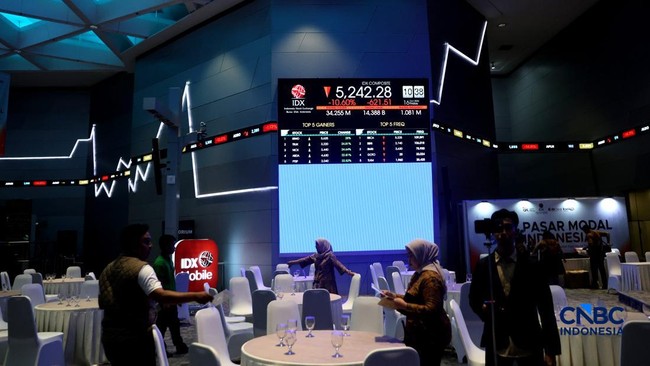
The story began in 2023, when the Jakarta Composite Index (IHSG) rose 6.16% over the year, from 6,850.62 to 7,272.79. This was higher than the 4.09% gain recorded the previous year.
In 2023, the IHSG was said to have delivered the second-best performance in ASEAN, behind only Vietnam’s VN-Index. However, the sharp rise was supported by a handful of conglomerate stocks whose prices had soared since their initial public offerings.
Data from the Indonesia Stock Exchange and Bloomberg show that shares owned by tycoon Prajogo Pangestu led the index’s gains in 2023. PT Barito Renewables Energy Tbk (BREN), which had only recently listed on the exchange, led the market with an 858.3% increase.
With a market capitalisation of Rp1,000 trillion, BREN contributed 259.38 points to the IHSG’s rise in 2023. PT Chandra Asri Petrochemical Tbk (TPIA) was also among the year’s top movers, surging 104.3% and reaching a market capitalisation of Rp454 trillion. Its rise contributed 85.24 points to the IHSG during the 2023 rally.
Two other companies owned by Prajogo also helped fuel the IHSG’s 2023 euphoria: PT Petrindo Jaya Kreasi Tbk (CUAN) and PT Barito Pacific Tbk (BRPT), whose shares rose 6,002% and 76.2%, respectively. CUAN contributed 55.51 points and had a market capitalisation of Rp151 trillion, while BRPT contributed 38.79 points, with a market capitalisation of Rp125 trillion.
Shares in PT Pantai Indah Kapuk Dua Tbk (PANI), owned by a consortium led by PT Multi Artha Pratama and affiliated with Sugianto Kusuma (Aguan) and the Salim Group, also surged 413.09% in 2023, contributing an estimated 30–40 points to the IHSG’s increase.
Shares in PT Amman Mineral International Tbk (AMMN), affiliated with the Panigoro family, rose 286.4% over the year and added 118.52 points to the IHSG. Its market capitalisation stood at Rp475 trillion. These conglomerate stocks contributed the equivalent of 132% of the IHSG’s net increase in 2023. The rally was highly concentrated in BREN, AMMN and stocks associated with Prajogo Pangestu.
The picture was similar in 2025, another year of strong gains. The IHSG rose by double digits, closing the final trading session of the year at 8,646.94, up 1,567.03 points, or 22.13% year to date.
PT Dian Swastatika Sentosa Tbk (DSSA), affiliated with the Sinar Mas Group, was the largest contributor, with its share price rising 172.97% in 2025 and adding around 246.67 points to the IHSG. Shares in PT DCI Indonesia Tbk (DCII), owned by tycoon Toto Sugiri, climbed 375.06%, contributing 200.49 points.
In third place, Prajogo Pangestu’s PT Barito Pacific Tbk (BRPT) rose 255.43%, contributing 147.10 points. Shares in PT Bumi Resources Minerals Tbk (BRMS) and PT Bumi Resources Tbk (BUMI), both controlled by the Bakrie Group together with the Salim Group, rose by about 217.92% and 210.17%, respectively. They contributed 88.86 and 62.08 points to the IHSG’s 2025 gain. These conglomerate stocks accounted for about 47.6% of the index’s net rise that year.
While the IHSG climbed about 22% in 2025, the LQ45 index, which comprises liquid shares with strong fundamentals, rose by only around 2.4%. This suggests that conglomerate stocks were the main driver of the broader index’s surge.
J.P. Morgan made a similar observation in its report, Indonesia Equity 2026 Outlook. It said the IHSG outperformed the MXID and LQ45 indices by around 16–22 percentage points in 2025, driven by a surge in low-free-float conglomerate stocks amid speculation about potential inclusion in MSCI indices.
According to J.P. Morgan, the phenomenon also helped drive retail investor participation to 58% of average daily traded value (ADTV) in October 2025, its highest level since 2021.
The problem is the wide gap between market capitalisation, net profit and returns on capital. BREN and DCII show the most extreme valuation disparities. BREN’s market capitalisation is about Rp799 trillion, against net profit of Rp2.22 trillion, while DCII is valued at Rp477 trillion, with profit of about Rp1 trillion.
Their price-to-earnings ratios of 360 and 479 times, respectively, indicate that market prices are extremely high relative to current earnings. DSSA, PANI and AMMN face similar issues.
DSSA has a market capitalisation of Rp492 trillion, but its net profit fell from about Rp5.05 trillion in 2024 to Rp3.87 trillion in 2025, and its return on equity (ROE) is 10.2%. PANI has a market capitalisation of Rp157 trillion and profit of Rp1.15 trillion, but an ROE of just 3.62%. AMMN’s profit fell from Rp10.35 trillion in 2024 to Rp4.18 trillion in 2025, while its ROE is only 4.58%.
This is where the stock market creates what Hyman P. Minsky called an “illusion of prosperity”: a rise in the main index appears to signal broad market prosperity, even though gains are concentrated in a small number of shares, are not matched by comparable improvements in fundamentals and do not reflect the performance of the market or real economy as a whole.
It is therefore unsurprising that the Asian Corporate Governance Association (ACGA), in its CG Watch 2023: Spectrum of Standards report, published with CLSA in June 2024, ranked Indonesia last among 12 Asia-Pacific markets, with a governance score of 35.7%. Although this was an improvement on the 33.6% recorded in 2020, it shows that Indonesia’s governance reforms still face structural challenges.
The main weaknesses highlighted by ACGA include poor enforcement, limited investor participation, inadequate protection for minority shareholders and insufficient oversight of related-party transactions. Indonesia scored 22% for enforcement and 20% for investors. These results point to a gap between having formal regulations and enforcing them effectively.
These findings are relevant to MSCI’s concerns about unclear share-ownership structures, the transparency of ultimate beneficial owners, free float and suspected coordinated trading.
The core problem facing Indonesia’s stock market is therefore one of exchange governance and enforcement by the relevant authorities, particularly in response to the potential violations highlighted by MSCI. Perceived weak enforcement undermines fairness and can appear to amount to inaction. The problem is not government programmes such as MBG, KDMP or Danantara.
Recommendations
Indonesia is not alone in facing conglomerate dominance, market concentration, free-float issues and a lack of ownership transparency. In South Korea, the Minority Shareholder Movement emerged in 1997, led by the People’s Solidarity for Participatory Democracy (PSPD).
Its main goal was to improve governance in a stock market dominated by conglomerates, or chaebol. These groups were often accused of “tunnelling” — transferring assets to enrich controlling families. At the same time, the rights of retail and minority investors were effectively dormant because they lacked legal protection.
India has also faced challenges because many companies are family-owned or have dominant controlling shareholders, known as promoters, whose interests can conflict with those of retail and minority investors. This prompted strict regulatory reforms under the Securities and Exchange Board of India (SEBI) and the Companies Act 2013.
In the United States, the Clayton Antitrust Act of 1914 prohibited specific practices, including price discrimination, anti-competitive mergers and interlocking directorates. It was introduced in response to the dominance of oil companies owned by John D. Rockefeller, which controlled almost the entire oil production and distribution chain.
In Indonesia, the state does not need to ban large companies or break up conglomerates simply because of their size. What must change is a system in which controlling shareholders can wield substantial influence without adequate transparency, while public investors bear the risks and have limited protection.
The state must curb abuses of conglomerate power and be willing to punish companies that breach competition rules or undermine fair market mechanisms. It must not fear conglomerates simply because they contribute significantly to the IHSG’s rise.
Authorities should require disclosure of ultimate beneficial owners, enforce genuine free-float requirements, monitor affiliated transactions consistently, uphold the law and ensure effective rights for minority investors.
In his book Gatekeepers: The Professions and Corporate Governance, John C. Coffee Jr examines how auditors, lawyers, securities analysts, underwriters and credit-rating agencies act as reputational intermediaries, helping investors trust corporate information and statements. However, these gatekeepers have failed in corporate scandals, including cases recently identified by the Financial Services Authority (OJK) involving DSSA, BREN and CUAN.
When those tasked with verifying information or ensuring compliance fail to do their jobs, investors may receive signals that appear legitimate even though the processes behind them are problematic.
The World Bank’s Indonesia, Financial Sector Assessment Program: Technical Note, Capital Markets Regulation and Supervision says Indonesia’s problem is not a lack of regulation. In the World Bank’s assessment, the country’s legal and regulatory framework for capital markets is broadly aligned with international standards, including IOSCO principles.
This points to shortcomings in state and regulatory capacity. In particular, it raises the question of why action against suspected “pump-and-dump” stocks, price manipulation and coordinated trading has only been taken recently.
Are authorities struggling to detect signs of violations? Why have rules not been applied effectively, or enforcement measures not taken adequately, until now? Is the economic influence of large groups and conglomerates connected to weak enforcement of Indonesia’s capital-market laws?
This raises the possibility of what George Stigler called “regulatory capture”, in which government regulators are ultimately dominated and controlled by the networks of conglomerates they are meant to oversee. The state must prevent market regulators from becoming instruments for protecting the interests of those they are supposed to supervise.
Indonesia also needs an integrated map of business-group ownership and control, rather than merely a list of shareholders for each listed company. This should help regulators identify ultimate beneficial owners, affiliations and parties that may be acting in concert.
The country should also strengthen approval mechanisms for affiliated transactions and representation for minority investors. Most importantly, it should continue demutualising the Indonesia Stock Exchange (BEI), with governance arrangements designed to minimise conflicts of interest, and introduce independent audits of the consistency of enforcement in cases of suspected manipulation and violations by influential parties.
Source: jawawa.id (https://jawawa.id/newsitem/key-lessons-from-msci-governance-and-transparency-are-crucial-1792385456)
Originally published by CNBC Indonesia (https://www.cnbcindonesia.com/opini/20261019104741-14-777392/pelajaran-penting-dari-msci-tata-kelola-transparansi-menjadi-kunci), translated from Indonesian