
Kemdiktisaintek: Research into technology opens the way for Indonesia to produce a unicorn
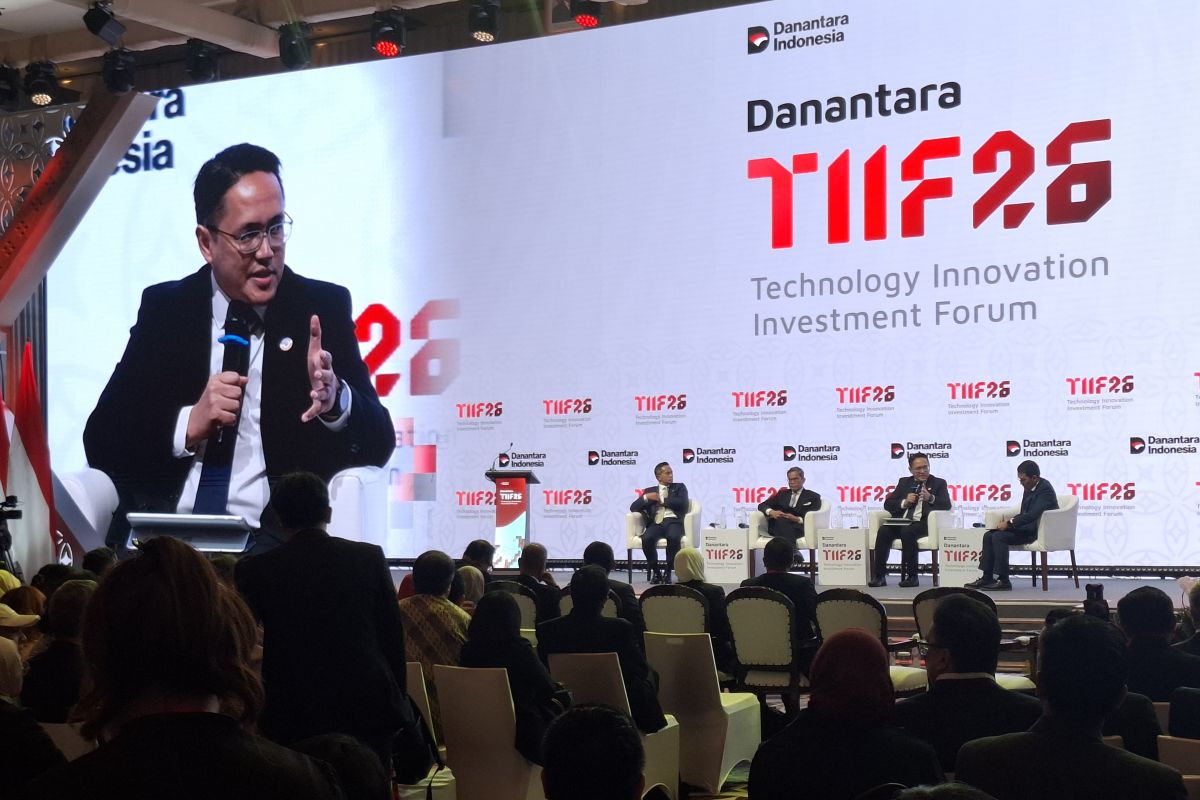
Jakarta (ANTARA) – Mohammad Fauzan Adziman, Director General of Research and Development at the Ministry of Higher Education, Science and Technology (Kemdiktisaintek), believes the development of research-based technology could create opportunities for Indonesian start-ups to become unicorns.
He made the remarks during a panel discussion at the Danantara Technology Innovation Investment Forum (DTIIF) 2026 in Jakarta on Wednesday, citing the development of deep-tech start-ups in Europe.
“In Europe, deep-tech companies reach valuations of more than US$1 billion (unicorn status) in five years and seven months, or two years and four months sooner,” Fauzan said.
According to PitchBook data cited by McKinsey and presented in his briefing, European deep-tech start-ups take an average of five years and seven months to reach unicorn status, compared with seven years and 11 months for conventional technology start-ups.
A unicorn is a start-up valued at at least US$1 billion, equivalent to around Rp18.14 trillion.
Fauzan explained that deep tech refers to innovation grounded in scientific research, with technological advantages that are difficult to replicate and the potential to develop into large-scale businesses.
“Deep tech draws on research, something that other industries cannot easily copy, and has the potential to be developed on a large scale,” he said.
In his presentation, Fauzan said deep-tech companies’ advantages stemmed in part from their intellectual property, technologies that are difficult to replicate, and ability to address long-term needs.
Potential fields for developing such technologies include energy, food and healthcare, where innovation is needed to tackle various challenges and strengthen industrial capabilities.
Fauzan said these opportunities must be matched by stronger research capabilities in Indonesia, so companies do not merely rely on existing technologies but can also develop their own innovations.
“This is where independent product innovation and joint research and development begin to play a role,” he said.
He said industrial capabilities should be developed in stages, moving from routine production and adapting technology towards independent product innovation and research collaboration with various partners.
Data for 2022 presented by Fauzan showed that businesses in Indonesia accounted for 16.7 per cent of total national research and development spending.
That was lower than the figures for Taiwan, at 85.5 per cent; South Korea, 79.4 per cent; China, 77.6 per cent; and Japan, 73.1 per cent.
Fauzan said stronger business-sector research must be accompanied by investment in human resources, funding support and investor confidence so that innovations can be developed into economic activities.
“We need to build two things strongly: talent, and trust,” he said.
He said trust was vital for research-based companies seeking investment, particularly when technology development requires time and funding before it can be commercialised.
“Investors are not afraid of risk, but they are afraid of uncertainty,” Fauzan said.
On government support, Kemdiktisaintek reported on 8 July 2026 that it had disbursed around Rp454 billion for more than 1,070 applied research projects involving partnerships between universities and industry.
The ministry has also launched the Deeptech Hackathon scheme, offering up to Rp1.5 billion in funding for participating universities to identify technological solutions to real-world problems, including in semiconductors, food and energy.
Through the 2026 Berdikari Partnership Catalyst Programme, the government is also developing three schemes — Mandala, SKALA+ and Saintek Nusantara — to expand the application of research findings in line with the needs of communities and regions.
On 27 October 2026, Fauzan also stressed the importance of commercialising genomics and biotechnology research so that findings can be developed into technology-based products or businesses in healthcare, food and industry.
He said collaboration among researchers, universities, industry players and investors was needed to ensure innovation meets market needs and can be scaled up.
Source: jawawa.id (https://jawawa.id/newsitem/kemdiktisaintek-research-into-technology-opens-the-way-for-indonesia-to-produce-a-unicorn-1793195662)
Originally published by Antara (Indonesian) (https://www.antaranews.com/berita/5817727/kemdiktisaintek-riset-teknologi-buka-peluang-lahirkan-unikorn-di-ri), translated from Indonesian