
Kelapa Gading Resident Nasim Dipo Saved by JKN Programme During Emergency Stroke
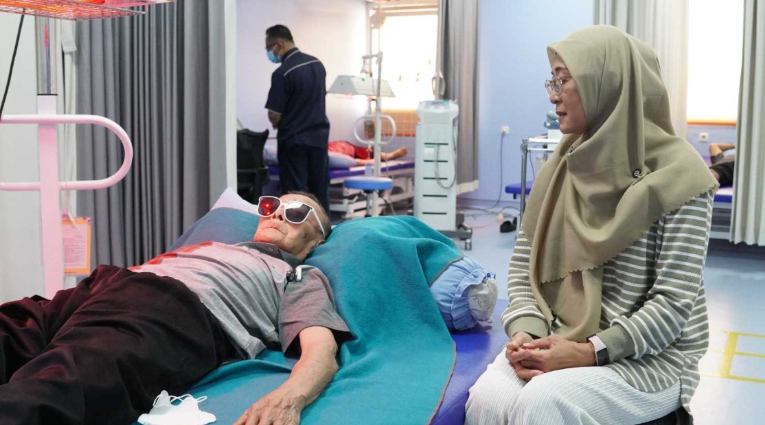
The existence of the National Health Insurance Programme (JKN), managed by BPJS Kesehatan, has once again proven its role as a crucial social safety net for the public, particularly when facing unexpected medical emergencies. The tangible benefits of this strategic government programme were felt directly by the family of Nasim Dipo Sumarto (91), a resident of Kelapa Gading who required intensive treatment following a sudden stroke.
His daughter, Sari (58), recounted that her father’s condition changed abruptly. Nasim experienced weakness on the right side of his body. When examined at home, his blood pressure was approaching 200 mmHg. Worried about his condition, Sari and her family immediately took him to hospital for treatment.
For Sari, the JKN programme brought peace of mind to her family, especially when facing such an unforeseen situation. According to her, the administrative process ran smoothly, allowing her father to be treated promptly by medical staff without any obstacles.
“Seeing my father’s condition, we immediately discussed it as a family. We were worried because his symptoms were quite serious. In the end, we decided to take him to RS Islam Cempaka Putih for treatment as quickly as possible,” said Sari.
Upon arrival at the Emergency Department (IGD), Nasim was immediately examined and treated by medical staff. After undergoing a series of tests, doctors determined that Nasim had suffered a stroke and required intensive care.
During the administrative process, Sari discovered that her father’s BPJS Kesehatan membership was inactive. Nevertheless, the hospital continued to treat Nasim whilst giving the family the opportunity to reactivate his BPJS Kesehatan membership.
“Alhamdulillah, the hospital was extremely helpful. My father was treated straight away. Meanwhile, we were given time to sort out the reactivation of his BPJS Kesehatan membership. The reactivation process went smoothly, so his treatment could continue,” she explained.
Sari considered the care her father received during his treatment to be highly satisfactory. In her view, there was no difference in treatment between BPJS Kesehatan participants and general patients. All medical staff, from administrative officers to doctors and therapists, provided friendly, professional and attentive service.
“My father was treated extremely well. All the medical staff served with all their hearts. We felt greatly helped and, of course, grateful to receive such quality care,” she said.
Sari urged the public, especially those not yet registered as JKN participants, to obtain BPJS Kesehatan membership as soon as possible. According to her, no one can predict when they will need healthcare. Illness can strike at any time and affect anyone.
“I just want to remind everyone that it would be best for all members of the public to have BPJS Kesehatan. Because whenever we fall ill or need healthcare, we need not worry because we already have health insurance. Certainly, the presence of BPJS Kesehatan helps people access healthcare services that are easy, fast and of high quality,” Sari concluded.