
Keeping the sky blue amid the siege of forest and land fires
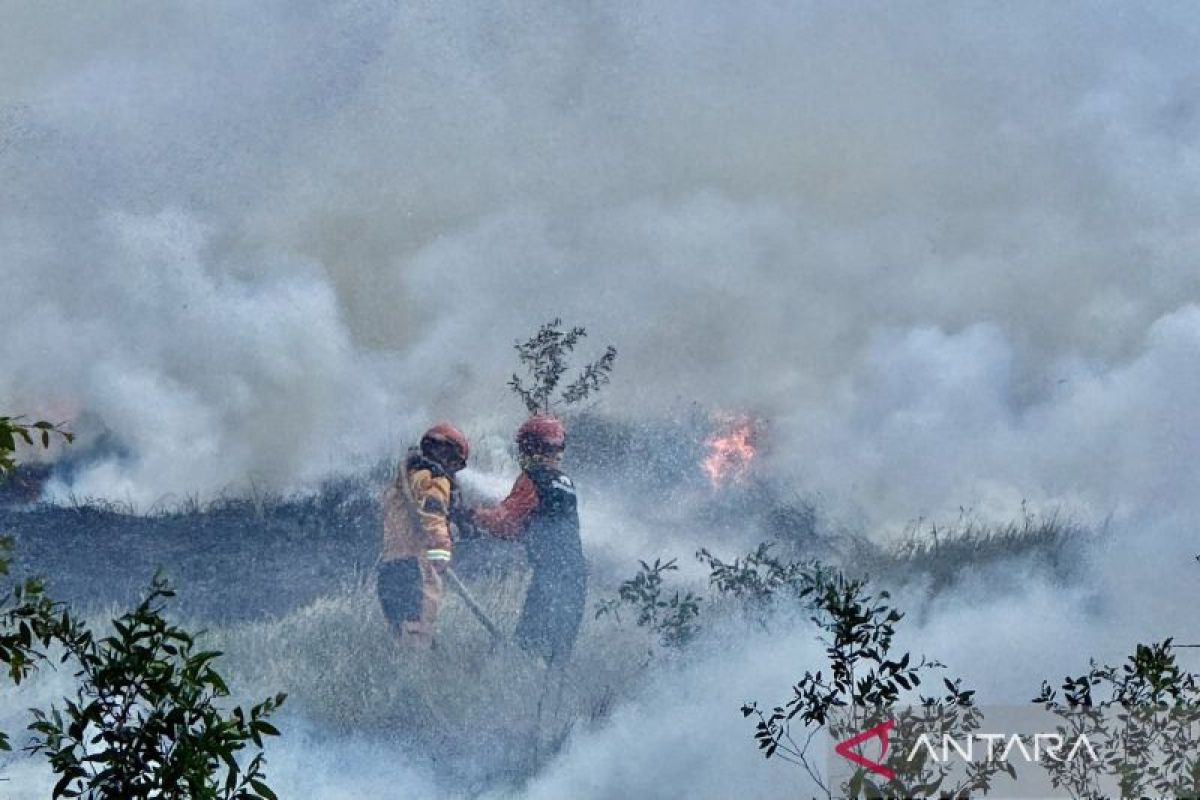
Under the scorching sun and surrounded by smoke haze, thousands of personnel are struggling across the peatlands of South Kalimantan. Hoses are extended, pump engines started, and water sprayed to tame forest and land fires.
They are out of breath, their legs trembling and arms weary after working from morning until night. While some people choose to move away from the smoke, these officers move closer to the fire hotspots.
They work under a command system and take turns guarding the front line. Families wait at home, but the duty continues because they understand that smoke haze not quickly brought under control can disrupt health, education, social activities, the economy and even food security.
The struggle does not end when the surface flames are extinguished. On peatland, embers can continue to burn underground and reignite fires. Officers must therefore ensure the land is thoroughly soaked before leaving the site.
Environment Minister Mohammad Jumhur Hidayat reminded the task force to ensure the land remains wet even after the flames are out so that fires do not recur.
“Forest and land fire handling must ensure all fires are successfully extinguished through collaboration between various agencies,” Jumhur said while inspecting fire handling in the Jalan Kurnia area, Liang Anggang, Banjarbaru, on Monday (24/8).
The ground task force applies an underground injection method, channelling water several metres into the peatland to extinguish embers still burning below. This approach is crucial because fire that scorches surface vegetation does not necessarily kill the heat underground.
The central government is also preparing to build a number of boreholes in fire-prone areas, particularly Banjarbaru. The wells are planned to be 40 to 50 metres deep to serve as water sources for extinguishing and soaking the land.
The need for water is increasingly important because the dry season makes land more flammable. BMKG’s warning that the El Niño phenomenon is expected to last until early 2027 means the government must maintain ground saturation so fires do not keep recurring.
The government has divided handling into three priority zones in Banjarbaru: Guntung Damar, Liang Anggang Protection Forest and Pengayuan. The central government, South Kalimantan provincial government, Forestry Ministry technical units, police, military, regional agencies, Forkopimda elements, firefighting volunteers and the public share duties in these areas.
The area is considered ring one because it is close to Syamsudin Noor International Airport, so forest and land fires need to be suppressed as quickly as possible to avoid disrupting regional economic activity and resilience.
In the three priority areas, the government has deployed 300 pumps operated by thousands of personnel. Each pump requires six personnel and is operated in rotating day and night shifts to ensure ground saturation continues.
In addition to ground forces, BNPB has sent four water-bombing helicopters with capacities of 400 to 1,000 litres of water to extinguish hotspots difficult for ground crews to reach.
Air support is reinforced by one patrol helicopter and one aircraft for weather modification operations. The air patrol fleet is used to monitor hotspots early and to watch for possible human activity involving deliberate burning. With these additions, seven aircraft are assisting forest and land fire handling in South Kalimantan.
The presence of helicopters is an important part of the task force’s struggle. While ground crews extend hoses towards hotspots, the air fleet moves from above to reach locations that are difficult to access and help speed up extinguishing.
From morning to night, thousands of personnel from various elements continue working. They leave their families and carry out their duties with the spirit of “no going home before it is out”, because every remaining ember has the potential to become fire again.
The South Kalimantan Public Works and Spatial Planning Agency (PUPR) is supplying water around the clock to strengthen handling in priority areas.
The agency has prepared one eight-inch pump and around 15 four-inch dumping pumps for ground saturation in Liang Anggang Protection Forest.
All equipment is operated in rotation to keep it in prime condition. “Because this is 24-hour work, it must be rotated so the equipment remains in prime condition for soaking the protection forest area,” said South Kalimantan PUPR Agency head M Yasin Toyib.
In Guntung Damar, water supply is directed towards Embung Jokowi. The retention basin supports ground team saturation and serves as a water source for BNPB water-bombing operations.
Water supply comes from the irrigation network in Cidayalus. The River Basin Agency has prepared booster pumps with a capacity of 250 litres per second, while the South Kalimantan PUPR Agency is repairing channels to speed up water flow to the basin.
This chain shows that extinguishing is not only the work of those facing the fire directly. Behind the front line are pumps, channels, retention basins, personnel and air fleets working together so that ground saturation is not interrupted.
Deputy Coordinating Minister for Food Hanif Faisol Nurofiq said natural factors are only a trigger for fires, while the main cause is human activity. The South Kalimantan provincial government has therefore increased ground patrol teams from four to 20.
“The 20 forest and land fire patrol teams will be supported by teams using drone technology to prevent new hotspots, especially in priority areas in Banjarbaru,” Hanif explained.
Monitoring and law enforcement are needed so fires do not keep recurring.
Jumhur said more than 30 companies were processed throughout 2026 in various regions, with potential state losses and environmental recovery reaching nearly Rp15 trillion.
“Around Rp5 trillion for state losses and nearly Rp10 trillion for environmental recovery,” said Environment Minister Jumhur.
The government is also investigating around 42 companies in Kalimantan over suspected violations that caused fires throughout 2026. Of that number, 11 companies are in South Kalimantan.
Deputy for Environmental Law Enforcement at the Ministry of Environment, Police Inspector General Rizal Irawan, said indications in South Kalimantan were identified after hotspot data from satellite imagery was overlaid with maps of company concession areas to see hotspots located in HGU and IUP areas.
As of 25 August 2026, South Kalimantan Provincial BPBD head Ronny Eka Saputra said 1,903 forest and land fire incidents affecting 9,088 hectares had occurred in South Kalimantan. Banjar Regency recorded 388 incidents covering 2,037.72 hectares, Tanah Laut 301 incidents covering 1,661.77 hectares, and Banjarbaru 360 incidents covering 1,398.40 hectares.
Hulu Sungai Selatan recorded 246 incidents covering 1,171.63 hectares, Tapin 151 incidents covering 861.75 hectares, and Barito Kuala 132 incidents covering 803.20 hectares. Hulu Sungai Utara recorded 93 incidents covering 507.78 hectares, Hulu Sungai Tengah 57 incidents covering 153.61 hectares, Tanah Bumbu 48 incidents covering 150.35 hectares, Tabalong 29 incidents covering 135.13 hectares, and Kotabaru 42 incidents covering 40.42 hectares.
These figures serve as a reminder that the forest and land fires of 2023, when the affected area in South Kalimantan reached around 190,000 hectares, must not be repeated.
Amid these threats, life must go on, and food security is an important foundation.
Head of the South Kalimantan Agriculture and Food Security Agency Syamsir Rahman confirmed the region has produced more than 900,000 tonnes of rice from a target of 1.2 million tonnes in 2026.
This production is part of efforts to maintain food security while forest and land fires and the dry season occur simultaneously.
Meanwhile, in the field, pump engines keep working, helicopters are ready to move, patrols continue to monitor, and thousands of personnel ensure embers do not become fire again.
Behind all this lies a great hope that the public can once again breathe clean air.
A sky free of smoke haze may seem simple, but behind it lies long work from sunrise until night.
Keeping the sky blue is not only about extinguishing fires. More than that, it is about keeping life going, ensuring space to breathe remains available, and allowing people to face tomorrow with greater safety and calm.
Source: jawawa.id (https://jawawa.id/newsitem/keeping-the-sky-blue-amid-the-siege-of-forest-and-land-fires-1787752489)
Originally published by Antara (Indonesian) (https://www.antaranews.com/berita/5712324/menjaga-langit-tetap-biru-dalam-kepungan-kebakaran-hutan-dan-lahan), translated from Indonesian