
Keeping the Forest Giant’s Last Breath Alive: How Aek Nauli Cares for Elephants
As the clock approached 9am, activity began at the Aek Nauli Elephant Conservation Camp (ANECC), a Sumatran elephant conservation centre. After checking in and having breakfast, mahouts prepared to take the elephants into the forest to find natural food.
One by one, the elephants were guided to grazing areas, where they spent time eating grass and other available vegetation. The mahouts know which routes the elephants can safely use and where they can forage amid the forest’s varied terrain.
This routine is an important part of caring for the seven Sumatran elephants (Elephas maximus sumatranus) managed by ANECC. Officially opened on 7 December 2017, the centre is on the Trans-Sumatra Highway in Sibaganding Village, Girsang Sipangan Bolon district, Simalungun regency, North Sumatra. It cares for elephants, most of which have a history of conflict with people.
Boby Natalisus Purba, head of the ANECC Resort and Batu Gajah Nature Reserve, said the seven elephants comprise five females and two males, aged between 20 and 47. Each has its own history and character.
Luis Figo, a 20-year-old male, weighs about 2,352 kilograms. Bongkar, a 46-year-old male, weighs about 2,457 kilograms. Siti, aged 47, weighs 2,268 kilograms, while 46-year-old Ester Juwita weighs 2,425 kilograms.
The other two female elephants are 36-year-old Pini Elpionita, weighing 1,979 kilograms, and 38-year-old Dini Anjani, weighing 1,956 kilograms. A 39-year-old female named Caicilia is also part of the group.
Boby said most of the elephants at Aek Nauli came from South Sumatra. They had been involved in conflicts with people before being placed at the conservation centre. Another elephant came from the Sosa area of Padanglawas, with a similar history. Luis Figo was born through breeding.
The forest is one source of food for the elephants. Every day, from about 9am to 2pm, mahouts take them to known grazing areas.
“From 9am to 2pm, our elephants are taken into the forest to graze. They eat natural food there, including the grasses in the forest. Our mahouts know which places can be used for grazing,” Boby said on 26 September 2026.
Forest grasses and other natural vegetation are an important part of their diet. After returning from the forest, the elephants receive supplementary food, including elephant grass, oil-palm fronds and fruit such as bananas, pineapples, watermelons, papayas and sugar cane.
Boby said an elephant’s daily food requirement is estimated at about 10 per cent of its body weight. An elephant weighing two tonnes may therefore need about 200 kilograms of food a day, depending on its condition and the composition of its diet.
For seven elephants, the centre must ensure a substantial supply of food every day. Supplies must also take account of changing environmental conditions, each animal’s needs and the availability of vegetation in grazing areas.
Supplementary feed is therefore important to ensure adequate nutrition. The centre also weighs the elephants regularly to monitor their condition, usually on the 26th of each month.
“Our supplementary feed includes elephant grass, oil-palm fronds and fruit. We also monitor the elephants’ weight regularly,” Boby said.
Monthly weighing is more than a record-keeping exercise. Changes in weight can help assess an elephant’s condition and whether it is receiving enough food. If an animal loses weight, staff need to investigate the cause, from the availability of natural food to its nutritional requirements.
Boby said caring for the animals requires more than visual observation. Weight data, health records, food supplies and routine examinations help staff make better-informed decisions.
About 25 staff, including partner personnel, are involved in managing the conservation area. Their duties include animal care, providing food, maintaining facilities and managing the site.
“The government cannot manage elephant conservation alone. Support from partners and relevant agencies is essential,” he said.
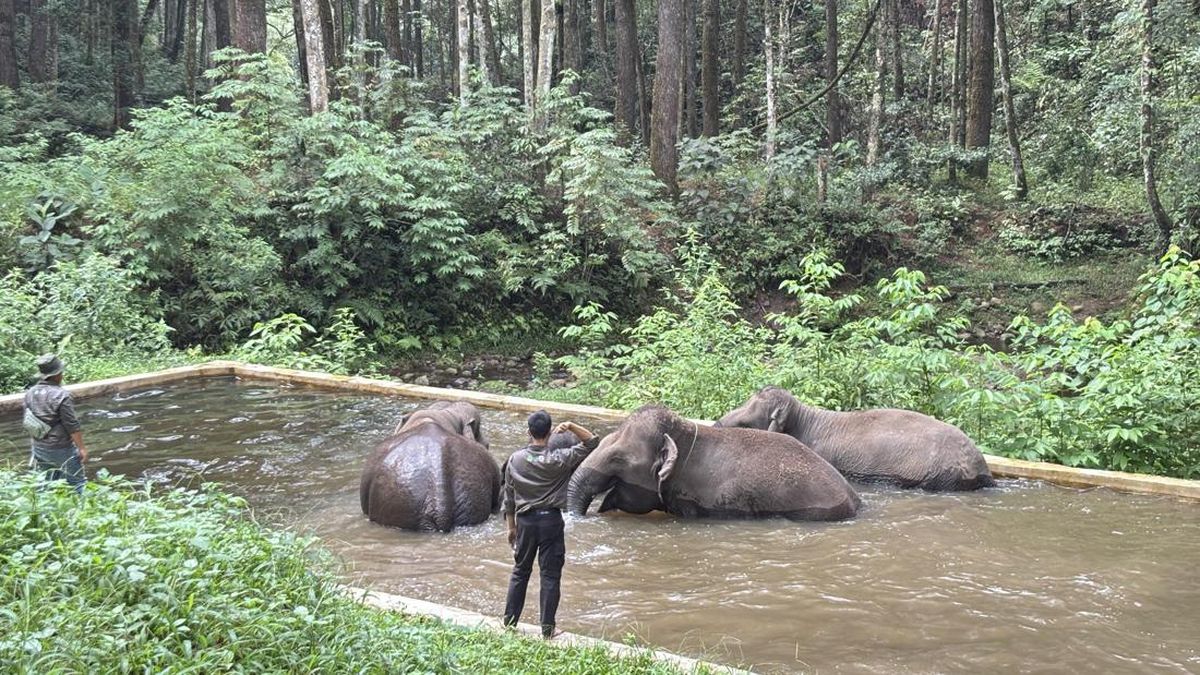
From early afternoon, the elephants’ routine shifts from foraging in the forest to care at the centre. Between about 2pm and 4pm, they are brought back to be washed and given health checks.
Staff inspect their soles and nails, check their skin for wounds or other problems, examine their ears and eyes, and look for injuries elsewhere on their bodies that may have occurred while moving through the forest. For male elephants, their tusks are also checked.
The examinations are carried out every day, even when an elephant shows no signs of illness. This allows changes in its physical condition to be detected early and any problems to be addressed promptly.
Boby said Aek Nauli has three animal-care workers available to assist with examinations. Mahouts are required to bring the elephants in their care for checks, whether or not they appear unwell.
“We do not want to wait until an elephant is injured or ill before examining it. We want to know its condition early so that any problem can be dealt with promptly,” he said.
Aek Nauli’s cool climate also requires adjustments. Staff limit bathing to once a day, in the afternoon, and tailor supplementary food to the animals’ needs and the local conditions.
Aek Nauli’s geography presents significant challenges. The forest covers about 2,400 hectares, with varied terrain; roughly 250 hectares are designated for elephant management. Not every part of the area is suitable for grazing such large animals.
Boby said some of the terrain is relatively steep, while the flat areas are limited. This restricts the choice of grazing locations. Staff must consider the elephants’ safety and comfort when selecting routes.
“Steep slopes would be hard on the elephants. Our challenge is to find suitable areas where they can move and forage safely,” he said.
Support from various parties is important to the ongoing management of ANECC. One contributor is Pertamina Patra Niaga, through its Pematangsiantar Fuel Terminal, which has worked with the centre’s management since 2018.
Its assistance includes developing elephant-grass supplies, providing weighing equipment, handy-talkies, elephant chains, water pumps and water tanks. It has also supported the provision of vitamins and other facilities needed for animal care.
“We are very grateful for the extensive assistance Pertamina has provided to this conservation area. The elephant scales are one example. Previously, it was difficult for the management to know the elephants’ weight because there were no scales, even though they are very important for regular monitoring,” Boby said.
A free educational destination and Pertamina’s role
ANECC is not currently open as a general tourist destination. Visits are mainly for educational purposes, particularly for schools wanting to learn about elephants and conservation at first hand.
Seeing elephants up close, learning about their food needs and watching staff check their health can offer a different experience from reading about them in books, Boby said. Above all, it helps convey the message of conservation.
“Anyone who wants to visit can simply write to us. I can assure you there is no charge. We would, however, be grateful if schools could donate fruit,” he said.
Zakharia Habibuw, manager of Pertamina Patra Niaga’s Pematangsiantar Fuel Terminal, said the partnership with Aek Nauli was part of the company’s commitment to protecting wildlife and the environment near its operations.
“This partnership has been in place since 2018. We have provided several forms of assistance, particularly for elephant conservation and Aek Nauli’s environment, including vitamins, land for elephant fodder, weighing facilities and water supplies for the elephants,” he said.
Zakharia said the support also reflected the proximity of Pertamina’s Pematangsiantar operations to the conservation area. Protecting elephants is part of the company’s concern for protected wildlife and the environment that sustains it.
“Elephants are protected animals, and their population needs to be safeguarded. We want to support their conservation and help educate the public about the importance of protecting nature,” Zakharia said.
Pertamina also supports orchid conservation by providing a propagation facility for endemic varieties in the area. This shows that its environmental work extends beyond one animal species to include the biodiversity that forms part of the forest ecosystem.
“We also have a partnership on orchid conservation. The propagation facility is for orchid varieties endemic to this area, so they can be better conserved,” he said.
He said the programme’s implementation still required guidance from people with technical expertise in conservation. Pertamina provides support in response to the centre’s needs and proposals, while technical decisions on animal care remain with qualified personnel.
“Energy does not come only from fuel. It can come from many things, including our forests and nature. By preserving forests and protecting wildlife, Pertamina is also helping to sustain life,” Zakharia said.
As evening fell in Aek Nauli, the elephants finished bathing and underwent examinations before returning to their resting area. Mahouts made sure the day’s routine had gone smoothly. Health staff checked the animals, while food requirements for the following day remained part of the planning.
Aidil Adha Rahab, one of the mahouts, was busy accompanying Pini Elpionita as she bathed in a small stream in the forest. From time to time, he poured water over the large animal.
The work has been part of his life since 2017. He did not learn about elephants from books or in a training classroom. At first, he learned by following the instructions of more experienced mahouts.
“At first, an older colleague brought me along. I learned from there, following the senior mahouts’ instructions until I got used to caring for elephants,” Aidil said.
For Aidil, knowing Pini means more than knowing her size. He must also understand her temperament, including when the 36-year-old female is “sulking”. The bond between a mahout and an elephant does not form in a day. It grows through repeated interactions, shared routines and the ability to read the animal’s behaviour.
“Every day, we take the elephants into the forest to find food in the morning. In the afternoon they are bathed and given supplementary food. We also have to pay attention to their condition every day,” he said.
Aidil recalled an incident that made him smile. One day, Pini sulked because he had brought no food. Instead of approaching him as usual, she turned her back and moved away, ignoring his attempts to engage with her.
“When she sulks, you have to coax her. That time I came without food, and she turned her back on me. She would not let me touch her either. Once I gave her food, she stopped sulking. So if you come here, you have to bring fruit,” Aidil said.
According to Aidil, every elephant has different habits and reactions. Caring for them therefore requires more than providing food: it also takes closeness, patience and an ability to understand each animal’s character.
Since the partnership with Pertamina Patra Niaga began, the elephants’ food needs have been met. Aidil hopes the collaboration will continue.
“Pertamina has provided a great deal of assistance to this conservation area, including an elephant-grass field and weighing equipment. We are grateful that the scales allow us to monitor the elephants’ development. We also have enough food for them. I hope this partnership can continue,” he said.
Source: jawawa.id (https://jawawa.id/newsitem/keeping-the-forest-giants-last-breath-alive-how-aek-nauli-cares-for-elephants-1793004878)
Originally published by CNN Indonesia (https://www.cnnindonesia.com/nasional/20261026142910-12-1419758/menjaga-napas-terakhir-raksasa-rimba-cerita-aek-nauli-merawat-gajah), translated from Indonesian