
Kamojang Geothermal Plant Uses Reinjection System to Manage Geothermal Fluids
Water management at geothermal power plants is crucial to sustaining energy production while protecting community water sources. At a geothermal power plant, fluids from the reservoir are used to generate electricity, while water from the production process is returned underground through injection wells.
Tina Talisa, Special Staff to the Vice-President, observed the process during a visit to the Kamojang geothermal power plant in West Java. She was briefed on geothermal drilling, the use of steam to drive turbines, and fluid management within the plant system.
“It is interesting to understand how Indonesia’s geological wealth can become a cleaner, reliable and sustainable energy source to support national electricity needs and the energy transition,” Tina said on her personal Instagram account, @tina_talisa, on Wednesday (14 October 2026).
During the visit, Tina also highlighted the difference between fluids in a geothermal reservoir and the groundwater used by the public for everyday needs.
“So, simply put, what needs to be understood is that the water inside the Earth—the geothermal reservoir—is different from the water used every day by households, right?” said Tina, who is also a commissioner at Pertamina Patra Niaga.
Teza Permana, Laboratory Manager at Pertamina Geothermal Energy’s (PGE) Kamojang Area, explained that geothermal systems form when heat from magma warms rocks and fluids in cracks and pores. Indonesia has geothermal potential because it lies in the Pacific Ring of Fire, an area of intense volcanic activity.
According to Teza, geothermal wells drilled to reach the reservoir generally extend to a depth of about 2,000 metres, or two kilometres, below the Earth’s surface.
“That is what our drilling is targeting in the geothermal reservoir. In fact, what we are talking about is only the outer layer,” Teza said.
He explained that the water used by communities generally comes from shallow aquifers replenished by surface water. Geothermal fluids, meanwhile, are found in deeper reservoir systems with different temperature and pressure characteristics.
This distinction is important to understand when managing water resources in geothermal operations. Even so, protecting water sources still requires proper well management and regular environmental monitoring.
Teza said the plant uses steam from the reservoir to drive turbines. The rotating turbines generate electricity, which is then supplied to the public.
“What we use is the steam. We use it to turn the turbine. The rotating turbine generates electricity, which we distribute to the public,” he said.
After production, operators return water underground through injection wells. The system helps maintain the balance of fluids in the reservoir and supports sustainable geothermal production.
Teza said operators locate production and injection wells at different points to manage reservoir conditions. This arrangement matters because the fluid reintroduced through injection wells is cooler than the fluid drawn from production wells.
“The temperature in the injection well is slightly lower than in the production well,” he said.
The temperature difference is related to enthalpy, a thermodynamic quantity describing the energy content of a fluid. If cooler fluid reaches a production well too quickly, it can lower enthalpy and affect the thermal energy available for electricity generation.
Operators therefore need to manage the location and rate of injection to maintain reservoir productivity. Reinjection is an integral part of fluid management in geothermal production, while environmental monitoring remains necessary to protect water sources and the surrounding environment.
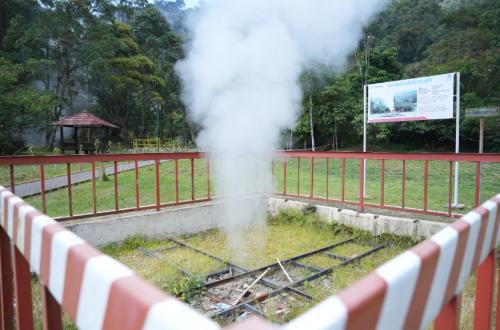
Alongside fluid management, Tina discussed Kamojang’s long history of geothermal development. The site’s history dates back to 1926, when the Dutch East Indies government carried out exploratory drilling, including at well KMJ-3, which is about 60 metres deep.
“Kamojang’s geothermal journey began exactly 100 years ago. In 1926, the Dutch East Indies government conducted exploratory drilling in this area. One of the wells was KMJ-3, drilled to a depth of only around 60 metres. Remarkably, it is still emitting geothermal steam today,” Tina said.
Kamojang began generating 0.25 megawatts (MW) of electricity in 1978. Five years later, Kamojang Unit 1, with a capacity of 30 MW, began commercial operations.
Today, the site has five generating units with a total installed capacity of 235 MW. Indonesia has an estimated geothermal potential of around 23.2 gigawatts (GW), of which approximately 2.78 GW of installed capacity has been harnessed.
The large untapped potential offers opportunities to develop geothermal energy in support of national energy security. Such development must continue to take account of reservoir management, water-source protection, environmental conservation and the interests of communities near operational areas.
Source: jawawa.id (https://jawawa.id/newsitem/kamojang-geothermal-plant-uses-reinjection-system-to-manage-geothermal-fluids-1791989591)
Originally published by Republika (https://esgnow.republika.co.id/berita/tmwihd522/pltp-kamojang-gunakan-sistem-reinjeksi-untuk-kelola-fluida-panas-bumi), translated from Indonesian