
KAIST Researchers Develop Nano 'Fingerprint' to Detect Product Authenticity
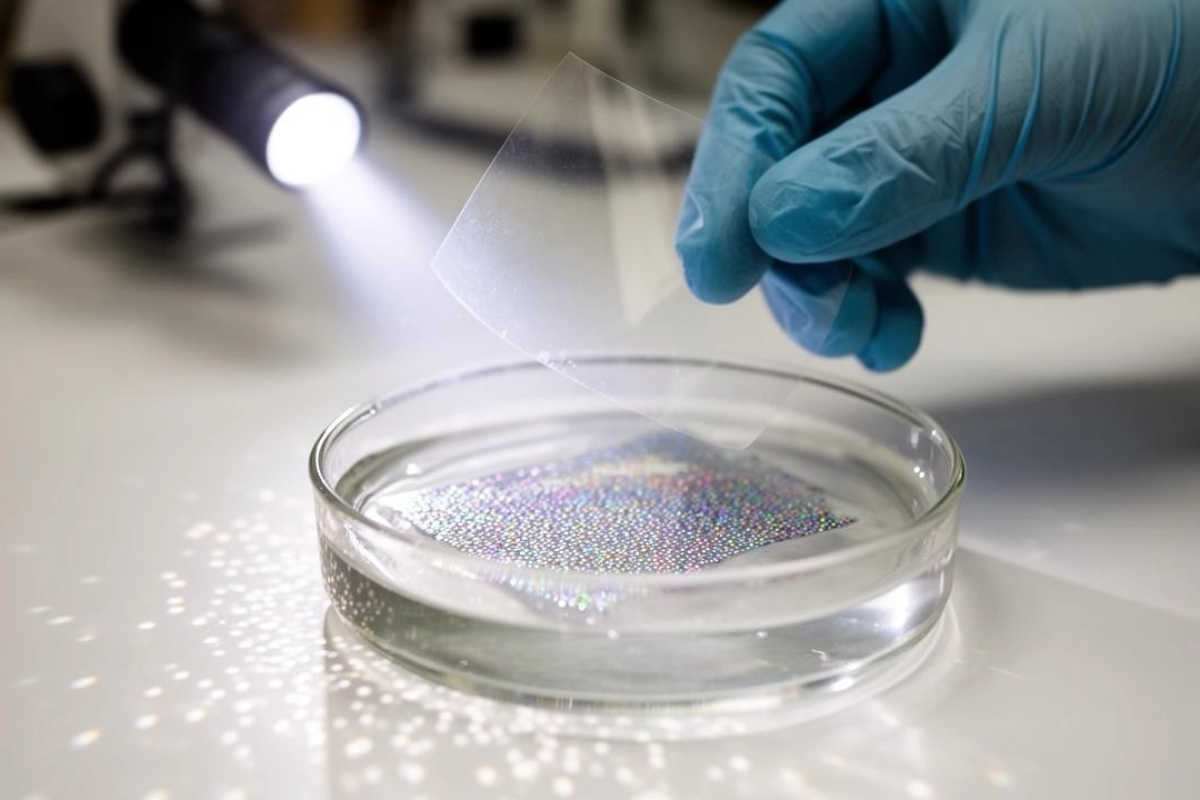
Imagine if every item possessed its own unique ‘fingerprint’ that no one could counterfeit. To verify it, there would be no need for expensive microscopes; a simple smartphone torch would suffice.
A joint research team, led by Professor Sang Ouk Kim from the Department of Materials Science and Engineering at KAIST, alongside Professor Seok Joon Kwon from Sungkyunkwan University, has successfully developed a tool capable of checking product authenticity using only light. The method utilises the unique patterns of randomly arranged nano-sized particles as an ‘artificial fingerprint’. This discovery was published in the international scientific journal Nature Communications on 23 July 2026.
This artificial fingerprint utilises the full three-dimensional information of the particles, allowing it to be read with two different light sources: a white LED lamp (such as a phone torch) and a green laser with a wavelength of 542 nm, which is scattered in various directions by the fine particle structure.
Because the structure cannot be physically replicated, the system is also relatively secure from password hacking by artificial intelligence or future quantum computers. This is particularly relevant as cyber-attacks become increasingly sophisticated and the resilience of conventional cryptographic systems is being called into question.
In the security world, this concept is known as a Physical Unclonable Function (PUF)—a technology that leverages microscopic physical differences that emerge naturally during the production process as security information. Much like humans have unique fingerprints, every finished product possesses a unique physical identity.
Until now, high-security PUFs had one practical weakness: their structures were so small and complex that they required microscopes or expensive equipment to read. The KAIST team sought to solve this weakness through a unique method using two optical responses generated by a single nano-pattern.
When the nano-pattern is exposed to white light, such as a phone torch, a specific colour is reflected by each part of the nano-structure, forming a distinctive reflection pattern. If one aspect of the nano-pattern is leaked, the other aspects remain unknown to hackers. To succeed, they would have to replicate three things simultaneously: the nanoparticle structure, the colour and reflection pattern under a torch, and the nano-pattern under a laser.
The research team has also successfully transferred these nano-structures to various surfaces, including flexible plastic, metal, transparent films, and even hydrogels or soft, water-retaining gel-like materials.
The potential applications are vast, ranging from luxury goods and artworks to pharmaceuticals. Since it can be applied to transparent films, this technology also has the potential to serve as security stickers that do not interfere with a product’s original design.