
KAI's container transport grows by 21.75% in January–April 2026
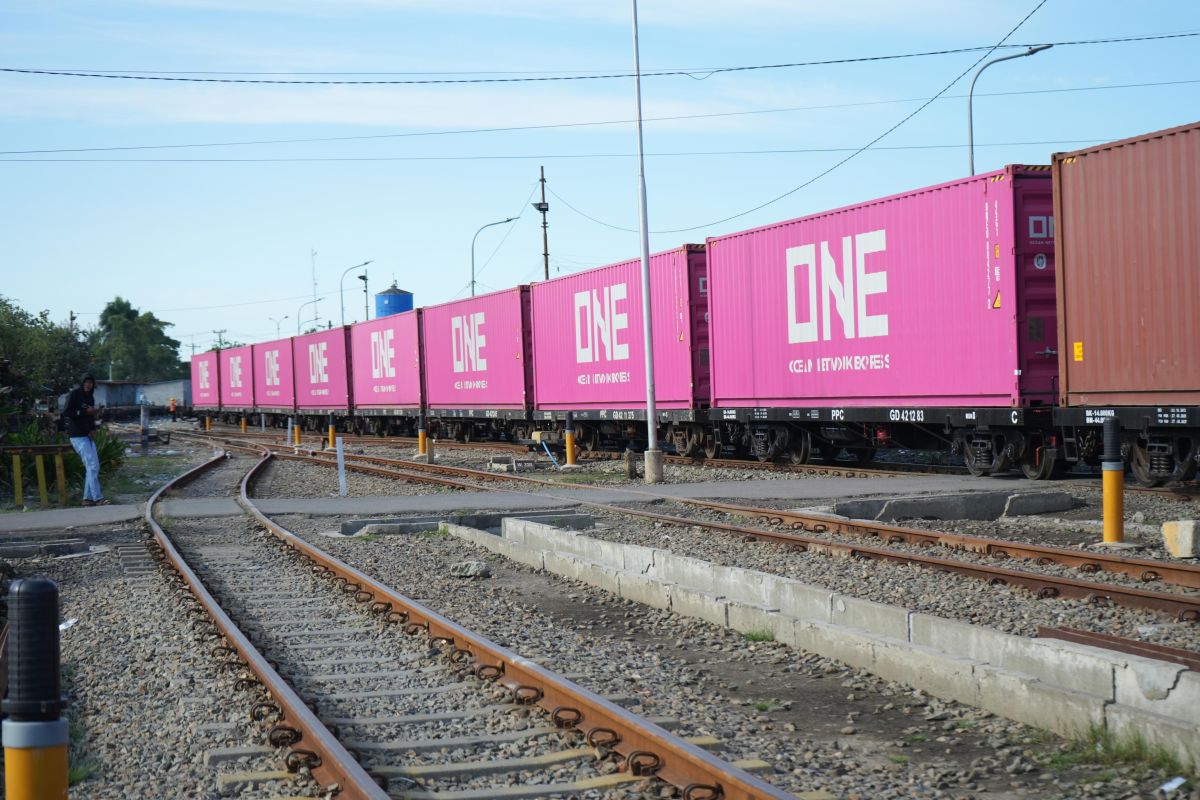
Jakarta, ANTARA – National logistics movements continue to grow as industrial activity, trade, and goods distribution rise across Indonesia. In the face of supply chains requiring faster and more efficient operations, rail-based transport is increasingly taking on a larger role as a high-capacity mode of distribution that is more measurable in terms of time, cost, and capacity. PT Kereta Api Indonesia (Persero) recorded container transport volume during January–April 2026 of 1,912,392 tonnes, up by 21.75% from 1,570,835 tonnes in the same period of 2025. This growth demonstrates increasing demand for rail-based logistics distribution, particularly to support connectivity between industrial estates, ports, and distribution hubs on Java. Anne Purba, KAI’s Vice President for Public Relations, said that the increase in container transport reflects a shift in logistics distribution patterns toward a mass transit system that is more efficient and integrated. ‘Rail-based transport is capable of carrying large cargo loads in a more measured way. When goods distribution operates more efficiently, the impact is felt throughout the industrial supply chain, business players, and even the public as end users of the products,’ Anne said. According to Anne, the rise in container transport is closely linked to industry demand for a more competitive distribution system. As logistics activity grows, demand for large-capacity transport modes with stable transit times becomes increasingly important. KAI is continuing to strengthen the development of rail-based logistics infrastructure through collaboration with various parties. One example is the signing of a Memorandum of Understanding for the development of rail-based logistics at the Dryport of the Batang Special Economic Zone (KEK Industropolis Batang), together with PT Kawasan Industri Terpadu Batang, PT Pelabuhan Indonesia (Persero), PT Sarana Pembangunan Jawa Tengah (Perseroda), and Perumda Aneka Usaha Kabupaten Batang. The development of the dryport is aimed at building a logistics system directly connected between industrial estates, railway lines, and ports. This scheme is seen as capable of reducing distribution processes that have long depended on road transport with high traffic density. ‘When an industrial area is directly connected to the rail and port networks, the distribution process becomes more efficient. Goods can move in large volumes with more stable operating patterns and more competitive logistics costs,’ Anne explained. Currently, Indonesia’s logistic costs still range from about 15% to above 20% of GDP, while the global standard sits around 7–8%. That gap represents a major challenge as well as an opportunity for developing a more efficient national logistics system. Across Java itself, around 60% of national logistics activity is in this island, with logistics costs estimated at Rp2,400–2,500 trillion per year. In this scale, distribution efficiency has a significant economic impact on the cost of national industrial production. KAI also continues to raise freight carrying capacity through asset strengthening. Currently, KAI operates wagons with an average capacity of 50 tonnes per wagon and is developing capacity to up to 70 tonnes per wagon. With a train consisting of 60 wagons, the freight capacity can reach around 4,200 tonnes per trip. In addition to increasing capacity, on-time performance is another crucial factor in national logistics distribution. From January to April 2026, KAI recorded an on-time performance (OTP) for departures of 95.97% and arrivals of 91.77%. This achievement demonstrates how rail-based distribution can provide the delivery time certainty increasingly required by industrial zones, ports, and the national supply chain. The scale of this capacity illustrates how rail-based transport can ease road distribution congestion. In a single journey, freight trains can carry large loads simultaneously with more efficient energy use and distribution space. In addition to increasing capacity, KAI is also promoting the development of direct routes to ports to improve distribution flexibility. Currently, distribution to Tanjung Priok Port still uses existing routes with certain operational time constraints. The development of direct connectivity is expected to accelerate the flow of goods from industrial areas to export ports or domestic distribution. Anne added that the development of rail-based logistics also opens new economic growth opportunities in various regions. The presence of dryports and distribution networks can spur the growth of warehousing zones, logistics consolidation hubs, and supporting economic activities around distribution nodes. ‘Freight trains are becoming an important part of building a more efficient and interconnected national supply chain. As distribution improves, industries become more competitive, goods move more smoothly, and regional economic growth follows,’ concluded Anne.