
KAI Wins 5 Indonesia Sustainability Awards 2026, Strengthens Inclusive Services and Low-Emission Transport
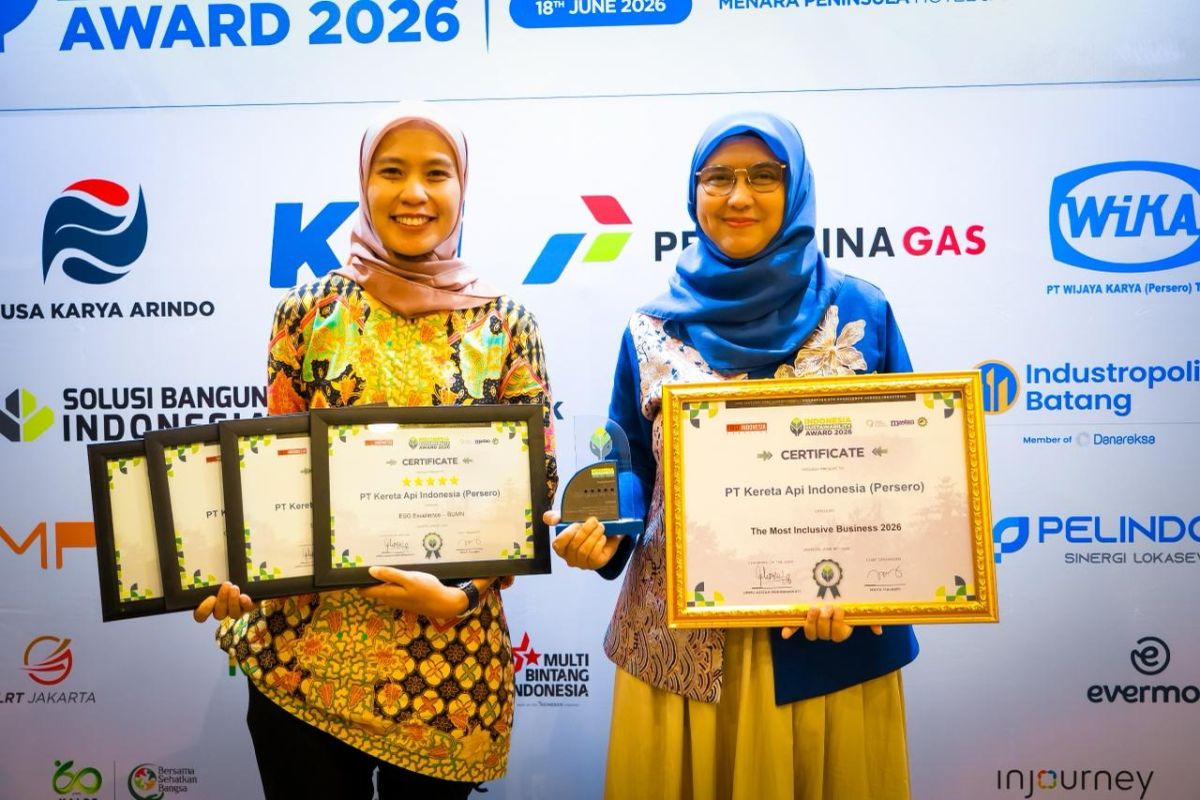
PT Kereta Api Indonesia (Persero) received five awards at the Indonesia Sustainability Award 2026 held at the Menara Peninsula Hotel, Jakarta, on Thursday (18/6). The event, themed ‘One Nation, One Commitment: Advancing ESG Excellence Across Industries’, recognises companies that implement Environmental, Social, and Governance (ESG) principles in their business activities. The awards received by KAI include: the Sustainable Innovation Award with a five-star rating; the Corporate Climate Action Leadership Award with a five-star rating; ESG Excellence – BUMN with a five-star rating; the ESG Leadership Excellence Award with a five-star rating, presented to Muhammad Sahli; and The Most Inclusive Business 2026 – Best of The Best.
Vice President Corporate Communication KAI Anne Purba stated that the awards encourage KAI to continue strengthening services that are close to customer needs, operationally efficient, and beneficial to society. ‘ESG is implemented through things directly felt by customers and the public. Journeys must be punctual, service access needs to be increasingly easy, energy must be used more efficiently, and goods distribution via rail must be stronger. These awards serve as a reminder for KAI to keep working with data, clear metrics, and tangible results,’ Anne said.
KAI manages a large service scale supporting national mobility and logistics, overseeing 608 stations, 6,031 km of active infrastructure, and 11,312 assets comprising locomotives, passenger carriages, freight wagons, KRL, KRD, and LRT. This scale requires KAI’s sustainability agenda to be implemented gradually, measurably, and across various service areas. The strengthening of KAI’s ESG runs alongside service growth. Based on data from January to May 2026, KAI Group served 214,045,803 customers, a 7.2 per cent increase compared to 199,663,907 customers in the same period of 2025. During this period, On Time Performance for passenger trains was recorded at 99.89 per cent for departures and 96.84 per cent for arrivals.
This customer growth is supported by various KAI Group services, ranging from long-distance and local trains, KAI Commuter, KAI Bandara, LRT Jabodebek, LRT Sumsel, KAI Wisata, KA Makassar–Parepare, to Whoosh. In terms of customer experience, KAI’s Customer Satisfaction Index for 2025 was recorded at 4.52, falling into the ‘very good’ category. The Most Inclusive Business 2026 – Best of The Best award aligns with KAI’s steps to expand services friendly to various customer groups. In the Access by KAI application, the Female Seat Map feature has been available since 23 March 2025. This feature helps female customers see the seat positions of other female passengers before choosing a seat, allowing journeys to be planned more comfortably.
At stations, KAI is also gradually preparing accessibility facilities for customers with disabilities and those needing assistance. These facilities include ramps, wheelchairs, disabled toilets, lifts or escalators at certain stations, guiding blocks, waiting rooms, and staff assistance according to service needs on the ground. ‘Public transport must be increasingly accessible to various customer groups. Therefore, KAI continues to improve services so that female, elderly, disabled, family, and general public customers can plan journeys more safely, comfortably, and according to their needs,’ Anne said.
Beyond serving public mobility, KAI is also strengthening the role of rail in the national supply chain. Throughout January to May 2026, KAI transported 26,486,417 tonnes of goods. The largest commodities were coal at 21,563,901 tonnes, containers at 2,428,471 tonnes, fuel oil (BBM) at 1,096,998 tonnes, cement and clinker at 977,983 tonnes, plantation products at 268,728 tonnes, retail goods at 48,684 tonnes, and other commodities at 101,652 tonnes. According to Anne, rail-based freight services hold significant value in the sustainability agenda because they can carry large loads more efficiently and help maintain smooth distribution. ‘Rail offers a more competitive logistics option for businesses. When goods distribution becomes more efficient, the benefits can enter the broader economic chain, from supply smoothness and industrial competitiveness to reducing pressure on roads,’ Anne stated.
From an environmental perspective, KAI is expanding the use of clean energy through Solar Power Plants (PLTS). As of June 2026, KAI has developed 113 PLTS units with a total installed capacity of 4,430.65 kWp spread across 92 locations. PLTS units and locations are recorded as two different things because more than one unit can be installed in a single location. These PLTS are installed at various KAI operational facilities, such as stations, depots, workshops, offices, and record centre buildings. With this capacity, KAI’s PLTS has the potential to generate approximately 5.8 million to 6.6 million kWh of clean electricity per year and reduce carbon emissions by around 5,100 to 5,800 tonnes of CO₂ annually.
KAI’s climate agenda is also strengthened through a biodiesel roadmap. Fuel use within KAI has progressed from B0 in 2017, B20 in 2018–2019, B30 in 2020–2022, B35 in 2023–2024, B40 in 2025–2026, and towards B50 in 2026. In KAI’s 2025–2030 strategic decarbonisation action programme, the fuel change from B35 to B50 is targeted to reduce emissions by 133,676 tonnes of CO₂e. In the digitalisation field, KAI is strengthening services through the Face Recognition Boarding Gate. As of 3 June 2026, this service has been used more than 25 million times, with 5.4 million customers registered. The digitalisation of the boarding process helps speed up service, improve customer comfort, and support savings of approximately 64 million sheets of paper. Anne added that the ESG Leadership Excellence Award given to Muhammad Sahli demonstrates that the sustainability agenda is driven by leadership committed to measurable targets.