
KAI transports over 149,000 passengers daily during extended holiday period
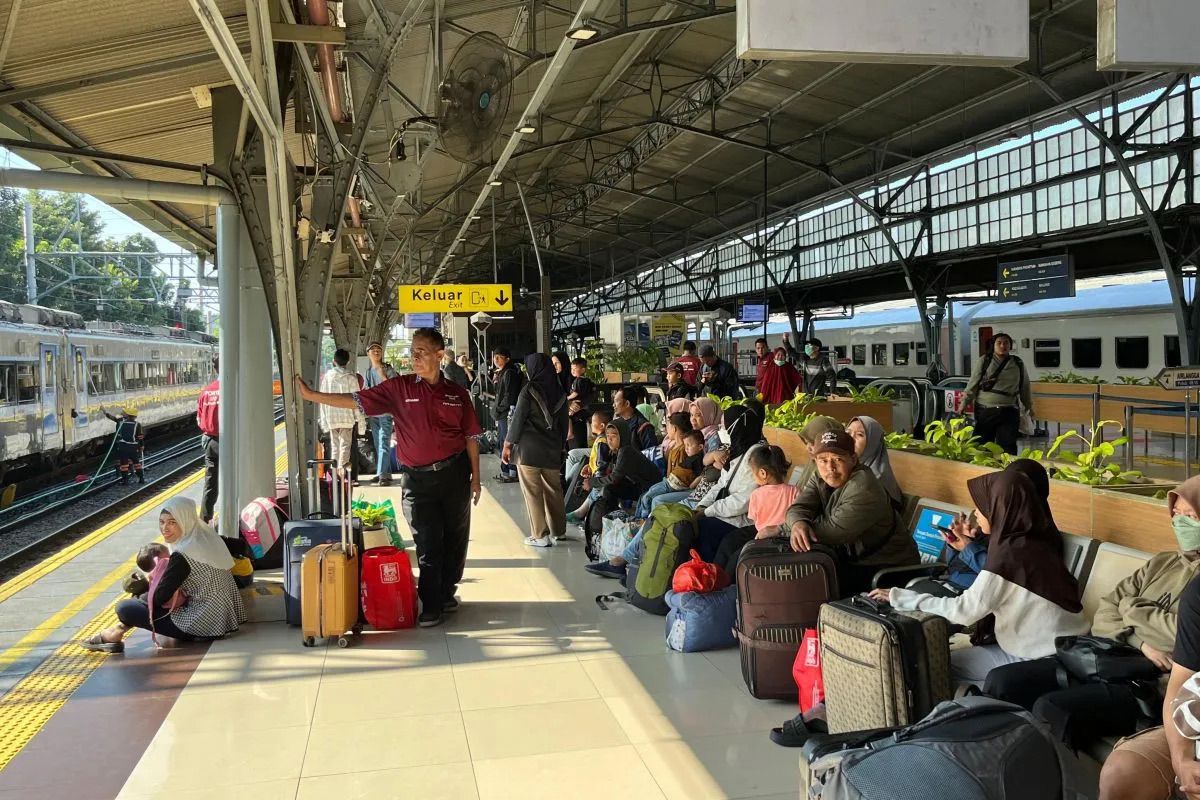
PT Kereta Api Indonesia (Persero) transported over 1.21 million passengers during the extended Eid al-Adha and Pancasila Day holiday period, with daily averages exceeding 149,000.
“Extended Eid al-Adha 1447 Hijriah holiday period, coinciding with Pancasila Day (June 1), has once again driven increased mobility across various regions,” said KAI Vice President of Corporate Communications Anne Purba in Jakarta on Saturday.
She explained that rail passenger numbers during the extended Eid and Pancasila Day holiday remained high, reflecting strong demand for travel throughout the period.
KAI reported that as of 10:00 WIB on Saturday, May 30, 2026, ticket sales for the travel period from May 26 to June 1, 2026, reached 1,215,456 tickets across its Java and Sumatra operational regions.
She detailed that passenger numbers peaked at 214,349 on May 26, 2026, followed by 155,110 on May 27, rising to 175,526 on May 28. Passenger numbers then increased to 191,834 on May 29 before dropping to 178,294 on May 30. As the holiday period neared its end, 150,479 passengers were recorded on May 31 and 149,864 on June 1, 2026.
“After the peak departure on May 26, 2026, with over 214,000 passengers, daily volumes remained consistently above 149,000,” Anne said.
She noted that numbers could still rise as ticket sales continue, reflecting a more evenly distributed travel pattern throughout the holiday period.
She stated that rail travel is increasingly preferred for its ability to connect economic, educational, governmental, and tourism hubs with reliable travel times and consistent comfort.
“Public confidence in rail-based transport continues to grow. Trains meet the public’s needs for easy access, predictable travel times, and consistent comfort,” Anne added.
KAI also observed increasingly diverse travel patterns. Previously, holiday travel was concentrated on specific days, but now departures are more evenly distributed throughout the holiday period.
This trend shows the public is becoming more flexible with travel timing, whether for tourism, family visits, attending events, or intercity trips.
KAI also listed the top 10 departure stations during the May 26–June 1, 2026 holiday period up to 10:00 WIB on May 30, including Pasarsenen Station (PSE) with 84,578 passengers; Gambir Station (GMR) with 73,532; Yogyakarta Station (YK) with 68,951.
Followed by Semarang Tawang (SMT) with 47,628; Bandung (BD) with 39,727; Surabaya Gubeng (SGU) with 39,094; Surabaya Pasarturi (SBI) with 37,837; Purwokerto (PWT) with 37,268; Semarang Poncol (SMC) with 35,712; and Solo Balapan (SLO) with 33,861 passengers.
“The high departure activity from these stations aligns with their roles as economic, educational, governmental, and tourism hubs,” Anne explained.
She explained that Jakarta, via Pasarsenen and Gambir stations, remains the largest departure point as the national activity hub with connectivity to various regions across Java and Sumatra.
Meanwhile, Yogyakarta, Bandung, Semarang, Solo, Purwokerto, and Surabaya are cities with high public mobility.
Anne added that the high mobility during the extended holiday has broader economic impacts on destination regions across various sectors.
Rail passenger movements support tourism, trade, hospitality, food and beverage, onward transport, and micro, small, and medium enterprises (MSMEs) reliant on interregional visits.
“Trains serve as connectors for community activities and drivers of interregional connectivity. When mobility flows well, economic activity follows,” she said.