
KAI Strengthens Role of Freight Trains in Reducing National Logistics Costs
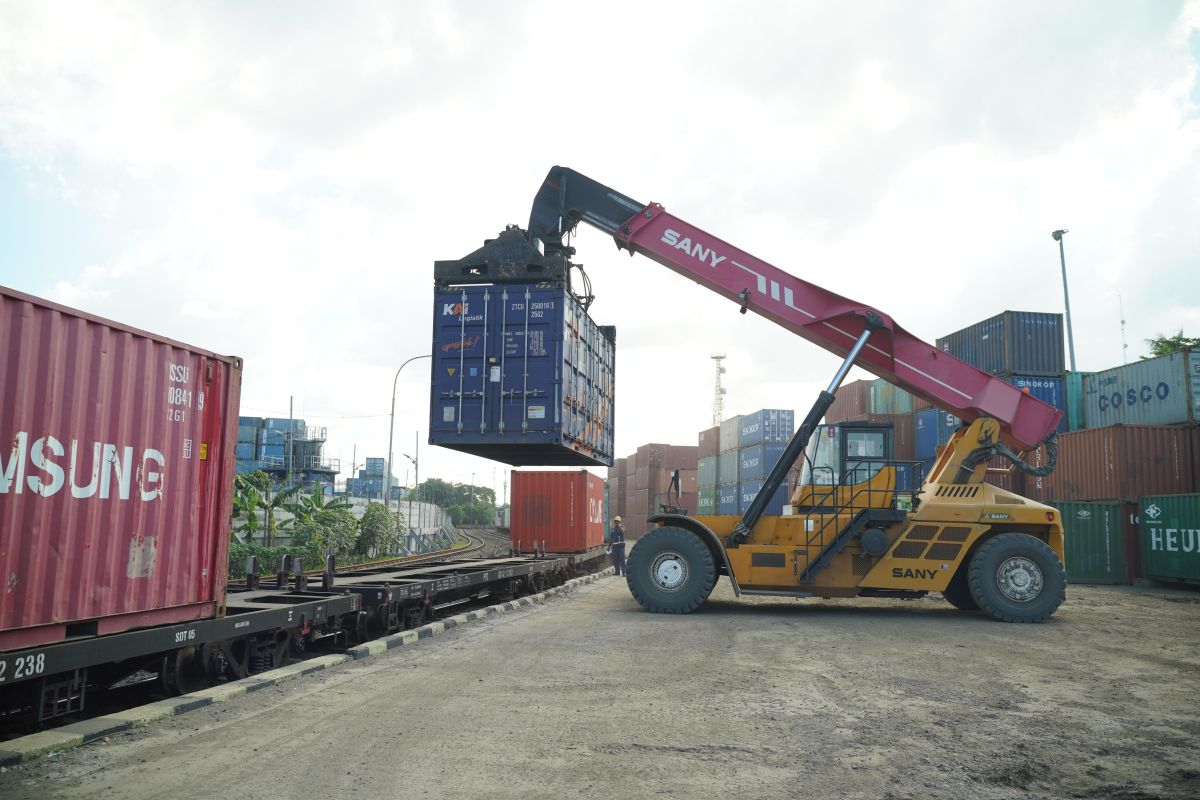
PT Kereta Api Indonesia (Persero) is strengthening the role of freight trains in supporting national logistics efficiency. Railways offer large capacity, measurable travel schedules, and the ability to connect production centres, industrial estates, ports, and distribution hubs.
During January to May 2026, KAI transported 26,486,417 tonnes of goods. This volume comprised 21,563,901 tonnes of coal, 2,428,471 tonnes of containers, 1,096,998 tonnes of fuel, 977,983 tonnes of cement and clinker, 268,728 tonnes of plantation commodities, 48,684 tonnes of retail goods, and 101,652 tonnes of other commodities.
Vice President of Corporate Communication at KAI, Anne Purba, stated that freight trains play a vital role in maintaining the smooth distribution of essential needs, ranging from energy and industrial raw materials to construction materials and consumer goods.
“Freight trains help make distribution costs more efficient because they can serve large volumes in a single journey. For businesses, more manageable distribution costs can help keep goods prices in check. For the public, a smooth supply chain can support more stable prices,” Anne said.
Logistics costs encompass all expenses incurred to move goods from production sites to consumers. These costs include shipping, storage, loading and unloading, and other distribution processes. If logistics costs are high, goods prices can be pushed upwards. Conversely, if logistics costs fall, businesses have greater room to keep prices competitive.
According to data from Statistics Indonesia, Indonesia’s Gross Domestic Product at current prices reached Rp23,821.1 trillion in 2025. GDP represents the total value of all goods and services produced by Indonesia in one year. Based on this figure, every one percentage point reduction in logistics costs relative to GDP equates to an efficiency gain of approximately Rp238.2 trillion per year for the Indonesian economy.
This calculation uses a simple formula: the percentage point difference in logistics costs multiplied by Indonesia’s GDP value. For example, one percent of Rp23,821.1 trillion yields around Rp238.2 trillion. This figure is a national economic simulation, providing an illustration of potential efficiency.
In the 2025–2029 National Medium-Term Development Plan, Indonesia’s logistics costs were recorded at 14.29 percent of GDP as the 2022 baseline. The document targets a reduction in logistics costs to 13.52 percent, and subsequently to 12.50 percent.
Using Indonesia’s 2025 GDP as the simulation base, lowering logistics costs from 14.29 percent to 13.52 percent of GDP could unlock efficiency gains of approximately Rp183.4 trillion per year. If reduced to 12.50 percent of GDP, the efficiency gain could reach around Rp426.4 trillion per year.
“These figures show that logistics is not just an industry concern. When distribution costs fall, the benefits can be felt more widely. Businesses can become more efficient, goods prices are better maintained, and public purchasing power can be boosted,” Anne said.
For comparison, a World Bank study notes that logistics costs in Latin America and the Caribbean range from 16 to 26 percent of GDP, while developed countries are around 9 percent of GDP. In Asia, the Indian government, through an official study, recorded India’s logistics costs at 7.97 percent of GDP in 2023–2024.
These global and regional data points indicate that logistics efficiency is a key factor in national competitiveness. For Indonesia, strengthening freight trains, freight terminals, loading and unloading facilities, logistics corridors, operational technology, and integration of shipments to and from freight stations is an important agenda to reduce distribution costs.
KAI continues to optimise freight train services by strengthening operational patterns, improving the reliability of facilities and infrastructure, and collaborating with corporate customers and logistics partners. These efforts are directed at making goods distribution increasingly scheduled, stable, and efficient, and capable of supporting the competitiveness of national industry.
“Investment in rail-based logistics is an investment in Indonesia’s competitiveness. The more goods that can be efficiently served by rail, the greater Indonesia’s opportunity to reduce logistics costs, strengthen industry, and safeguard public purchasing power,” Anne concluded.