
KAI Strengthens Rail-Based National Logistics Integration, Serving 32.50 Million Tonnes of Freight
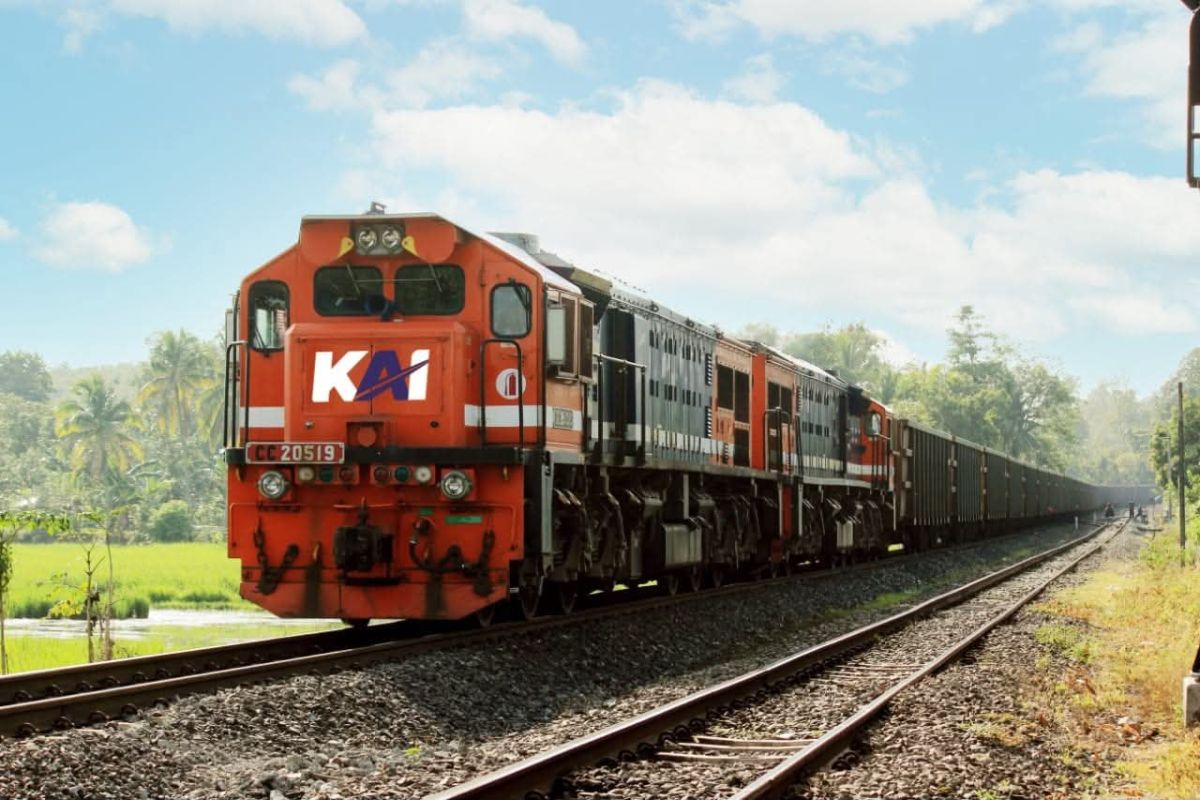
PT Kereta Api Indonesia (Persero) is continuing to strengthen the role of railways in the national logistics system by increasing freight capacity, developing connectivity to ports and industrial estates, adding rolling stock, and integrating services with other modes of transport.
During the first half of 2026, KAI carried 32,498,043 tonnes of freight. This comprised 26,534,095 tonnes of coal, or around 81.65%, and 5,963,948 tonnes of non-coal commodities, or around 18.35%.
The non-coal commodities served by KAI include containers, fuel oil, cement and clinker, plantation products, retail goods, fertiliser, steel, and a range of industrial and consumer goods. This achievement positions the railway as an important part of the distribution of energy, industrial raw materials, manufactured goods, and basic necessities between regions.
KAI’s Vice President of Corporate Communication, Anne Purba, said logistics integration requires ever-better connections between production centres, industrial estates, freight terminals, ports, warehouses, and final distribution destinations.
“Railways have large capacity, planned schedules, and the ability to serve inter-regional deliveries consistently. The strengthening of freight transport is directed at making rail-based services increasingly connected to ports, industrial estates, dry ports, and first- and last-mile services,” said Anne.
For coal transport, KAI is preparing capacity enhancements in South Sumatra through additional rolling stock, increased line capacity, the development of electric signalling, and optimisation of loading and unloading facilities. One long-term development direction is the Tarahan II terminal, planned to add capacity of up to 20 million tonnes per year.
The development of Tarahan II is designed as a joint investment with PT Bukit Asam Tbk. PTBA is directed to handle the development of the loading terminal, unloading terminal, and supporting infrastructure, while KAI prepares rolling stock and the electric signalling system. The rolling stock planned for the project includes 22 locomotives and 1,200 wagons.
KAI is also planning increased coal transport in South Sumatra through rail infrastructure strengthening, additional rolling stock, and improved unloading facilities, including capacity development related to the Kramasan terminal and terminals owned by private partners.
This reinforcement has been supported by the arrival of 1,080 flat wagons by the first half of 2026. The rolling stock is being prepared to strengthen freight service capacity in Sumatra, including supporting the distribution needs of commodities in large volumes.
“Freight investment must be built as a single ecosystem. The addition of locomotives and wagons must be accompanied by the readiness of tracks, signalling, terminals, maintenance facilities, and volume certainty from partners so that available capacity can be used productively,” said Anne.
To increase the contribution of non-coal commodities, KAI is developing regular non-dedicated container train services in Java. Under this scheme, customers can book capacity based on load slots so that wagon use can be tailored to actual demand.
The model is aimed at improving train load factors, travel productivity, transparency of capacity allocation, and service flexibility. In the first half of 2026, KAI’s container transport volume stood at around 2.62 million tonnes.
KAI also operates the Brumbung Cargo train with a capacity of up to 800 tonnes per train set. The service expands rail-based goods distribution options for businesses in Java.
The next direction includes building connectivity between the Cilacap Container Terminal and the railway network and major logistics centres, particularly the Semarang Container Terminal. This development is projected to widen the port’s service area, strengthen export-import and domestic distribution, and shift some cargo from roads to railways.
The integration of the Cilacap port and the rail network is also expected to support the distribution of industrial commodities in Central Java and surrounding areas. In KAI’s 2026–2030 Long-Term Corporate Plan (RJPP), the initial investment requirement for developing this connectivity is indicated at around Rp3.6 billion, with implementation still subject to feasibility studies, partner readiness, and project development stages.
KAI is also preparing the development of logistics connectivity between Krakatau Steel’s production facilities and industrial estates in East Java. The rail-based service is designed as a pilot project for steel distribution supporting the implementation of the Zero Over Dimension Over Load (Zero ODOL) policy.
Railways can carry heavy commodities in large volumes with more standardised dimensions and loads. The development is expected to reduce the pressure of heavy vehicles on roads, improve distribution safety, and provide schedule certainty for industry.
The RJPP indicates an investment requirement of around Rp22 billion for the initial phase of this connectivity development. The value and scope of the investment remain subject to technical studies, volume commitments, infrastructure readiness, permits, and agreements with partners.
KAI’s logistics strategy also includes a study on developing a dry port at the Batang Integrated Industrial Estate. The study covers volume potential, rail connectivity needs, terminal readiness, operational schemes, financing, and integration with ports.
The indicative investment requirement for accelerating and revitalising logistics railway operations is estimated at around Rp2.5 trillion. This figure remains a preliminary estimate requiring further studies together with ministries, agencies, estate managers, industrial partners, and prospective funders.
In the plantation sector, KAI is developing cooperation on crude palm oil (CPO) transport. Available service capacity is recorded at more than 1.1 million tonnes per year, while utilisation still has room for improvement through cooperation with producers, multimodal integration, and optimisation of available rolling stock.
KAI is also preparing green freight services to meet the needs of companies pursuing emission reduction targets in their supply chains. Development is directed at emissions measurement, more efficient operations, the use of low-emission energy, and the provision of verifiable and certifiable green transport services.
“National logistics integration must deliver direct benefits to industry and the public. Increasingly efficient distribution can help maintain supply, improve delivery time certainty, expand market reach, and support the competitiveness of Indonesian products,” said Anne.
KAI will carry out each development in stages, taking into account business feasibility, infrastructure readiness, safety, operational reliability, volume certainty, regulation, and sound financing schemes.
“Through collaboration with the government, Danantara, port operators, industrial estates, cargo owners, and logistics companies, KAI wants to increase the railway’s contribution to the national supply chain. The end goal is a distribution system that is increasingly integrated, high-capacity, scheduled, efficient, and low-emission,” Anne concluded.
Source: jawawa.id (https://jawawa.id/newsitem/kai-strengthens-rail-based-national-logistics-integration-serving-32-50-million-tonnes-of-freight-1785232649)
Originally published by Antara (Indonesian) (https://www.antaranews.com/berita/5669273/layani-3250-juta-ton-barang-kai-perkuat-integrasi-logistik-nasional-berbasis-rel), translated from Indonesian