
KAI Strengthens Rail-Based Logistics to Cut Distribution Costs
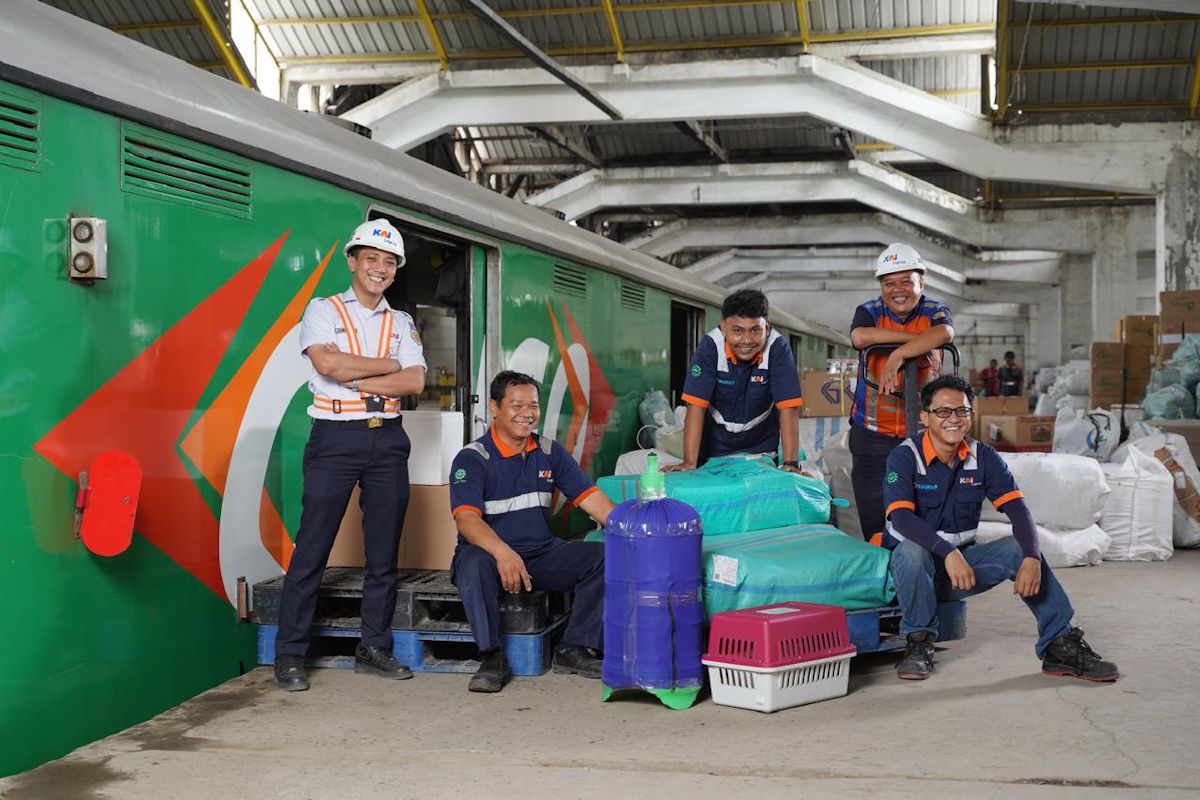
Logistics efficiency will have a direct impact on industrial production costs. When goods distribution becomes more effective, the national supply chain will also become more competitive.
Jakarta (ANTARA) - PT Kereta Api Indonesia (Persero) is strengthening rail-based logistics transport to curb national distribution costs, improve supply chain efficiency, and support economic growth and gross domestic product.
‘Strengthening rail-based logistics transport is important given that Indonesia’s logistics costs are currently in the range of 15 to above 20 percent of GDP, while the global standard is around 7–8 percent,’ said Anne Purba, Vice President Corporate Communication at KAI, in a statement in Jakarta on Saturday.
According to her, this condition shows there is still a very large room for efficiency in the national logistics sector. The more efficient the distribution costs, the greater the opportunity for the domestic industry to enhance the competitiveness of its products in both domestic and global markets.
‘Logistics efficiency will have a direct impact on industrial production costs. When goods distribution becomes more effective, the national supply chain will also move more competitively,’ said Anne.
KAI recorded positive growth in retail transport services from January to April 2026. During this period, KAI’s retail transport volume reached 82,129 tonnes, up 4.86 percent compared with the same period in 2025 of 78,323 tonnes.
She noted that compared with January-April 2024 of 66,654 tonnes, retail transport volume grew 23.22 percent. Specifically in April 2026, KAI provided retail transport of 21,844 tonnes, up 22.87 percent from April 2025’s 17,778 tonnes.
‘Railways are increasingly chosen as a goods distribution mode because they have large capacity, more measurable travel times, and support logistics cost efficiency in the national supply chain,’ Anne said.
KAI is continuing to strengthen freight transport capacity through upgrading equipment capabilities and developing rail-based distribution patterns.
Anne said KAI currently operates with an average capacity of 50 tonnes per wagon, which is being raised to 70 tonnes. With a train set of up to 60 wagons, freight capacity can reach 4,200 tonnes in a single journey.
In addition to capacity strengthening, KAI also continues to push for integration of logistics services with industrial estates, warehousing, and ports so that goods distribution can be faster and more efficient.
On the other hand, Java Island remains the main hub of national logistics activity. Around 60 percent of Indonesia’s logistics activity is on Java Island, with logistics costs estimated at Rp2,400 trillion–Rp2,500 trillion per year.
‘An efficiency of just 30 percent is expected to yield savings of around Rp1,000 trillion,’ Anne said.
She assessed that rail-based freight transport has enormous potential to strengthen this efficiency because it can carry goods in large volumes more steadily and with fewer road traffic obstacles.
‘With a wide operational network and large freight capacity, railways have great potential to support more efficient, safe, and sustainable national logistics distribution,’ Anne explained.
KAI will continue to strengthen the development of freight transport services to support industrial growth and national logistics connectivity.
Optimising rail-based distribution is expected to spur economic efficiency and strengthen Indonesia’s competitiveness going forward.
‘The bigger the share of goods distribution moved to rail, the greater the efficiency benefits that the business sector and wider society can feel,’ Anne said.