
KAI Strengthens PSO Trains for Public Economy, KA Cikuray and Farmer-Trader Train Provide Productive Access
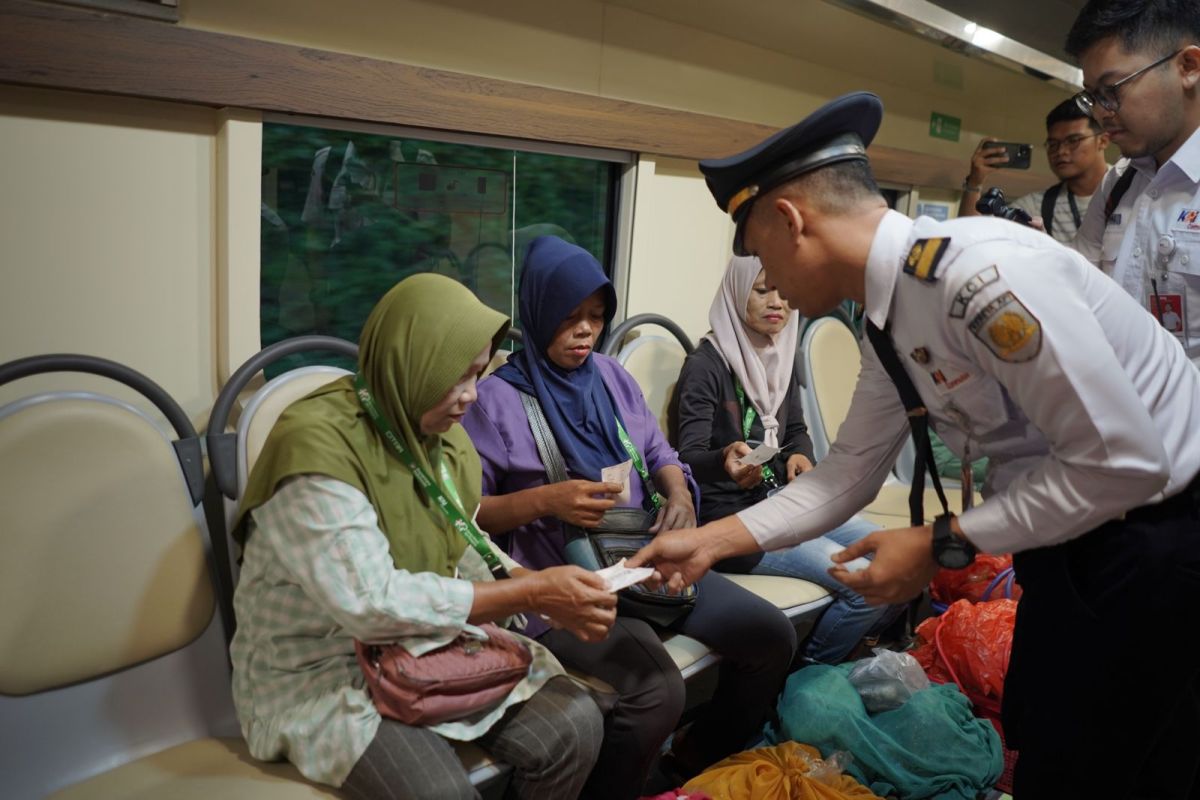
PT Kereta Api Indonesia (Persero) is strengthening the role of Public Service Obligation (PSO) trains as safe, affordable public transport that supports community economic activities. This is being implemented through the People’s Economy Train service on the Pasar Senen–Lempuyangan round-trip route and the KA Cikuray Garut–Pasar Senen round-trip route, as well as the Farmer-Trader Train on the Rangkasbitung–Merak route and KA Cikuray.
Vice President Corporate Communication of KAI, Anne Purba, stated that the People’s Economy Train and Farmer-Trader Train are designed to meet the needs of daily commuters, farmers, traders, MSME operators, students, families, and communities requiring productive access at affordable costs. “Trains connect people to jobs, education, markets, public services, and economic opportunities. Through PSO services, KAI together with the government aims to ensure the benefits of rail transport are increasingly felt in the daily lives of passengers,” Anne said.
The People’s Economy Train was first introduced to the public via the Lempuyangan–Pasar Senen round-trip additional train during the 2026 Lebaran transport period, from 11 March to 5 April 2026. During that period, the service recorded 24,398 passengers, comprising 12,262 on the Lempuyangan–Pasar Senen route and 12,136 on the Pasar Senen–Lempuyangan route.
Following this, the People’s Economy Train was also deployed on the KA Cikuray Garut–Pasar Senen round-trip service. KA Cikuray first began operations on 25 March 2022. From 11 June 2026, KA Cikuray has been served with the People’s Economy Train and Farmer-Trader Train after being launched at Garut Station together with the Directorate General of Railways of the Ministry of Transportation and the Garut Regency Government.
During the period of 11–17 June 2026, the People’s Economy Train and Farmer-Trader Train services on KA Cikuray recorded 10,448 passengers. This comprised 10,426 passengers on the People’s Economy Train and 22 passengers on the Farmer-Trader Train. Specifically, KA 299A on the Garut–Pasar Senen route served 5,700 passengers, KA 300A on the Pasar Senen–Garut route served 4,726 passengers, KA 299PP on the Garut–Pasar Senen route served 10 farmer-traders, and KA 300PP on the Pasar Senen–Garut route served 12 farmer-traders.
With the implementation on the Lebaran 2026 additional train and KA Cikuray, the People’s Economy Train has served a total of 34,824 passengers based on the latest data from the periods of 11 March–5 April 2026 and 11–17 June 2026. “This figure shows that the public has responded positively to the People’s Economy Train since its introduction. The pattern indicates that services with larger seating capacity and affordable fares are needed by passengers during peak travel periods and on productive daily routes,” Anne said.
KA Cikuray’s performance has grown steadily since it began operations. In 2022, it served 293,265 passengers. This rose to 514,767 passengers in 2023, then 591,089 in 2024, and reached 615,723 in 2025. From January to May 2026, KA Cikuray has served 266,993 passengers. Cumulatively, KA Cikuray has served 2,281,837 passengers since its first operation.
KA Cikuray serves 12 stations: Garut, Cibatu, Leles, Kiaracondong, Bandung, Cimahi, Purwakarta, Cikampek, Karawang, Cikarang, Bekasi, and Pasar Senen. This route connects agricultural and horticultural centres in Garut, education and trade hubs in Greater Bandung, industrial zones in Purwakarta, Karawang, and Cikarang, and the national economic centre in Jakarta.
Meanwhile, the People’s Economy Train service on the Lempuyangan–Pasar Senen additional train connects Yogyakarta, Central Java areas, Cirebon, and Jakarta. This route generates passengers from the education, tourism, trade, and worker sectors, as well as families and community travel during the Lebaran holiday period.
These regional profiles show that the People’s Economy Train has strong relevance on routes with high travel demand. Garut has potential in agriculture, horticulture, MSMEs, and tourism. Greater Bandung is a centre for education, services, trade, and the creative economy. Purwakarta, Karawang, and Cikarang have large industrial and worker bases, while Bekasi and Jakarta are primary destinations for work, education, trade, and public services. On the Lempuyangan–Pasar Senen route, passenger potential arises from the mobility of families, students, workers, tourists, and small business operators.
Through a new formation, KA Cikuray uses six People’s Economy Train carriages and one Farmer-Trader Train carriage. The People’s Economy Train is the result of seating arrangement innovation by the Manggarai Railway Workshop, with a capacity of 93 seats per carriage. In one train set, the People’s Economy Train capacity reaches 558 seats.
The Manggarai Railway Workshop played a role in preparing the People’s Economy Train rolling stock. The innovation was carried out through seating reconfiguration to optimise service capacity, maintain orderly travel, and ensure PSO fares support public access to affordable public transport. “The Manggarai Railway Workshop is an important part of improving passenger rolling stock services. Through seating arrangement innovation on the People’s Economy Train, KAI can optimise service capacity while maintaining comfort, safety, and affordability for passengers,” Anne said.
Meanwhile, the Farmer-Trader Train is a rolling stock innovation from the Surabaya Gubeng Railway Workshop. This carriage is prepared to accommodate farmers and traders carrying agricultural produce, with a capacity of 20 passengers per carriage. The Farmer-Trader Train on KA Cikuray serves the Garut–Pasar Senen round-trip route, while the Farmer-Trader Train on the Rangkasbitung–Merak route has been in operation since 1 December 2025 and has served 27,824 passengers as of 17 June 2026.