
KAI Strengthens National Energy Transition Through B50 Biodiesel Roadmap
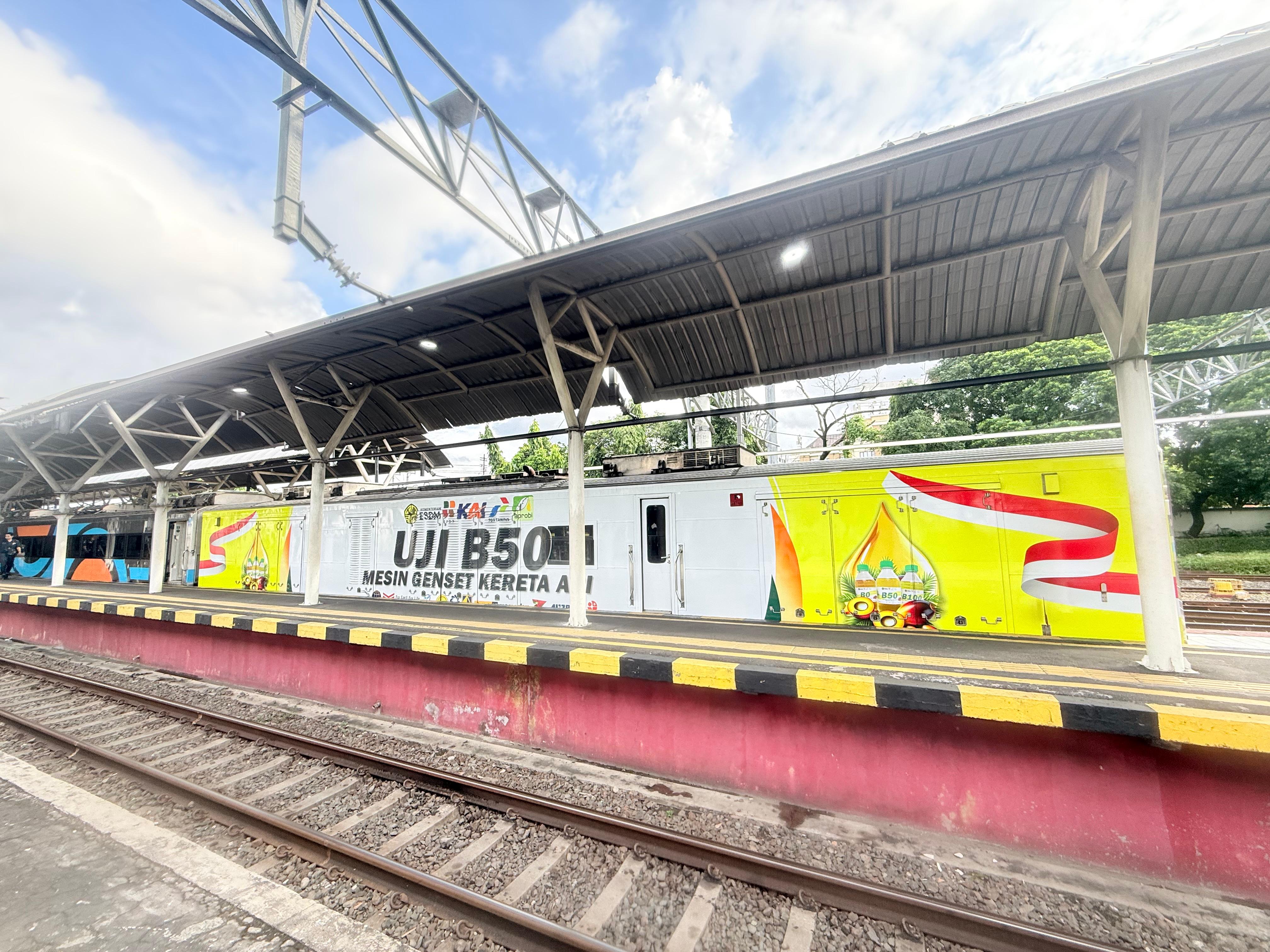
PT Kereta Api Indonesia (Persero) continues to demonstrate its commitment to supporting the national energy transformation by increasing the use of biodiesel in its railway operations. This move aligns with the government’s policy to expand the utilisation of new and renewable energy, strengthen energy security, and reduce carbon emissions from the transport sector.
KAI’s biodiesel implementation is carried out in stages, following the government’s mandatory programme. According to company data, biodiesel fuel usage has progressed from B0 in 2017 to B20 in 2018–2019, then increased to B30 in 2020–2022, B35 in 2023–2024, B40 in 2025–2026, and is targeted to reach B50 in 2026.
President Director of KAI Bobby Rasyidin assessed that the journey towards B50 usage is important evidence of the continuity of national energy policy and the readiness of transport operators to implement the policy optimally. “The transformation of Indonesia’s energy requires a transport sector that can adapt in a measured way. KAI is strengthening the role of railways through a biodiesel roadmap from B0 to B50, ensuring each stage proceeds in line with safety, service reliability, energy efficiency, and emission reduction,” said Bobby.
According to him, railway transport holds a strategic role as it connects public mobility, logistics distribution, and national emission reduction targets. With its extensive service coverage, every energy efficiency effort made by KAI has the potential to significantly impact public service quality and the competitiveness of the logistics sector.
“The railway works for the community and the national economy. Therefore, the energy transition at KAI must yield measurable benefits, from maintaining reliable services and increasingly efficient energy use to a clearer contribution to sustainability,” Bobby stated.
Meanwhile, Vice President of Corporate Communication at KAI Anne Purba explained that the biodiesel transition process is carried out in stages through intensive coordination with the government and various related institutions. According to her, each implementation phase must undergo comprehensive testing to ensure compatibility with the operational characteristics of railways, which require high reliability standards.
“KAI supports the government’s policy to expand the use of more environmentally friendly energy. At the same time, we ensure that each stage of biodiesel usage proceeds through technical testing and evaluation so that services to customers and the logistics sector remain safe and reliable,” said Anne.
Anne revealed that since April 2026, KAI, together with the Ministry of Energy and Mineral Resources (ESDM), has been conducting a series of technical tests on the use of B50 biodiesel in the railway sector. The tests cover locomotives and train generator sets to evaluate engine performance, fuel efficiency, emission levels, and equipment durability during operation.
For locomotive testing, KAI used a CC206 locomotive operated with the Sembrani train set. The test was conducted from Sidotopo Depot, comparing fuel consumption between B40 and B50. Meanwhile, generator set testing was performed on an MTU 2000 P02411 unit used on the Bogowonto train, with the test location at the Yogyakarta Train Depot.
The generator set testing series includes engine performance tests, fuel consumption efficiency, emission measurements using B40 and B50, and a six-hour static endurance test at maximum load bank capacity. After this phase, testing continues with a 2,400-hour dynamic endurance test that began on 27 April 2026 at PUK Lempuyangan. As of June 2026, KAI is still monitoring and evaluating the test results as a basis for wider B50 implementation.
“The test results form the basis of KAI’s evaluation, particularly regarding engine performance, fuel consumption, operational stability, filter condition, emission aspects, and maintenance requirements. Our principle is clear: the energy transition must proceed in line with safety and operational reliability,” said Anne.
In addition to energy transformation, the sustainability of railway services is also supported by the availability of subsidised fuel. For operational needs that still use subsidised fuel, KAI coordinates with the Downstream Oil and Gas Regulatory Agency (BPH Migas) and SKK Migas, while fuel supply is supported by PT Pertamina Patra Niaga. This collaboration is a crucial factor in maintaining the smooth operation of national transport and logistics distribution.
Based on monitoring data as of 5 June 2026, KAI has been allocated 214,342,000 litres of subsidised fuel for 2026. Of this amount, actual usage has reached 95,394,629 litres, or approximately 44.51 percent, leaving a remaining quota of 118,947,371 litres.
“The government’s support through subsidised fuel ensures that railway services remain available for the community and the logistics sector. During this energy transition period, this support helps KAI maintain operational continuity while gradually preparing for the use of lower-emission energy,” Anne stated.
In terms of sustainability, the B50 usage target is part of KAI’s decarbonisation programme for the 2025–2030 period. Through this programme, the increase in biodiesel usage from B35 to B50 is projected to reduce emissions by up to 133,676 tonnes of CO₂e. This contribution is the largest among the three main decarbonisation programme targets, which collectively aim to reduce emissions by 166,873 tonnes of CO₂e. The other programmes include conservation and carbon credits, as well as electricity efficiency.