
KAI Pursues Business Transformation, Targets 1.4 Billion Passengers per Year by 2045
PT Kereta Api Indonesia (Persero) or KAI is driving a business transformation to expand the company’s growth sources until 2045. The transformation is directed not only at improving transport business performance but also at optimising assets, technology, and company capabilities.
KAI President Director Bobby Rasyidin said that KAI’s future growth needs to be built by expanding the company’s sources of value. According to him, KAI’s increasingly large business scale opens opportunities to develop various new growth sources.
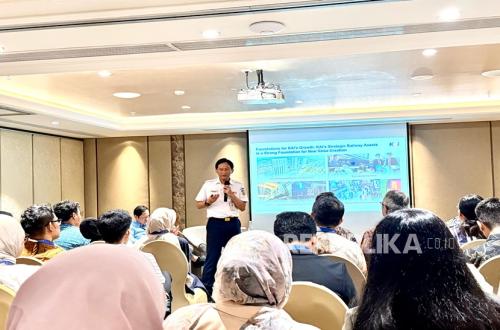
Bobby delivered this at the SBM ITB Industrial Summit 2026 at Hotel AYANA Midplaza Jakarta on Wednesday (19/8/2026). In the forum organised by the School of Business and Management Institut Teknologi Bandung (SBM ITB) in cooperation with Adam Smith Business School, University of Glasgow, Bobby was a speaker in the Parallel Session – Transportation Sector.
In his presentation titled ‘Growth Beyond the Limits: Transforming Railways for Indonesia’s Economic Future’, Bobby said the KAI Group recorded a volume of 503.5 million passengers throughout 2025. This figure increased by 8.52 percent compared to 2024, which reached 464 million passengers.
In addition to the large passenger volume, KAI also records around 2.8 million customer interactions every day. According to Bobby, this scale is an important asset for the company to create new growth sources.
‘KAI’s scale is already very large. The next challenge and opportunity is to increase the contribution of assets, technology, expertise, and the customer base as new growth sources that provide greater value for the company and the economy,’ said Bobby.
Bobby explained that currently around 94 percent of KAI’s revenue still comes from the transport business. Meanwhile, the contribution of non-farebox business is only around 6 percent.
This condition provides room for KAI to expand its revenue sources through four growth engines, namely operational assets, tangible assets, capability-based assets, and technology assets.
KAI has around 327.8 million square metres of railway land assets that can be developed more optimally. In addition, the large customer base also provides opportunities to develop various derivative services and businesses.
This development is carried out, among others, through the optimisation of areas and property, Transit-Oriented Development (TOD), digital services, maintenance, repair and overhaul (MRO), manufacturing, and the development of railway expertise.
‘Future growth must be more productive. KAI needs to be stronger in operations, more optimal in managing assets, and faster in utilising technology,’ said Bobby.
KAI’s business transformation is not only directed at improving company performance. According to Bobby, strengthening the role of railways is also important to improve national transport and logistics efficiency.
Increasing the use of trains for the mobility of people and goods is considered able to help strengthen the competitiveness of Indonesian industry. More efficient transport will support the movement of people, goods, and economic activity between regions.
On the other hand, KAI is beginning to encourage the use of artificial intelligence (AI) and digital technology to increase operational productivity. Technology is also directed at helping the company optimise the available railway network capacity.
In the roadmap towards 2045, KAI targets passenger volume to reach around 1.4 billion passengers per year. In the same period, the company also targets the contribution of non-farebox business to increase to around 20–25 percent.
This target reflects KAI’s efforts to reduce dependence on revenue from the transport business while creating new growth sources through business diversification.
‘We need to move from waiting for demand to creating opportunities. Advanced industries build opportunities, then growth follows,’ said Bobby.
Bobby emphasised that the transformation towards 2045 requires the company’s ability to read changes and develop growth sources sustainably. This effort also requires collaboration between KAI and the government, academics, industry players, and the public.
According to him, collaboration is an important part of building a railway ecosystem capable of answering Indonesia’s mobility needs and economic development.
‘Towards 2045, KAI is targeting a position as a world-class railway operator. To achieve this, we must strengthen productivity, expand growth sources, and ensure that railways make an increasingly greater contribution to Indonesia’s connectivity and competitiveness,’ concluded Bobby.