
KAI Prepares Study of FRMCS for Next-Generation Railway Communications
The study covers operational requirements, safety, communications networks, funding and stages of implementation.
Jakarta (ANTARA) – PT Kereta Api Indonesia (Persero) has begun preparing a study of the Future Railway Mobile Communication System (FRMCS) as part of its long-term planning for railway communications technology. FRMCS is a next-generation, 5G-based communications system designed to support the exchange of voice, data and video in railway operations.
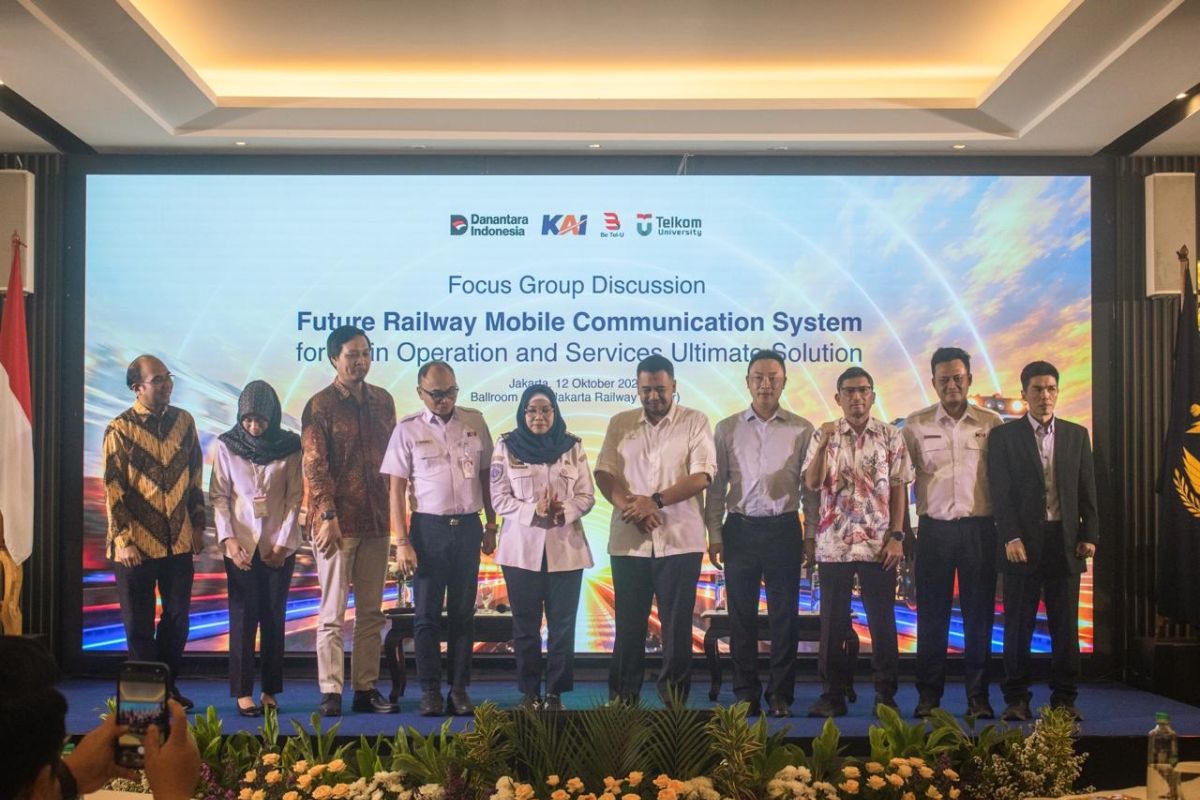
The discussion took place at a Focus Group Discussion on “FRMCS for Train Operation and Services Ultimate Solution” at Jakarta Railway Center on Monday (12 October). Participants included KAI, the Directorate General of Railways at the Ministry of Transportation, the Ministry of Communication and Digital Affairs, academics and telecommunications industry representatives. Topics included operational requirements, technological readiness, spectrum use, network provision options, funding and implementation stages.
KAI Director of Portfolio Management and Information Technology I Gede Darmayusa said FRMCS development needed to start with needs identified in the field. The technology must be relevant to railway operations and benefit safety, efficiency and service reliability.
“Technology must address real needs. That is why the FRMCS study considers various potential uses, from safety-related communications and train movement management to the maintenance of rolling stock and infrastructure, as well as requirements in emergencies,” I Gede said.
KAI’s study has identified several needs that FRMCS could support, including communication between railway staff and control centres, train location information, monitoring rolling stock condition, train management, level-crossing monitoring, disruption response and communications during emergencies.
According to I Gede, communications directly related to safety and operations must have a higher level of reliability than general communications services.
“In railway operations, some communications must be available at all times because they are related to the safety of train journeys. The system must be designed so that important information is delivered quickly, securely and with the appropriate priority,” he said.
FRMCS is also designed to enable multiple communications needs to operate on a single network with different priority levels. This approach would allow safety, operational and supporting communications to be managed according to their respective requirements.
Spectrum use is another subject covered by the study. Ministry of Communication and Digital Affairs Regulation No. 8 of 2026 on the Indonesian Radio Frequency Spectrum Allocation Table lists the 1,900–1,910 MHz band for FRMCS and advanced technologies for railway signalling.
Although the band is included in the regulation, its use still requires further testing and study. The frequency must be able to support stable railway communications without interference from nearby networks.
The FRMCS study also takes into account the varied communications systems currently used by the railway sector. Some services use analogue systems, while others have adopted digital technology according to their respective needs.
This means the transition to new technology will need to take place gradually. I Gede said existing systems must remain usable while preparations and development proceed.
“We have to consider current conditions, future needs, equipment readiness, regulations, investment and the transition process. Technological change must be planned carefully so that operations continue to run reliably,” he said.
KAI is also examining several options for providing the communications network. These could include building and managing the network itself or partnering with telecommunications operators. Each model will be assessed in terms of operational requirements, investment, security, management costs and the sustainability of its use.
FRMCS development is planned in several stages. The process will begin with mapping current conditions and KAI’s requirements, followed by system design, field testing, a limited pilot and potentially a phased operational rollout. The roadmap remains an initial recommendation and will be discussed further with regulators and relevant stakeholders.
“FRMCS is a long-term discussion. Our focus now is to ensure the study is thorough, so that any future decisions are based on operational needs, appropriate technology, sound investment calculations and regulatory support. Coordination with the Directorate General of Railways, the Ministry of Communication and Digital Affairs, academics and industry is an important part of this process,” I Gede concluded.