
KAI Managing Director Inspects Bogor and Bogor Paledang Station Developments as Capacity Readied for 12-Train Operations
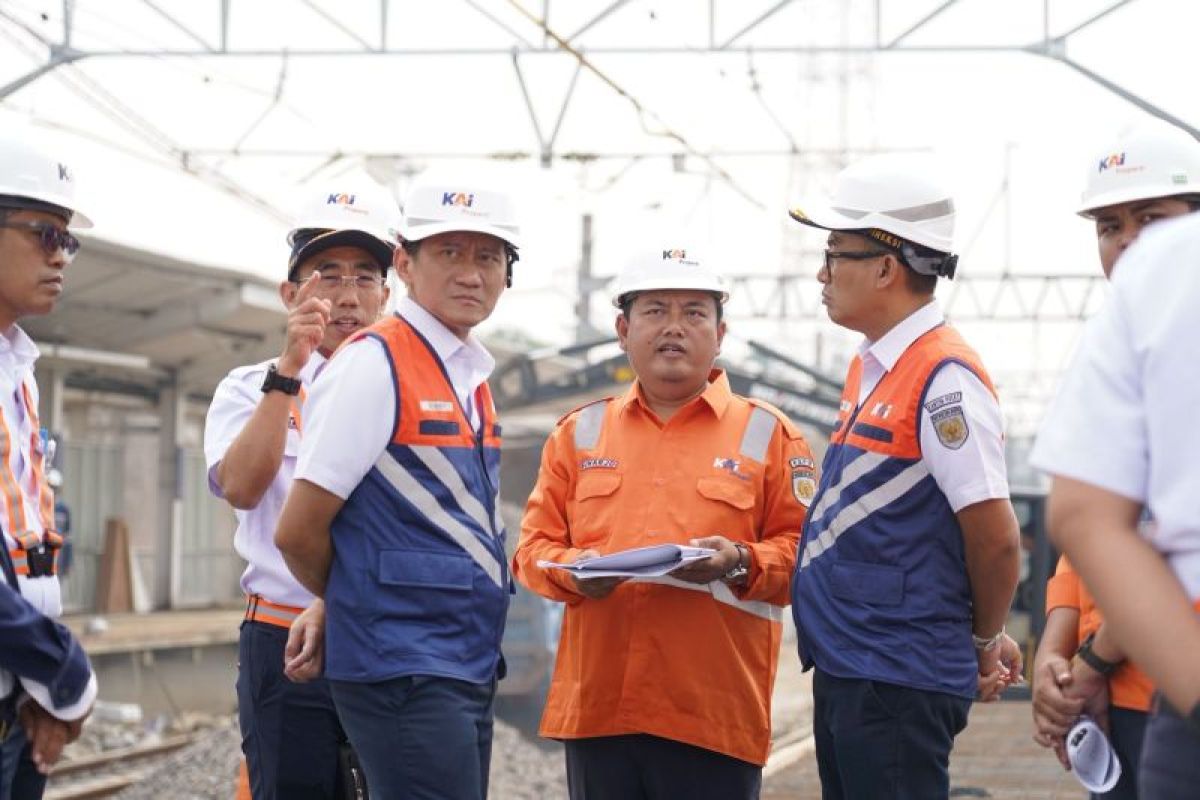
Platform works for tracks 6, 7, and 8 are progressing faster than target, accommodating Bogor Line passenger growth surpassing 155 million in 2025.
Bogor (ANTARA) – PT Kereta Api Indonesia (Persero), in collaboration with the Ministry of Transportation’s Directorate General of Railways (DJKA), is continuously preparing to enhance service capacity through the development of Bogor Station and strengthening connectivity at Bogor Paledang Station. During a site inspection of the track 6, 7, and 8 platform developments at Bogor Station on Monday, 1 June, KAI Managing Director Bobby Rasyidin stated that the accelerated progress is a crucial step to address growing public demand for Commuter Line services.
‘Alhamdulillah, the platform development works for tracks 6, 7, and 8 at Bogor Station are ahead of schedule. This acceleration is positive news as service capacity can be quickly enhanced to meet the growing mobility needs of Bogor Line passengers,’ said Bobby.
Platform development for tracks 6, 7, and 8 began on 15 April 2026 and is targeted for completion in July 2026. The platform extensions are to support the operation of 12-car Commuter Line trains (SF12), which have higher passenger capacity.
KAI Corporate Communications Vice President Anne Purba explained that Bogor Line passenger growth has been steadily increasing in recent years. In 2022, passenger volume was 102,054,022, rising to 133,040,885 in 2023, then 145,920,264 in 2024, and further increasing to 155,009,997 in 2025. By April 2026, passenger volume had reached 51,868,066. Over the past three years, Bogor Line passenger numbers have increased by approximately 52.9 million, a growth of 51.9 per cent.
According to Anne, this growth indicates that the Bogor Line has become a backbone of Jabodetabek mobility. As passenger numbers rise annually, demand for greater service capacity has increased both on trains and at stations. Commuter Line users are 91% of working age, with 52% travelling for work or school. Forty-two per cent are private sector employees, and 55% earn up to Rp5 million monthly. These figures highlight the strategic role of rail transport in supporting daily economic and social activities.
This dynamic is evident at Bogor Station, the starting and ending point for millions of passengers annually. As the main station on the Bogor Line corridor, passenger activity here continues to grow with rising mobility. In 2025, gate-in passengers reached 18,199,619 and gate-out 18,171,350, higher than 2024’s 17,124,802 gate-ins and 17,276,284 gate-outs. From January to April 2026, gate-ins totalled 6,140,074 and gate-outs 5,959,832.
This high passenger activity coincides with intense Commuter Line services. Currently, Bogor Station handles 392 Commuter Line trips on weekdays and 373 on weekends, making it one of the busiest stations in the Jabodetabek Commuter Line network.
Mobility growth in Bogor has also strengthened connections with surrounding areas. From Bogor Station, passengers can continue their journey to Sukabumi via Bogor Paledang Station, connected by a skybridge. This facility eases transfers between Commuter Line and Pangrango trains, while integrating with Trans Pakuan and JR Connexion services to expand travel options for Bogor residents.
This improved connectivity is reflected in rising Pangrango train passengers on the Bogor-Sukabumi corridor. Passenger numbers increased from 786,001 in 2023 to 874,789 in 2024, then to 1,109,398 in 2025. In the first quarter of 2026, the service handled 281,659 passengers. This growth trend underscores the strengthening Bogor-Sukabumi mobility link supported by rail transport.
Passenger growth on the Bogor Line, high activity at Bogor Station, and improved connectivity to Sukabumi underpin KAI’s efforts to strengthen service capacity on this corridor. Through the platform extensions for tracks 6, 7, and 8, Bogor Station is being prepared to support SF12 train operations with higher capacity per trip, optimising passenger distribution especially during peak hours. Beyond boosting capacity, the development also reinforces Bogor Station’s role as an integration hub connecting urban mobility with travel to southern West Java.
In addition to platform works, the development includes new canopies connected to station walkways to enhance passenger comfort during transfers and waiting. Works are currently in the stage of reinstalling overhead electrical line poles (LAA) and constructing new platform foundations. All works are being carried out progressively while ensuring railway safety and service continuity.
During the works process