
KAI Chief Seeks Parliamentary Approval to Manage Tracks, Stations, and Signalling Systems
PT Kereta Api Indonesia (Persero) has proposed a major overhaul in the governance of national railways. KAI is seeking support from the House of Representatives (DPR) and the government to be appointed as the Infrastructure Provider Business Entity (BUPP). This designation would grant the company the authority to directly manage various state-owned railway infrastructure assets, ranging from tracks and stations to signalling systems and other supporting facilities.
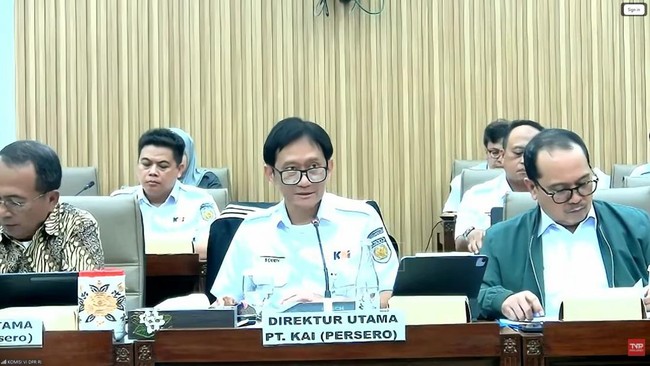
Bobby Rasyidin, President Director of PT KAI (Persero), stated that the proposal is currently being discussed with the government alongside plans to increase capacity and electrification for urban rail services. “The increase in electrification capacity for urban services, where the financing portion is currently being discussed with Danantara, involves infrastructure that is classified as State-Owned Assets (BMN). Therefore, we must enter into a concession agreement with the government. On the other side, we are also proposing to the State-Owned Enterprises Agency and the Ministry of Transport to issue a Presidential Regulation to assign KAI as the BUPP,” Bobby said during a Hearing with Commission VI of the DPR RI at the Parliament Complex, Jakarta, on Wednesday (3/6/2026).
According to Bobby, if KAI is established as the BUPP, the company would not only be responsible for operating trains but would also possess full authority over the management of infrastructure assets currently held as State-Owned Assets. “Once established, as the infrastructure provider, there are four things we can do with these assets: first, planning; second, construction; third, operation; and fourth, commercialisation,” he explained.
This implies that KAI would be able to plan network expansions, construct new infrastructure, operate railway facilities, and optimise economic value through various commercial schemes. Currently, Bobby noted that the management of railway infrastructure assets remains highly complex. State-owned infrastructure is maintained through the Infrastructure Maintenance and Operation (IMO) scheme, where the government pays maintenance costs to KAI. Simultaneously, KAI is required to pay a Track Access Charge (TAC) to use the infrastructure for train operations.
“Currently, the treatment is that these are State-Owned Assets; they are maintained by the state, and the state pays IMO to us for maintenance tasks assigned by the Ministry of Transport. However, when we use these assets, we must pay the TAC, making the process very complex,” Bobby explained. He added that appointing KAI as the BUPP would simplify this governance and eliminate the annual disputes regarding the IMO and TAC schemes that frequently arise between KAI and the government. “We have now reached an agreement with the Ministry of Transport to initiate the assignment of KAI as the BUPP, so that there will be no more recurring conflicts between IMO and TAC in the future,” he concluded.