
KAI Chief Reveals Rp350 Trillion Requirement for Ambitious Sumatra Railway Project
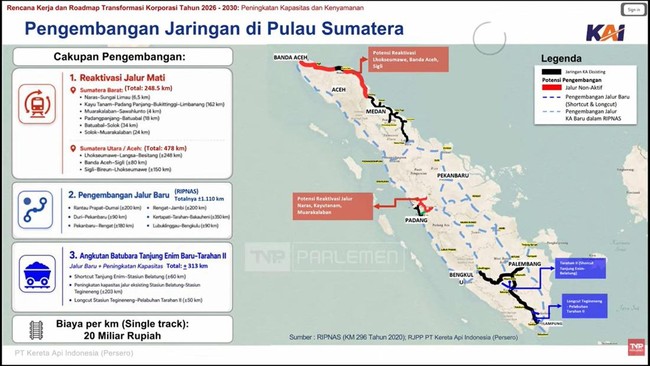
PT Kereta Api Indonesia (Persero) has revealed that the investment required to construct a railway network connecting Bandar Lampung to Banda Aceh reaches approximately Rp350 trillion. This figure represents one of the greatest challenges in the plan to develop an integrated rail corridor on Sumatra Island, as directed by President Prabowo Subianto.
The President Director of PT KAI (Persero), Bobby Rasyundari, stated that the Sumatra railway connectivity project is still in the assessment stage. However, based on preliminary calculations, the investment needed to build the rail network from the southern tip to the northern tip of Sumatra amounts to tens of billions of US dollars.
“If we look at the total for the Sumatra rail network development, it could be around US$20 to US$25 billion, or approximately Rp350 trillion from end to end,” Bobby said during a Hearing with Commission VI of the Indonesian House of Representatives (DPR RI) in the Parliament Complex, Jakarta, on Wednesday.
He explained that the project is a follow-up to President Prabowo’s directive to develop a railway network capable of connecting all regions of Sumatra within a single corridor. Currently, the railway network in Sumatra is not fully connected and operates in separate segments across various regions, including sections from Bandar Lampung to Palembang, Lubuk Linggau, Medan, and Padang.
As an initial phase, KAI is prioritising the construction of a line connecting Banda Aceh to Besitang in North Sumatra. This section spans approximately 478 kilometres, and the Detailed Engineering Design (DED) is currently being prepared.
To manage this project valued at hundreds of trillions of rupiah, the government has formed a special team involving several ministries and agencies. This team is tasked with studying everything from technical aspects to project financing schemes. The team includes the Coordinating Ministry for Infrastructure and Regional Development, Danantara, and the Ministry of Transportation.
Despite the scale of the plan, neither the government nor KAI has yet determined the funding sources to be used for the project. Notably, the planned railway line, spanning nearly 1,700 kilometres, is intended to be built with double-track capacity from the outset, following the President’s specific instructions. Bobby acknowledged that constructing such an extensive network will be a long-term endeavour, likely spanning multiple budget years.