
KAI Chief: Disused Railway Lines Do Not Fall Under Agrarian Reform Category
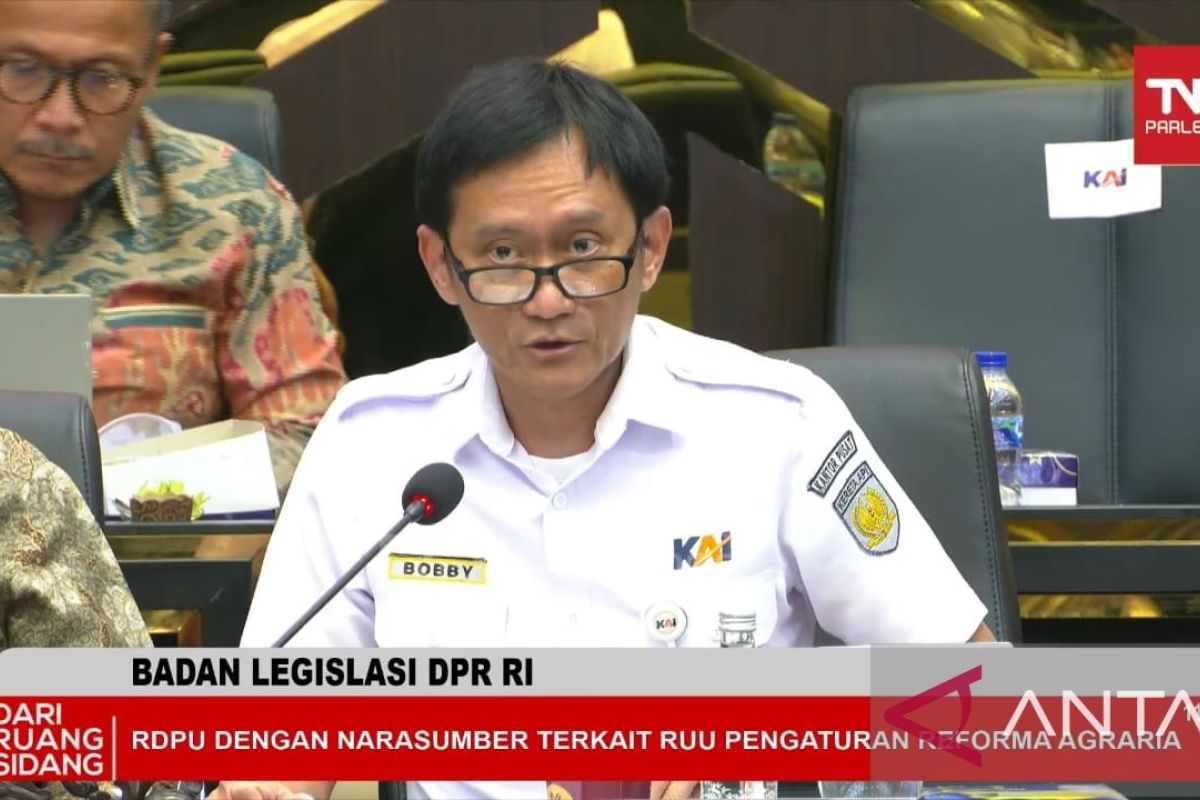
Jakarta (ANTARA) - The President Director of PT Kereta Api Indonesia (Persero), Bobby Rasyidin, has said that railway lines no longer in operation are not idle assets and cannot automatically be categorised as assets suitable to become objects of agrarian reform.
Bobby stressed that PT KAI will re-optimise a number of railway lines currently not in operation as part of the company’s land assets being prepared for its reactivation programme.
“For lands that were formerly dead lines, we have a programme to carry out reactivation in accordance with the President’s mandate to strengthen railway lines throughout Indonesia,” Bobby said during a discussion of the Agrarian Reform Bill with the House of Representatives’ Legislation Body (Baleg) DPR RI, attended online in Jakarta on Tuesday.
Several lines included in the plan are the Aceh-Besitang route, routes in West Sumatra stretching around 248 kilometres, and a number of segments on Java such as Bandung-Soreang-Ciwidey, Central Java and East Java.
Based on state-owned enterprise regulations and their derivatives, along with the company’s internal rules, PT KAI is actively conducting an inventory of dormant land to be reactivated, as well as outreach to ensure the land is leased to KAI as its owner.
Because the land is still required for railway network development plans, KAI considers it inappropriate for the land to be directly designated as an object of agrarian reform merely because it is not currently used for operations.
KAI recorded total corporate land assets of approximately 327 million square metres. Of that figure, around 54 million square metres overlap with State-Owned Property (BMN), particularly in areas related to railway right-of-way and railway-owned spaces.
In addition, around 27 million square metres of KAI’s land assets remain in dispute with residents and third parties.
In managing its assets, KAI said land use is directed not only at supporting railway operations or farebox business, but also at developing non-farebox business, both directly and in cooperation with other parties.
Some assets have also been used as leverage for the company’s investment and operational financing.
For land in conflict with other parties, KAI stated that it prioritises persuasive resolution. Should that approach fail, the company may take legal steps through enforcement or litigation against parties occupying the land without a legal basis.
KAI therefore considers that land asset management must be carried out with the company’s long-term needs in mind, including railway network development.