
KAI and BRIN Strengthen ATP Research to Support Railway Safety
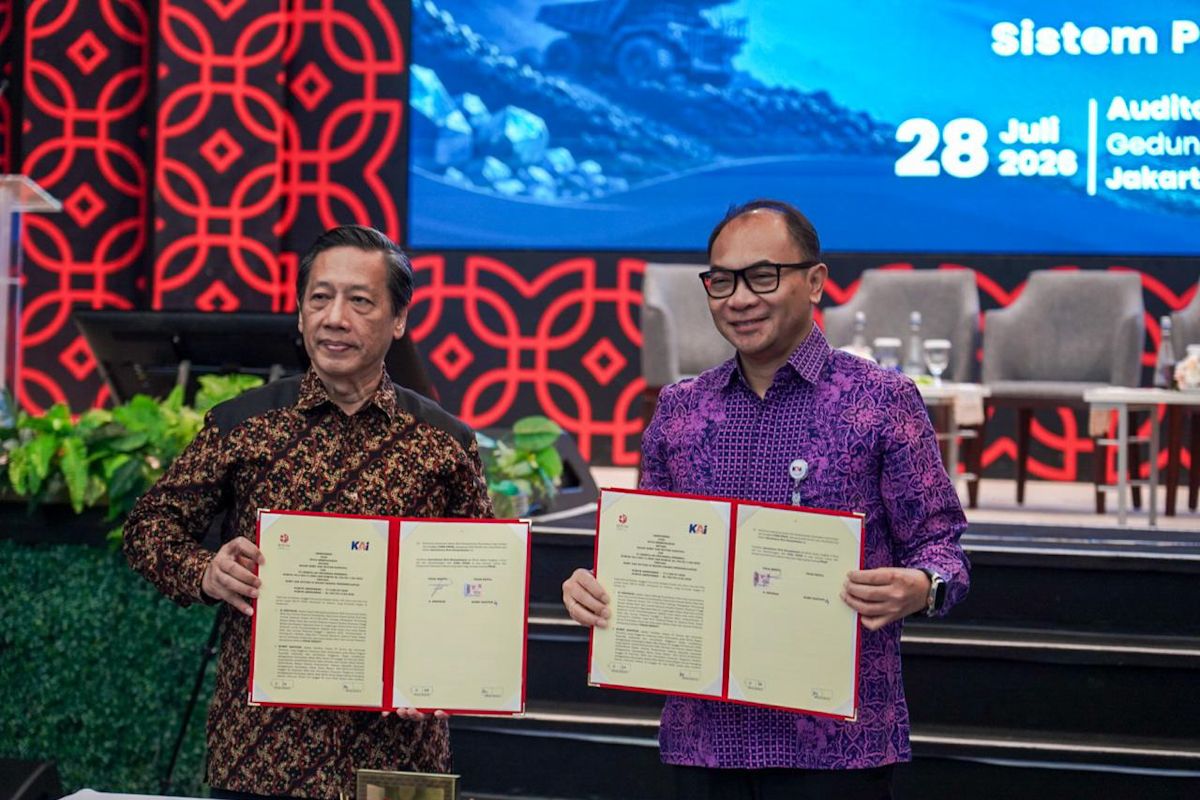
Jakarta - PT Kereta Api Indonesia (Persero) and the National Research and Innovation Agency (BRIN) are strengthening research into Automatic Train Protection (ATP) to improve safety, operational reliability, and the sustainable development of national railway technology.
KAI’s Director of Portfolio Management and Information Technology, I Gede Darmayusa, stated that ATP development requires measured stages of study, testing, and evaluation because it must adapt to Indonesia’s railway operational conditions. “Safety is the primary consideration in every technology adoption process at KAI,” I Gede said after signing a Memorandum of Understanding with BRIN during the BRIN Goes to Industry 5 event in Jakarta on Tuesday.
He said the collaboration is directed towards strengthening research, exploration, and adoption of railway technology, including ATP development. According to him, the collaboration with BRIN provides space for KAI to test various research-based technology alternatives so that implementation decisions have a strong technical, operational, and safety foundation.
ATP is a train journey protection system with three main functions: preventing trains from passing signals in a stop condition, known as Signal Passed at Danger, supervising travel speed, and conveying operational information to the driver. The system requires integration between devices installed on the infrastructure and onboard devices on locomotives or powered trains. The technology development refers to Minister of Transportation Regulation Number 52 of 2014 concerning the obligation to implement Automatic Train Control Systems.
In the division of responsibilities, the infrastructure manager determines the system installed on the track, while the rolling stock operator installs onboard devices compatible with that system. “KAI and BRIN will use a proof of product approach as a validation stage before determining the ATP technology to be adopted,” he explained.
This approach is used to validate the function, integration, and performance of the technology under conditions representing KAI’s operations, while also identifying gaps, mapping risks, and formulating adjustment and mitigation needs. Validation is necessary because KAI’s operational environment has a high level of complexity, including diverse train traffic, different rolling stock characteristics, variations in operational patterns, infrastructure complexity, interoperability requirements, and the use of technology from various providers. The process also considers data readiness, regulations, human resources, and maintenance systems.
The ATP development roadmap is structured in three stages. The first stage will be implemented in the third quarter of 2026 through the formation of an ATP Working Group involving KAI and the Directorate General of Railways. Alongside this working group, cooperation with BRIN will be carried out to study local ATP operational conditions, including standardisation, weather conditions, lightning strikes, and long-term maintenance sustainability.
The team will formulate the ATP adoption concept, functional requirements, implementation roadmap, consultant framework, study of rolling stock and infrastructure diversity, gap analysis, and technology recommendations. The second stage is planned for the fourth quarter of 2026, focusing on Proof of Product planning, formulation of design criteria, technical, operational, and safety requirements, as well as conducting market sounding with technology providers.
The third stage will run from the fourth quarter of 2026 until no later than the second quarter of 2027. This stage includes ATP technology validation through field tests, assessment and evaluation, as well as safety assessments of operational aspects and ATP products on both rolling stock and infrastructure. The prepared studies cover ATP technology based on onboard devices, balises or transponders on the track, and integration with signalling systems.
BRIN Head Arif Satria emphasised the importance of ensuring research results can be utilised by industry and generate economic, social, and environmental impacts. According to Arif, collaboration between researchers, government, and businesses is expected to accelerate the emergence of applicable innovations, increase productivity, open business opportunities, and support emission reduction and environmental management.
BRIN’s Deputy for Research and Innovation Utilisation, R. Hendrian, added that BRIN Goes to Industry 5 is designed to strengthen the collaboration framework between research institutions and industry. The activity includes technical discussions, business matching, showcasing of research results, and direct meetings between researchers and business actors, involving around 135 industries. He noted that the signing is part of a series of collaborations between BRIN and various industry players to accelerate the utilisation of research results in operational activities and technology development.