
KAI aims for Rp66 trillion revenue alongside rail network expansion
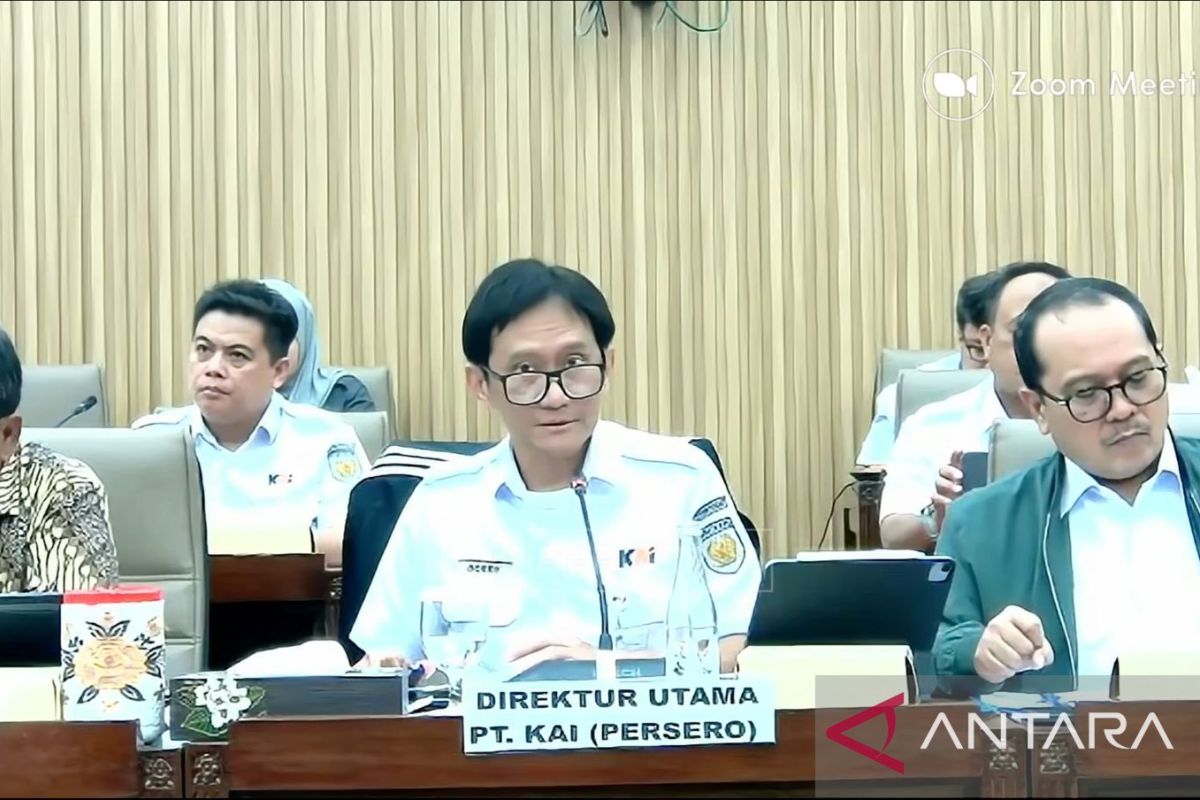
PT Kereta Api Indonesia (KAI) is targeting revenue of approximately Rp66 trillion by 2030, alongside the expansion of its rail network to over 7,000 kilometres, as outlined in the company’s 2025-204ng roadmap.
“Currently, the rail length is only 6,700 km, with company revenue at Rp35.7 trillion. It is expected that by 2030, the rail length will exceed 7,000 km with revenue reaching around Rp66 trillion,” stated the President Director of PT KAI, Bobby Rasyidin, during a Hearing with Commission VI of the Indonesian House of Representatives (DPR RI) in Jakarta on Wednesday.
Bobby explained that KAI has established a roadmap to achieve its vision of becoming a world-class operator based on standards set by the International Union of Railways (UIC). This transformation is divided into five stages leading up to 2045. The first stage, ‘establishment’, occurring in 2025, focuses on building the foundation for transformation and strengthening corporate credibility.
In the second stage, arriving in 2030, the company aims to enhance core capabilities to meet international standards. Bobby noted that this stage serves as an inflection point for broader network development by 2035. He remarked that the active rail length in Java is currently less than 7,000 km, whereas it reached 10,000 km during the Dutch colonial era, suggesting that the current focus is not merely adding tracks in Java but addressing the reduction in existing coverage.
By the third stage in 2035, KAI intends to operate a more integrated and productivity-oriented railway system. Development priorities include expanding passenger rail networks, optimising and scaling up freight services, developing Transit Oriented Development (TOD) in priority areas, and creating value through business exploration.
“Regarding TOD in priority areas, we have started in Manggarai and will continue in Kampung Bandan. We have also planned developments in Semarang, Surabaya, and Bandung,” said Bobby. He noted that 96 per cent of KAI’s revenue still comes from farebox and logistics, while TOD contributes only about 4 per cent. For comparison, he cited Japan Railways (JR), which derives approximately 40 per cent of its revenue from TOD development.
Consequently, KAI is working to strengthen non-transport revenue through various TOD projects, including the construction of mid-to-low-cost housing in the Manggarai area, which is targeted for completion in 2027. “The Manggarai TOD is currently in the construction phase, involving nearly 5,000 housing units,” he added.
In the subsequent stage, targeted for 2040, KAI will focus on sustainably increasing the rail modal share for both passengers and freight, expanding TOD, and increasing revenue from business exploration. This includes plans for integration between PT KAI and INKA. Bobby noted that while maintenance and MRO (Maintenance, Repair, and Overhaul) currently take place at KAI’s Balai Yasa while manufacturing is handled by INKA, the future roadmap involves integrating these technology-based industries.
KAI’s total revenue reached Rp35.7 trillion in 2025. Passenger transport revenue rose by 8 per cent year-on-year from Rp11.9 trillion to Rp12.9 trillion, while freight revenue saw a 1 per cent decrease from Rp12.8 trillion to Rp12.7 trillion. In terms of profitability, the company’s profit increased by 2 per cent year-on-year from Rp2.2 trillion to Rp2.3 trillion, and EBITDA grew by 7 per cent from Rp7.8 trillion to Rp8.3 trillion. Furthermore, KAI’s contribution to state revenue increased significantly from Rp4.4 trillion in 2024 to Rp6.8 trillion in 2025.