
Kadin proposes three ways to boost trade among BRICS nations
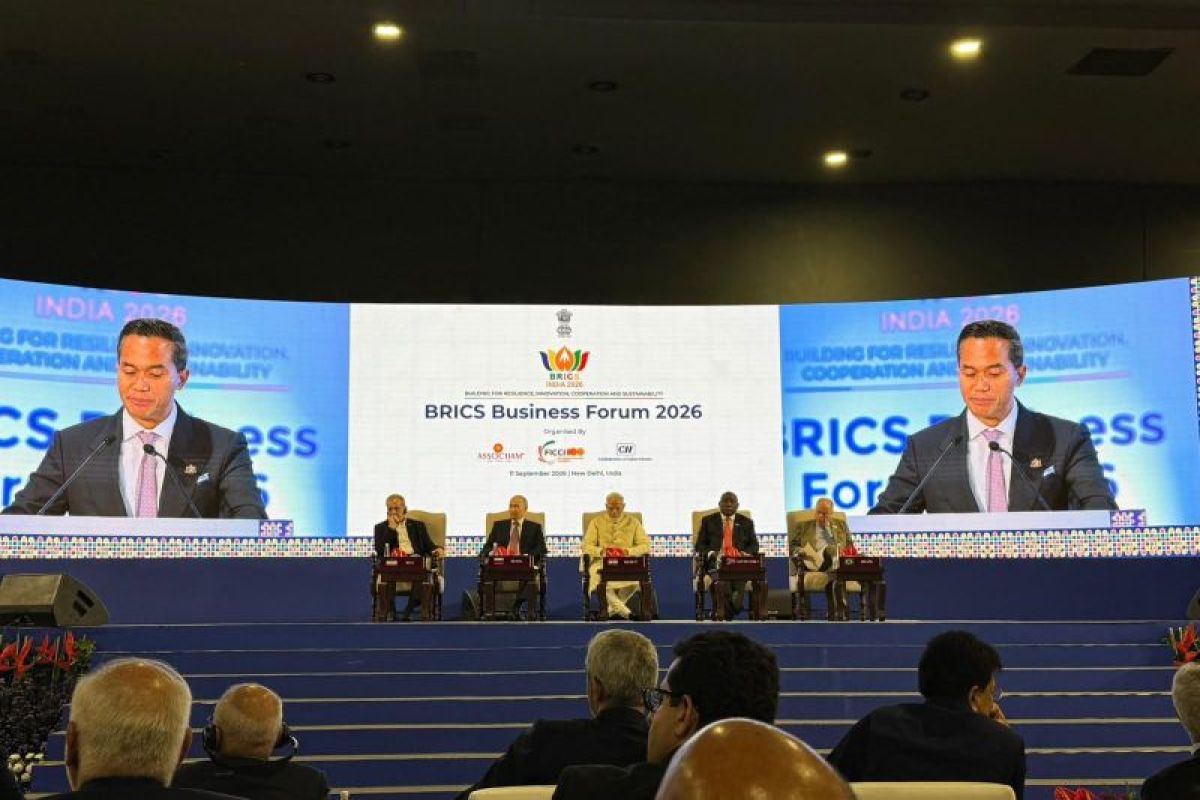
The General Chair of the Indonesian Chamber of Commerce and Industry (Kadin), Anindya Novyan Bakrie, has proposed three measures to strengthen trade and services among BRICS member nations. These steps include facilitating the mobility of companies and professionals, strengthening the connectivity of cross-border payment systems, and increasing investment in human resources and services trade infrastructure.
Anindya presented these proposals during the BRICS Business Forum 2026 held in New Delhi, India, on Friday. For the first step, Anindya encouraged BRICS to simplify the mobility of companies and professionals across borders. He suggested that the BRICS Business Council needs to identify concrete obstacles faced by the business community and then present specific solutions to the respective governments. Mutual recognition of certain professional qualifications and easier business travel could accelerate transactions and investment. He also proposed the development of a BRICS Business Travel Card to support business mobility.
The second step involves connecting and strengthening cross-border payment systems, particularly digital payments. Anindlam noted that India, Brazil, and China have demonstrated the significant potential of real-time payments. The challenge lies in making these payment systems interconnected and efficient for cross-border transactions. Furthermore, BRICS should expand the use of local currencies in trade transactions, provided that data security and financial system stability are maintained. “Financial sovereignty does not have to mean financial isolation,” said Anindya, who also serves as the Chair of the BRICS Business Council Indonesia.
This proposal aligns with discussions at the BRICS Business Forum regarding payment system connectivity, increasing transactions using local currencies, and developing fast, cheap, and secure cross-border payment mechanisms.
The third step involves encouraging BRICS nations to increase investment in human resources and the infrastructure supporting services trade. The business community, according to Anindya, needs to enhance worker training, build collaborations with universities, and assist companies—especially micro, small, and medium enterprises (MSMEs)—in utilising Artificial Intelligence (AI). Anindya proposed that every branch of the BRICS Business Council should have measurable targets regarding the number of workers trained annually. He also suggested that the New Development Bank could play a role in financing digital networks, training, and supporting infrastructure development.
Anindya emphasised that new member states, such as Indonesia, must help determine the BRICS agenda rather than merely serving as a market for products and companies from earlier members. Every partnership, he stated, should build domestic capabilities so that citizens across all member nations can act as both service providers and users. He described true BRICS integration as an ecosystem where micro and small business owners in Surabaya, Sao Paulo, Durban, and Alexandria can find customers, offer services, and receive payments through the BRICS economic network. “That is the test for truly meaningful BRICS integration,” he said.
In the forum, which was also attended by Indian Prime Minister Narendra Modi, Russian President Vladimir Putin, South African President Cyril Ramaphosa, and Iranian President Masoud Pezeshkian, Anindya asserted that Indonesia does not wish to be just a new market, but also wants to help shape the direction of BRICS economic cooperation. He noted that Indonesia now has an active branch within the BRICS Business Council, allowing it to drive agendas in trade, investment, industry, technology, and services among member nations. “We are very pleased and honoured that Indonesia has joined the BRICS family thanks to President Prabowo. Indonesia now has a very active chapter within the BRICS Business Council,” said Anindya.