
Kadin Promotes Regenerative Forestry Businesses to Support Indonesia’s Bioeconomy Transformation
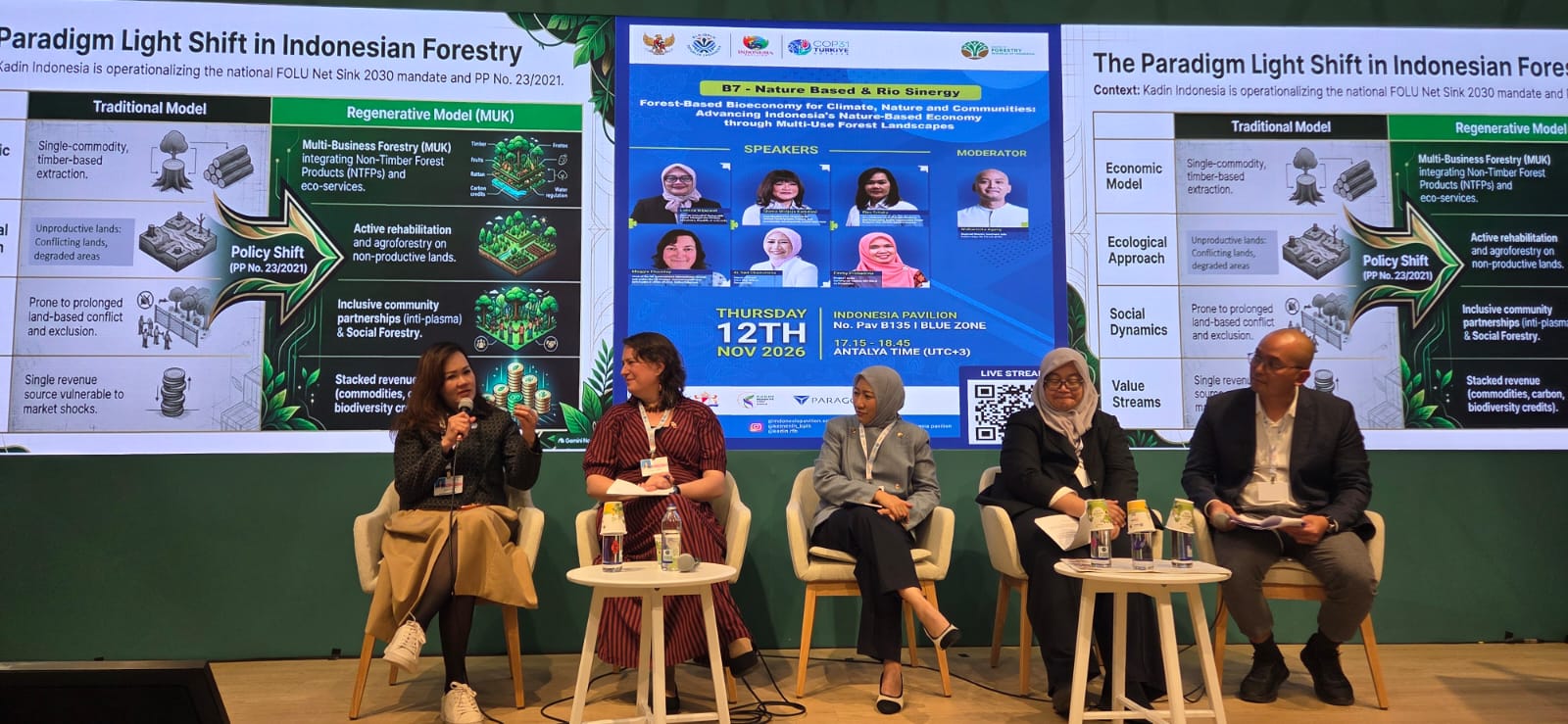
The Indonesian Chamber of Commerce and Industry (Kadin) is promoting regenerative forestry businesses as part of Indonesia’s bioeconomy transformation, supporting climate action, biodiversity conservation and community welfare. Through the Kadin Regenerative Forest Business Hub (RFBH), it aims to strengthen collaboration between the government, businesses, communities and international partners to expand the sustainable use of biological resources and increase their added value through innovation, investment and market development.
Shinta Widjaja Kamdani, Kadin Indonesia’s Coordinating Deputy Chair for Human Development, Culture and Sustainable Development, called for the development of a forest-based bioeconomy to increase economic value while supporting climate action and community welfare.
“Indonesia’s biological wealth needs to be developed into a source of sustainable economic growth through the regenerative and sustainable use of forests in partnership with local communities. To achieve this, businesses need to strengthen partnerships with the government, communities and development partners,” Shinta said.
She made the remarks in her closing address at the dialogue “Forest-Based Bioeconomy for Climate, Nature and Communities: Advancing Indonesia’s Nature-Based Economy through Multi-Use Forest Landscapes”, organised by the Kadin RFBH at the Indonesia Pavilion at COP31 in Antalya, Türkiye, on Thursday, 12 November 2026.
Shinta said that stronger regenerative forestry businesses needed to be linked with industrial innovation, market development and access to investment. Such partnerships are necessary to ensure that the use of biological resources supports business growth while protecting ecosystems and community livelihoods.
On the government side, Laksmi Wijayanti, Director General of Sustainable Forest Management at the Ministry of Forestry, emphasised the role of sustainable forest use in meeting Indonesia’s nationally determined contribution (NDC) targets, its FOLU Net Sink 2030 target and the development of a forest-based bioeconomy.
“Multi-use forestry policy aims to increase the added value of forest products while carrying out forest rehabilitation with communities through social forestry schemes, including customary forests. These efforts are being developed into value chains so that economic benefits are shared more widely and fairly among stakeholders,” Laksmi said.
She said the development of traceable, deforestation-free forest products across landscapes needed to be supported by business partnerships, including financing. Sustainable landscape management provides the basis for maintaining these economic benefits over the long term.
Elim Sritaba, Kadin Indonesia’s Deputy Chair for Business and Sustainable Governance, outlined the RFBH’s approach to creating added value through productive, inclusive and regenerative landscape-based forestry businesses. The RFBH plans to expand the implementation of multi-use forestry (MUK) from 2027 to 2029, aiming to reach at least 10 Forest Utilisation Business Licence (PBPH) units and social-forestry sites.
This phase will build on efforts to strengthen the foundations from 2022 to 2025 and pilot projects from 2025 to 2027. “We are ready to partner in expanding regenerative forestry, promoting social inclusion and contributing to global climate and biodiversity targets,” Elim said.
Kadin projects that MUK development on unproductive land, through agroforestry, could cover 1.8 million hectares. The initial phase aims to establish 10 MUK pilots between 2025 and 2029, before full implementation. The projected gross revenue from the target is Rp814 trillion per production cycle, with the potential to create 1.4 million jobs.
Elim highlighted the need for long-term financing, guaranteed buyers, policy support and community partnerships with inclusive benefit-sharing. Pilot locations currently being developed include the Bentala landscape in East Kalimantan and Kubu Raya in West Kalimantan, with plans to expand to other landscapes in Sumatra and Kalimantan.
ParagonCorp Deputy CEO Dr Sari Chairunnisa emphasised the private sector’s role in creating markets for a forest-based bioeconomy through value chains that support nature conservation. Research and innovation in raw materials, she said, can connect Indonesia’s biological wealth with industry needs.
“Sustainability underpins our decisions and innovation priorities, and shapes how we create long-term value,” Sari said. She cited Sulawesi patchouli, which is being explored for skincare; Kalimantan tengkawang, which is being developed as a local alternative to shea butter; and microalgae research in West Java in partnership with the National Research and Innovation Agency (BRIN).
For patchouli, strengthening the value chain involves regenerative cultivation, bioprospecting and research, standardised ingredient extraction, and product formulation. Sari also stressed the importance of quality, safety and responsible practices at every stage, alongside fairer market access for communities. Her remarks also covered the link between corporate decarbonisation and Indonesia’s transition to a low-carbon economy, including the role of Kadin Net Zero Hub.
The development of value chains based on biological resources and the reduction of industrial emissions are intended to complement one another in supporting national climate commitments. Maggie Charnley, Head of the International Forests Unit at the UK Foreign, Commonwealth & Development Office (FCDO), highlighted the role of international partnerships and development finance in expanding a sustainable and inclusive forest bioeconomy.
“Development finance can help prepare viable business models and open up access to investment for sustainable forest management. Partnerships must ensure that economic benefits go hand in hand with biodiversity protection and the empowerment of local and Indigenous communities,” Maggie said.
She said exchanges of experience between countries could help develop business models, innovative financing and partnerships tailored to the needs of each landscape. Kadin RFBH Coordinator Rukmantara said the planned landscape-based MUK pilots were aligned with the 2025–2029 National Medium-Term Development Plan (RPJMN), which sets a target of 10 pilots with a minimum investment of Rp1.2 trillion.
“Over the next three years, Kadin RFBH will focus more on developing MUK in unproductive forest areas, applying agroforestry in partnership with communities to build business ecosystems across landscapes,” Rukmantara said.
In parallel, Kadin RFBH is working with stakeholder initiatives to develop innovation and explore biodiversity credits as a market mechanism for MUK, alongside the carbon market already in operation. The dialogue underscored the importance of connecting sustainable forest management with industrial needs, long-term financing and market access to expand the forest-based bioeconomy.
Through stronger partnerships, Kadin RFBH is promoting regenerative forestry businesses that support national climate targets, create jobs and ensure fair benefit-sharing for local and Indigenous communities.
Source: jawawa.id (https://jawawa.id/newsitem/kadin-promotes-regenerative-forestry-businesses-to-support-indonesias-bioeconomy-transformation-1794509431)
Originally published by forestinsights.id (https://forestinsights.id/kadin-dorong-bisnis-kehutanan-regeneratif-mendukung-transformasi-bioekonomi-indonesia/), translated from Indonesian