
Kadin Indonesia Visits China to Boost Trade and Investment
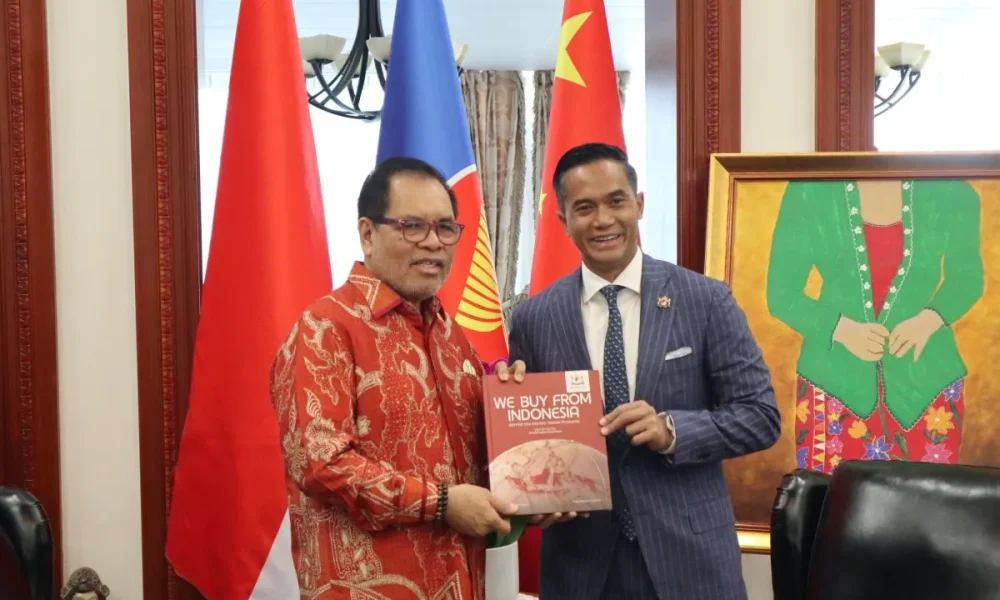
A delegation from the Indonesian Chamber of Commerce and Industry (Kadin) visited China in an effort to strengthen economic cooperation and increase the value of trade and investment between the two countries. Kadin Indonesia Chairman Anindya Novyan Bakrie said the visit aimed to boost the volume of Indonesia–China trade, which is currently seen as needing improvement to be more competitive in the Asian region. “Our first target here is how to help increase Indonesia-China trade. It was mentioned that Indonesia-China trade is 168 billion US dollars, but it is still below Malaysia and Vietnam. If it can be increased, that would be good,” Anindya said at the Indonesian Embassy in Beijing on Sunday (21/6). Anindya, also known as Anin, explained that he was in China to attend a number of agendas, including the China International Supply Chain Expo, the APEC CEO Forum in Beijing, Summer Davos 2026 in Dalian, and various meetings with other business partners. The trade value between Indonesia and China was recorded at 167.48 billion US dollars in 2025, with Indonesian export growth of 16.7 percent. When combined with Hong Kong, which reached around 6 billion US dollars, total trade between the two territories reached approximately 173 billion US dollars. However, this figure still lags behind Malaysia, which recorded 191.66 billion US dollars, and Vietnam, which is China’s largest trading partner in ASEAN with a value reaching 296.14 billion US dollars. Anin noted that trade does not only rely on major commodities such as palm oil, coal, and steel, but also covers various sectors with smaller volumes that have great potential for development. Beyond trade, Kadin Indonesia is also targeting increased investment from China into Indonesia. According to Anin, investment is needed to support national economic growth of up to 8 percent and to create new jobs. “The goal is to increase both trade and investment figures,” he said. Kadin Indonesia is also using this visit to expand cooperation and knowledge transfer from business partners in China, particularly in strengthening more transparent, sustainable, and competitive business practices. Several strategic sectors are also a focus of cooperation, including energy transition, healthcare, and agriculture. In the energy sector, Indonesia has great potential from coal, oil and gas, and critical minerals that can be developed through downstream processing and modern manufacturing technology. China is also considered to have advantages in developing renewable energy such as solar, wind, and hydro power, which can become opportunities for joint investment. In the healthcare sector, the increasing need for health services as the population grows presents cooperation opportunities, including in technology development and disease prevention. Meanwhile, in the agricultural sector, Kadin is encouraging the application of smart agriculture based on technology and artificial intelligence to increase productivity and absorb labour. “China is a patient and long-term oriented investor. We hope this cooperation also includes human resource capacity building so that industrialisation and digitalisation can proceed more quickly,” said Anin. Indonesian Ambassador to China and Mongolia, Djauhari Oratmangun, mentioned that in 2025, Chinese investment in Indonesia reached approximately 7.58 billion US dollars, while Hong Kong contributed around 10.1 billion US dollars. Combined, total investment reached about 18 billion US dollars, making China and Hong Kong one of the largest sources of foreign investment for Indonesia.