
KAAN Not Yet Ready, Turkey Seeks 24 Eurofighters from Qatar and Oman
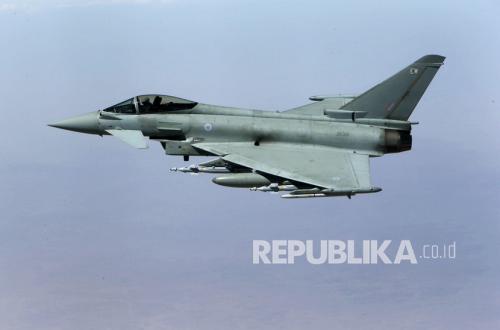
JAKARTA — Turkey is stepping up efforts to strengthen its fighter fleet by seeking an additional 24 Eurofighter Typhoon aircraft from Qatar and Oman. The move comes as Ankara develops its own fifth-generation fighter, KAAN, which is expected to become the backbone of Turkey’s air force in the future.
The decision to pursue the European consortium-built fighter highlights the challenges Turkey faces in maintaining military readiness. Ankara is seeking defence technology independence through KAAN, while its air force needs modern combat aircraft that can be operated before the domestic programme reaches full combat readiness.
Turkey’s Defence Ministry said it was still awaiting a draft sales contract and training programme from Qatar. The statement was made at the ministry’s regular briefing on Thursday (22 October 2026), Reuters reported.
Turkey previously signed a deal to buy 20 new Eurofighter Typhoons from the UK in October 2025. Ankara is also seeking 24 additional aircraft from Qatar and Oman, hoping to acquire them sooner by taking over planes already owned by the two countries.
If all the plans go ahead, Turkey could operate 44 Eurofighter Typhoons. That would significantly strengthen an air force that has relied heavily on US-made F-16 fighter jets for decades.
However, the purchase of the additional 24 aircraft has not been finalised. Negotiations are continuing and separate contracts with the aircraft-owning countries will be required.
Turkey’s Defence Ministry said delegations from Ankara and Doha had held meetings in August and September 2026. Discussions covered the types of aircraft and munitions to be acquired, as well as training for pilots and maintenance personnel.
Qatar is expected to prepare a draft training programme and sales contract to submit to the Turkish government.
The developments underline that fighter-jet procurement involves more than the delivery of aircraft. Pilots, technicians, maintenance facilities, weapons and support systems must also be ready for the planes to be used effectively.
Ageing F-16s and a KAAN not yet ready to replace them
Turkey’s main challenge is the need to modernise its fighter fleet relatively soon.
For decades, the F-16 has been the backbone of Ankara’s air power. The aircraft has been used for airspace patrols, national defence and various military operations.
However, some of Turkey’s F-16 fleet consists of older variants that have been in service since the 1980s and 1990s.
The Poland-based Centre for Eastern Studies (OSW), in an analysis published on 3 April 2026, estimated that Turkey had around 230 to 240 F-16s, of which about 150 were operational. This was a think-tank estimate, not a recent official announcement by the Turkish Air Force.
According to OSW, most of the aircraft are Block 30, Block 40 and Block 50 variants. Turkey also has F-16 Block 50+ aircraft, delivered in 2011 and 2012.
This presents a challenge in maintaining combat capability as other countries begin operating aircraft with more advanced radar, weapons and electronic warfare systems.
Turkey is developing KAAN to replace some of its F-16 fleet in the long term.
But developing a fifth-generation fighter takes considerable time, involving tests of the airframe, engine, flight-control systems, radar, software and weapons integration.
A successful maiden flight does not automatically mean that an aircraft is ready for combat missions.
Before it can be widely used by an air force, an aircraft must undergo testing and certification, achieve production capacity, and have operational support systems developed.
Eurofighter Typhoon is therefore seen as one way to bridge the capability gap while KAAN remains under development.
Why choose the Eurofighter?
The Eurofighter Typhoon is a multi-role fighter developed through a partnership between the UK, Germany, Italy and Spain.
It is designed to carry out air-superiority missions as well as attacks on ground targets, depending on its configuration and weapons.
For Turkey, the Eurofighter offers combat capability that is already operational, unlike KAAN, which is still being developed.
The contract to buy 20 new aircraft from the UK is worth up to £8 billion, or about US$10.7 billion at the exchange rate cited when the deal was signed in October 2025.
However, that figure does not reflect the cost of the airframes alone.
Reuters reported, citing sources familiar with the deal, that the procurement package includes weapons, among them the long-range Meteor air-to-air missile and the precision-strike Brimstone missile.
The Meteor enables fighter aircraft to engage airborne targets at long range, while Brimstone is designed to strike surface targets precisely.
These weapons could enhance the Eurofighter’s capabilities across a range of combat scenarios.
Even so, an aircraft’s operational capability depends on its radar configuration, sensors, communications systems, weapons integration and crew training.
According to OSW, delivery of the 20 new Eurofighters is scheduled for 2030 to 2033.
That timetable helps explain why Ankara is not relying solely on new aircraft from the UK.
By acquiring used aircraft from Qatar and Oman, Turkey hopes to build its Eurofighter fleet sooner rather than wait for all the new planes to be produced.
However, speeding up the process will still depend on sales agreements, transfer authorisations, inspections of the aircraft and the readiness of training and logistics.
Source: jawawa.id (https://jawawa.id/newsitem/kaan-not-yet-ready-turkey-seeks-24-eurofighters-from-qatar-and-oman-1792734718)
Originally published by Republika (https://news.republika.co.id/berita/tncfre451/kaan-belum-siap-turki-buru-24-eurofighter-dari-qatar-dan-oman), translated from Indonesian