
Justice Saldi: Reading, Writing and Communication Are Key to Making an Impact
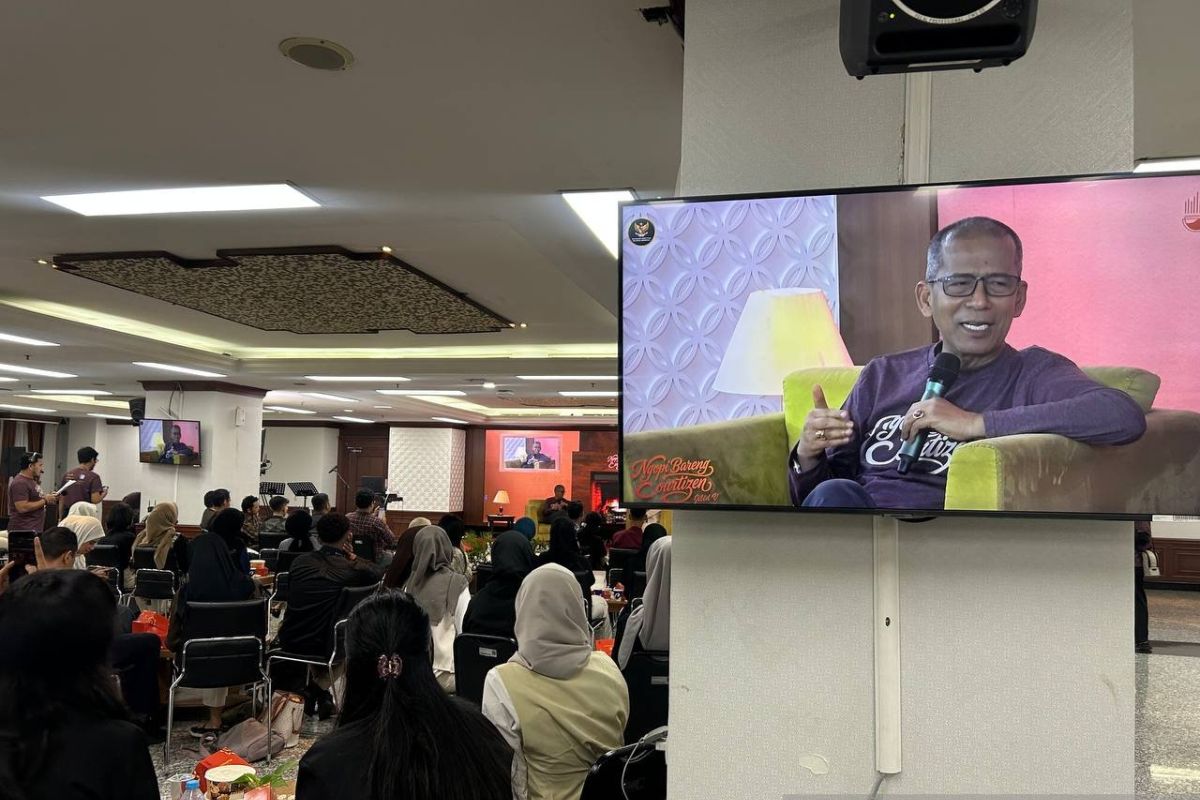
Jakarta (ANTARA) – Constitutional Court (MK) Deputy Chief Justice Prof. Saldi Isra has identified three keys to becoming a young person who can make an impact on the nation: reading, writing and communication.
Saldi shared the advice at the fifth Open House and Coffee with Courtizens talk show, held to mark Youth Pledge Day at the Constitutional Court building in Jakarta on Wednesday.
“From my observations, we really need to improve our interest in reading. Second, we need to improve our writing skills, and third, our ability to communicate,” Saldi said.
The judge, who is from West Sumatra, recounted a career path that Gen Z might describe as having “got lost on the way to the right destination”. He studied physics in secondary school, achieved the highest national examination score in Rayon 4 of West Sumatra and was top of his class for five semesters.
However, Saldi failed to gain admission to university through the academic talent selection route (PMDK) and the written entrance examination. At the time, he was aiming to study engineering at the Bandung Institute of Technology (ITB). He applied unsuccessfully to engineering programmes three times, in 1988, 1989 and 1990. Despite attending a six-month preparatory course, he still failed to get into his chosen subject.
On his fourth attempt, Saldi chose not to study at all, as he had begun thinking about how to support himself. Engineering remained his first choice, but he was unsure what to put as his third option until a friend suggested law school.
“I actually knew nothing about studying at a law faculty. In my first semester, I did nothing but complain. Physics and mathematics are different: you master formulas and solving problems is straightforward. At law school, you have to read lots of books, lots of articles and all sorts of things,” he said.
Saldi earned a grade point average of 3.71 in his first semester at law school. He then worked to improve his performance, earning a perfect 4.00 in the second semester.
“That was when I began to realise that perhaps I had a talent for studying law,” he said.
Saldi said the three habits he developed during his education had become the foundation of his career, eventually enabling him to become deputy chief of the institution known as the guardian of the Constitution.
In 1994, Saldi wrote his thesis on judicial review and the authority to review legislation, at a time when few legal practitioners had written about the subject. One earlier example was a 1993 work by Prof. Sri Soemantri.
He stressed that young people, particularly those studying social sciences, should improve their reading and writing skills.
“If you read widely and then follow that with writing, you will move towards a more complete set of skills, alongside the third ability: communicating well. If you have these three foundations, I do not think there is anything to stop you from becoming part of a better generation,” he said.
He cited Rian Fahardhi, founder of Distrik Berisik and Sekolah Tanah Air, who had spoken at the same event before Saldi, as an example of a young person with all three abilities.
Saldi said Rian was able to express his ideas orally very well, was rarely served with legal notices or reprimanded, and was understood by many people. Not many people, he said, had that combination of skills.
“Many people have considerable knowledge, but when asked to speak, their ability to present it in public does not always match their command of the subject. I think Rian is one example of a young generation making an impact,” Saldi said.
He also advised students not to rely too heavily on digital devices and artificial intelligence (AI). While these tools have benefits, excessive use can lead to dependence and disadvantages; one example, he said, is that young people are becoming less accustomed to writing well.
Saldi said that forcing himself to write during university had benefited him as a judge, since one of a judge’s responsibilities is to draft rulings.
“A judge’s career brings together reading, writing and speaking: first, reading the applications; then presenting matters in court; and finally putting them into a written judgement,” he said.
Saldi shared his advice and life experience with 63 participants at the fifth Open House and Coffee with Courtizens event organised by the Constitutional Court. They were young people from a range of backgrounds, including university students, lawyers and teachers.