
Just Transition Becomes a Key Challenge for the Low-Carbon Economy
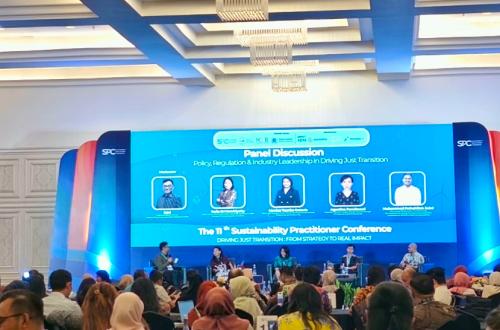
The transition towards a low-carbon economy is deemed insufficient if it only stops at commitments and strategies; it must be translated into policies, investment decisions, business transformations, and actions that deliver impact for society. This challenge emerged during the opening of The 11-th Sustainability Practitioner Conference (SPC) 2026, themed “Driving Just Transition: From Strategy to Real Impact”, on Wednesday (16/9/2026).
Sylvia Veronica N.P. Siregar, Chairperson of the Board of the Institute of Certified Sustainability Practitioners (ICSP), stated that a just transition must be viewed as an economic transformation process that influences the direction of capital, the speed of change, and the responsibility of institutions regarding the outcomes.
“This is how we manage economic transformation, determining how fast change occurs, where capital is directed, whose perspectives shape this process, and how institutions remain accountable for the results,” Sylvia said in her opening remarks at the 11th SPC.
According to Sylvia, the current challenge is no longer just about sustainability commitments, but the gap between targets and implementation. Transition priorities need to be integrated into governance and capital allocation, while financing and reporting must provide reliable information.
“Many organisations have announced sustainability ambitions, but real impact depends on the next steps: whether transition priorities are embedded in governance and capital allocation, whether financing supports credible activities, and whether reporting and assurance provide information that stakeholders can trust,” Sylvia added.
Ali Darwin, Executive Director of the National Center for Corporate Reporting (NCCR), stated that the low-carbon transition must also consider the impact on workers and communities. He noted that economic and energy changes must be carried out with attention to social justice aspects.
“Therefore, the low-carbon transition should not only focus on technology and investment, but must also address the issues of workers, communities, and social justice. This is the primary goal of a just transition,” Ali said in his opening speech.
Ali added that just transition planning needs to be incorporated from the outset into corporate strategies, including emission reduction targets, investment needs, and the impact on workers and communities. This process also needs to involve workers, trade unions, local communities, governments, investors, and educational institutions.
Robin Hodess, Chief Executive Officer of the Global Reporting Initiative (GRI), assessed that the current challenge of the transition lies in how change can occur fairly. A transition that is too rapid without planning can trigger social issues, while change that is too slow can increase climate, market, and investment risks.
“The essence of a just transition is ensuring that the shift towards a sustainable economy creates opportunities for society, rather than simply leaving them behind,” said Robin.
Robin explained that the GRI 102: Climate Change standard, published last year, increasingly integrates climate change issues and just transition into sustainability reporting. “Stakeholders now want a more complete picture of organisational performance. They want to understand how transition plans affect workers, communities, value chains, and society more broadly. In other as, they are looking for sustainability information that is credible, measurable, and connected to real, comparable results across organisations.”
Meanwhile, Emily Pierce, Director of Regulatory Implementation at the IFRS Foundation, stated that the International Sustainability Standards Board (ISSB) standards are becoming a global benchmark for providing sustainability information to capital markets. According to her, more than 45 jurisdictions have used or taken steps to adopt ISSB standards within legal or regulatory frameworks, cumulatively covering more than 60 per cent of global gross domestic product (GDP).
“The International Sustainability Standards Board (ISSB) standards are now truly becoming a global baseline that supports the information foundation for capital markets,” she said.
Through IFRS S1 and IFRS S2, companies also need to consider climate-related risks and opportunities in business decision-making. IFRS S2 specifically regulates the disclosure of company strategies regarding climate risks and opportunities, including targets, changes in business models or resource allocation, and transition plans.
The 11th SPC brought together governments, regulators, business players, financial institutions, and international organisations to discuss policy, financing, reporting standards, and social aspects of a just transition. Discussions covered the relationship between policy and industrial readiness, the alignment of capital with climate and social targets, business and human rights, and the implementation of GRI and ISSB standards.
The forum positioned implementation as the primary challenge of the low-carbon transition, ranging from business strategy, investment decisions, and risk management to financing and reporting. Thus, the success of a just transition is measured not only by emission reduction targets but also by the ability to ensure that economic changes continue to consider workers, communities, and public interests.