
Junior High School Students Develop Emotional Management Aid, Win Gold at ISIF 2026
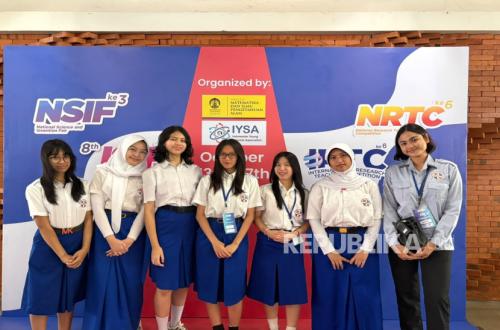
JAKARTA — Concern for mental health prompted six students from SMP Global Mandiri Jakarta to develop MindAid Pouch, a portable kit intended to help people with bipolar disorder manage their emotions and daily routines. The innovation won a gold medal at the eighth International Science and Invention Fair (ISIF) in 2026.
MindAid Pouch was developed by Salsabila Najwa Adela, Alisha Zahira Reza, Alisha Kirani Yudi Anwar, Kenisha Azzahra Akbar, Angeline Felice Lie and Rizuno Kayana Naureen Adesta as part of their research project, titled “Taming the Chaos: MindAid Pouch”.
In developing the kit, the team sought to understand the challenges faced by people with bipolar disorder, particularly changes in mood, energy and everyday activities. They then designed a simple portable aid for use alongside professional treatment.
Team member Salsabila Najwa Adela said the research had taught them to develop ideas in response to other people’s needs.
“Through this science research, we learnt that something simple can begin with concern for others. We hope MindAid Pouch can benefit people with bipolar disorder, helping them feel more comfortable, recognise their moods and manage their daily activities,” Najwa said.
To design the product, the team interviewed a clinical psychologist to understand users’ needs. MindAid Pouch contains a fidget spinner, stress ball, mood calendar, daily activity list and guidance cards to help users calm themselves.
The kit is designed to support sensory activities, mood tracking, routine planning and breathing exercises. The students also explored how scientific knowledge could be applied to create an aid addressing everyday needs.
The team conducted an initial trial with one adult participant with bipolar disorder over six days. During the observation period, the participant reported that the sensory items, particularly the stress ball, provided comfort and helped them calm down.
Measurements taken during the observation period also showed a reduction in symptom scores. However, the small number of participants and short testing period mean the results cannot be generalised or prove that any changes were caused by using MindAid Pouch.
Further research involving more participants and a longer observation period is therefore needed to assess the product’s benefits more comprehensively. MindAid Pouch is intended as a supportive aid, not a replacement for medical or psychological treatment for people with bipolar disorder.
Najwa said the team hoped to refine the product with feedback from users and professionals. For the students, the research was an opportunity to connect social concern with the scientific process.
ISIF 2026 was organised by the Indonesian Young Scientist Association (IYSA) in collaboration with the Faculty of Mathematics and Natural Sciences at the University of Indonesia (FMIPA UI). The competition provides a platform for students to present their research and exchange ideas with participants from different regions and countries.
ISIF is part of a series of competitions that also includes the National Science and Invention Fair (NSIF), the National Research Teacher Competition (NRTC) and the International Research Teacher Competition (IRTC). The series attracted 1,562 teams in total, comprising 717 online teams and 845 in-person teams.
The competition took place online from 6 to 9 October 2026 and in person from 13 to 17 October 2026 at Balai Purnomo Prawiro, Faculty of Social and Political Sciences, University of Indonesia, in Depok.
For the SMP Global Mandiri Jakarta team, the award is an incentive to continue the research and improve the innovation. The development of MindAid Pouch shows how students can make mental health a research topic while learning to understand users’ needs through a scientific approach.