
Judicial Review of Police Law: Advocates Seek to Place Police Under Home Affairs Ministry
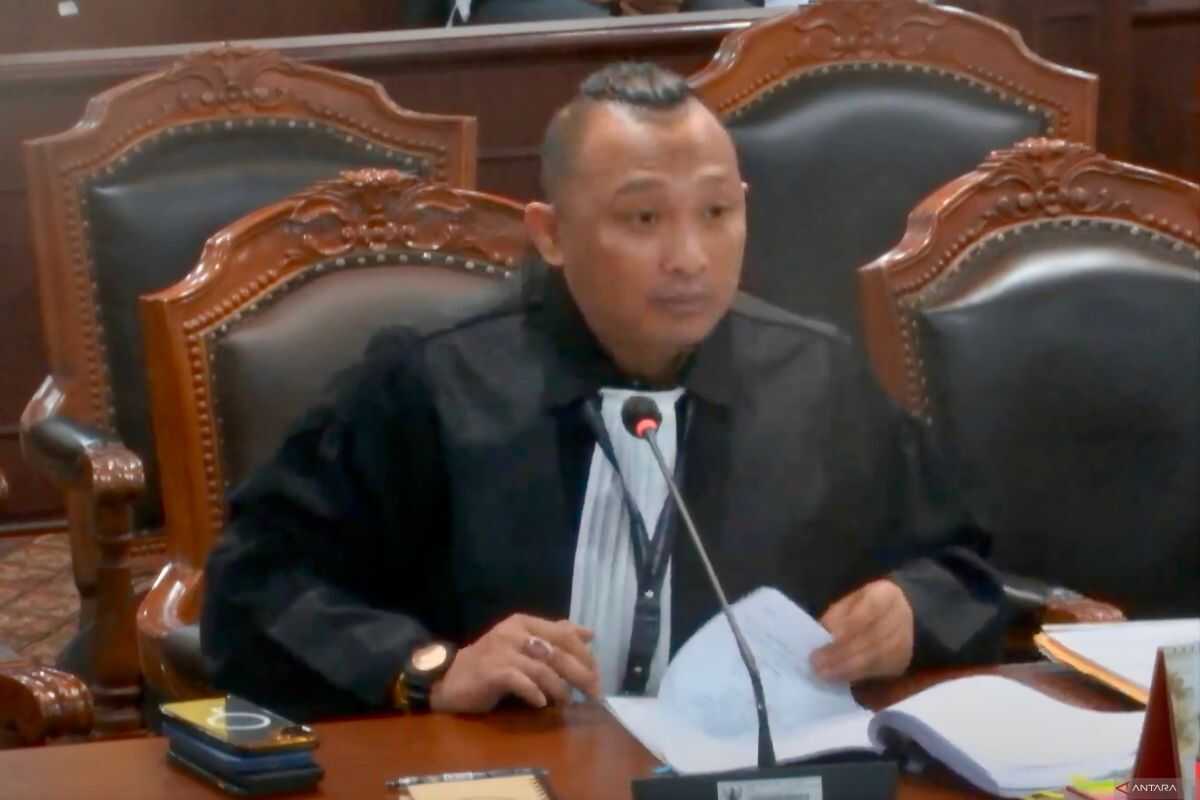
Jakarta (ANTARA) - Three advocates challenging Law Number 2 of 2002 on the Indonesian National Police (Polri) at the Constitutional Court have requested that the police be placed under the Ministry of Home Affairs.
The petitioners — Christian Adrianus Sihite, Syamsul Jahidin, and Edy Rudyanto — argue that placing Polri directly under the President has the potential to create discrimination against those with differing views, including advocates actively defending the legal interests of the public.
“Advocates defending the opposition or parties at odds with the government will be treated differently compared to advocates handling cases on the government’s side or its supporters,” Jahidin said during a preliminary hearing at the Constitutional Court in Jakarta on Thursday.
According to the petitioners, advocates are entitled to professional legal processes free from vested interests. If security apparatus become involved in the political interests of power, the three advocates argue, the integrity of investigations and prosecutions concerning their clients could be compromised.
The criminalisation of advocates is deemed to violate the petitioners’ constitutional rights to equal legal protection before the law, thereby contravening Article 27 paragraph (1) and Article 28D paragraph (1) of the 1945 Constitution.
In case number 63/PUU-XXIV/2026, the petitioners are challenging Article 8 paragraph (1), which stipulates that “the Indonesian National Police shall be under the President.”
They are also challenging Article 8 paragraph (2) of the Police Law, which states that “the Indonesian National Police shall be led by the Chief of Police who, in carrying out duties, shall be accountable to the President in accordance with prevailing laws and regulations.”
Beyond the lack of legal certainty, the advocates further argue that placing Polri directly under the President without going through a competent ministry creates problems in terms of institutional control, coordination, and accountability.
According to them, a President who simultaneously holds executive political functions would find it difficult to conduct detailed technical oversight of police operations. Consequently, there are concerns that Polri’s core duties, which should focus on public interests, could be drawn into the political interests of power.
The petitioners contend that the President is both the holder of executive power and a political office holder, meaning the direct relationship between Polri and the President would blur institutional control and accountability functions.
They believe that with a ministry serving as an intermediary, control and coordination functions could operate more effectively. A minister could manage technical and administrative matters, whilst the police could remain focused on their duty of protecting the public.
Such a framework is considered more aligned with the mandate of Article 17 paragraph (1) of the 1945 Constitution, which states that “the President shall be assisted by state ministers,” as well as Article 30 paragraph (4), which mandates that Polri as a state instrument “shall protect, safeguard, serve the public, and uphold the law.”
The placement of Polri directly under the President, according to the petitioners, not only raises issues of statutory norms but also creates tangible problems for the sustainability of democracy. In this context, they alluded to alleged involvement of security apparatus in general elections.
The petitioners therefore request the Constitutional Court to amend Article 8 paragraph (1) of the Police Law to read: “The Indonesian National Police shall be under the President through the minister responsible for domestic governance affairs.”
Furthermore, they request Article 8 paragraph (2) be amended to read: “The Indonesian National Police shall be led by the Chief of Police who, in carrying out duties, shall be accountable to the minister responsible for domestic governance affairs in accordance with prevailing laws and regulations.”
Additionally, the petitioners have requested that their case not be examined and adjudicated by Constitutional Justice Adies Kadir, owing to concerns about a conflict of interest with the justice who was nominated by the House of Representatives.
The case was heard by a panel presided over by Constitutional Justice Enny Nurbaningsih, accompanied by Constitutional Justices Anwar Usman and Arsul Sani.
During the advisory session, Arsul asked the petitioners to strengthen their arguments. He questioned whether the principles of the rule of law and free and fair elections would be fulfilled if Polri were placed under the Ministry of Home Affairs, as requested by the petitioners.
Arsul also queried: “What is the intended meaning of ‘under the President through the Home Affairs Minister’ as desired by Mr Jahidin and the petitioners? This must be explained.”
In accordance with Constitutional Court procedural law, the petitioners have been given 14 days to refine their petition. The revised petition document must be received by the Court no later than Wednesday, 4 March.