
Judicial Commission urges single code of ethics for lawyers to prevent 'job-hopping'
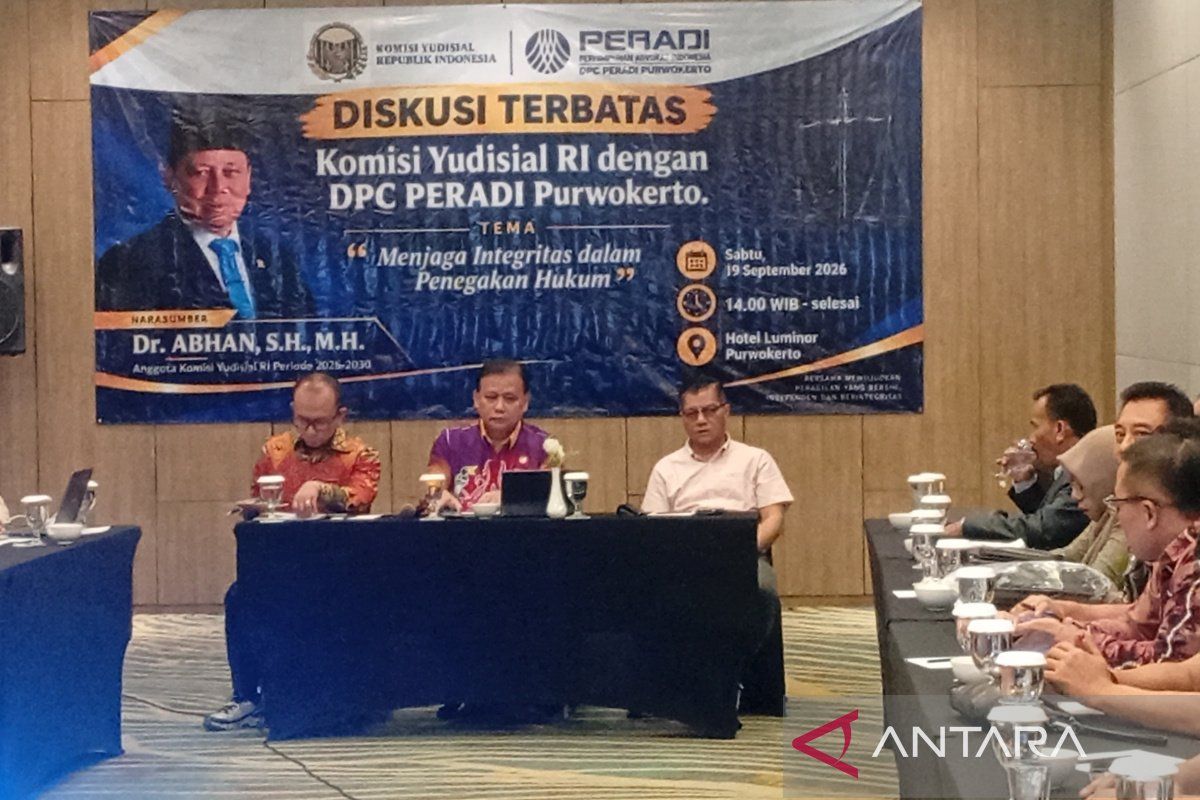
Banyumas, Central Java (ANTARA) - Judicial Commission (KY) member Abhan is pushing for the implementation of a single code of ethics for lawyers to prevent ‘job-hopping’ (switching organisations) by lawyers facing sanctions, while simultaneously strengthening professional integrity within law enforcement.
“There should be one code of ethics, and the ethical enforcement within the legal profession must also be unified. Therefore, when the single set of norms is violated and a sanction is imposed, that sanction must apply to everyone,” he stated during a Limited Discussion between the KY RI and the Peradi Purwokerto Branch, themed “Maintaining Integrity in Law Enforcement,” in Purwokerto, Banyumas Regency, Central Java, on Saturday.
According to him, the existence of multiple lawyer organisations does not necessarily require a proliferation of different codes of ethics and enforcement bodies. In this regard, he noted that while organisations may remain distinct, ethical norms and enforcement mechanisms should adhere to a single standard.
He stated that such a mechanism is necessary to ensure that lawyers facing heavy sanctions, including dismissal due to ethical violations, cannot easily move to another organisation and re-obtain their practising certificate. “This condition can weaken efforts to maintain professional integrity because a sanction imposed by one organisation is not necessarily recognised by others,” he said.
He cited the example of judges, who operate under a single code of ethics, while oversight is conducted through both internal and external mechanisms, namely the Supreme Court’s Supervisory Body and the Judicial Commission.
According to Abhan, the unification of the lawyers’ ethical mechanism should be driven by the legal organisations themselves, as the profession is independent and the government should not engage in excessive intervention.
In a separate instance, the Chairman of the Peradi Purwokerto Branch, Happy Sunary, stated that the discussion with the KY also aims to increase lawyers’ literacy regarding the role and function of the KY, as well as the professional regulations governing lawyers in the performance of their duties.
In this context, he noted that Law Number 18 of 2003 concerning Lawyers grants several authorities to Peradi, including specialised professional education, lawyer examinations, swearing-in, and the imposition of sanctions on lawyers who violate the code of ethics.
He remarked that while the freedom of association allows for the emergence of various lawyer organisations, these authorities are not automatically possessed by all organisations. “Even if there is a multi-bar system with many professional organisations, there must still be a single umbrella covering ethical issues, including sanctions,” he said.
He added that a single ethical umbrella is required so that sanctioned lawyers do not simply move to another organisation or form a new one.
Happy noted that based on the Constitutional Court Decision Number 126/PUU-XXIV/2026, delivered on 17 June 2026, any changes or replacements to Law Number 18 of 2003 concerning Lawyers must be completed no later than two years from the date of the ruling. Consequently, the deadline for amending or replacing the Lawyer Law is 17 June 2028.
“The regulatory change serves as a momentum to clarify the existence of professional organisations, including the regulation of ethics and the imposition of sanctions,” he said.
Happy concluded that the discussion regarding the revision of the Lawyer Law will involve two perspectives: the single-bar concept and the multi-bar concept, noting that the final policy choice rests with the legislature.