
Judicial Commission Records 740 Alleged Ethics Violations by Judges in First Half of 2026
The Judicial Commission (KY) has recorded persistently high numbers of suspected violations of the Judges’ Code of Ethics and Code of Conduct (KEPPH) in the first semester of 2026. From January to June this year, the KY received 1,402 public reports, more than half of which concerned suspected breaches of judicial ethics.
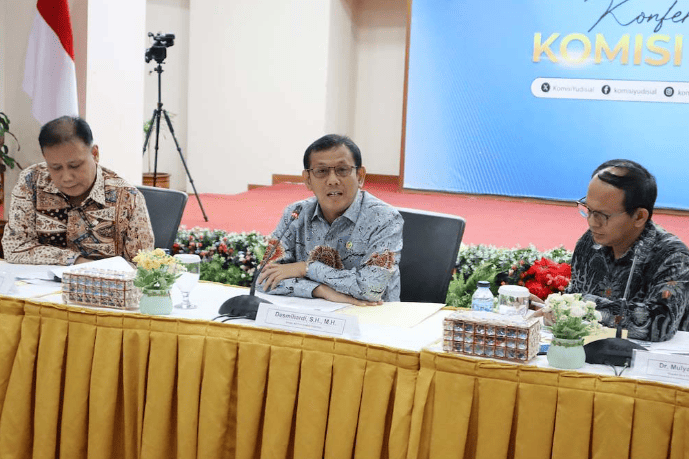
Deputy Chairman of the KY, Desmihardi, said that of the total reports, 740 related to suspected KEPPH violations, whilst 662 were copies of reports or information (external confirmations).
According to him, the high number of reports reflects the scale of public attention on the integrity of the judiciary as well as high expectations for more effective oversight of judges.
“The Judicial Commission received 1,402 public reports in the first semester of 2026. The high number demonstrates public attention to and expectations of the Judicial Commission. On the other hand, it also shows that many suspected violations of the judges’ code of ethics and conduct are still occurring in society,” Desmihardi said at a press conference in Jakarta on Thursday (30 July).
In addition to receiving reports, the KY has summoned 84 judges for questioning over suspected KEPPH violations. Over the same period, the KY also attended seven sessions of the Judges’ Honorary Council (MKH) alongside the Supreme Court.
“We see the high number of reports to the Judicial Commission as a mandate for the Commission to become more effective in overseeing the enforcement of the judges’ code of ethics and conduct,” he said.
Meanwhile, KY member and Head of the Judicial Oversight and Investigation Division, Abhan, explained that all reports received are first verified on administrative and substantive grounds.
From this process, only 88 reports met the requirements to be registered and processed further. That figure represents an increase compared with the January–June 2025 period, which saw 79 reports.
“Public reports reflect the scale of public hope for the upholding of judicial honour. That mandate must be fulfilled through professional, transparent and fair oversight of judges,” Abhan said.
He also stressed that copies of reports not addressed directly to the KY are still regarded as important information that will be examined further.
Abhan explained that not all reports can be processed because most complaints concern the substance of judicial rulings or legal reasoning. The KY’s authority, however, is limited to overseeing judges’ conduct, not to judging the correctness of court decisions.
“After verification, many public reports still question the substance of rulings or legal reasoning. That is not within the Judicial Commission’s authority, because we supervise judges’ conduct, not the content of court decisions,” he explained.
By case classification, of the 740 suspected KEPPH violation reports, civil cases accounted for the largest share at 439, followed by 158 criminal cases, 29 state administrative cases, 25 religious cases, 17 commercial cases, 8 corruption cases, 5 military cases, 2 industrial relations cases, 2 tax cases, and 37 other cases.
By region, the highest number of reports came from DKI Jakarta with 145, followed by West Java (91 reports), North Sumatra (73), East Java (62), Riau (39), Central Java (37), South Sulawesi (34), Banten (30), East Kalimantan (22) and South Sumatra (20).
Abhan said the majority of reports still originate from the general courts, indicating that this sector remains the public’s primary concern in monitoring judicial conduct.
Furthermore, Abhan affirmed that the KY will continue to encourage public and media participation in overseeing judicial integrity in order to maintain public trust in the judiciary.
“This oversight certainly requires public participation, including our friends in the media. With public support, we hope oversight of judges’ conduct can become increasingly effective and accountable,” he concluded.