
Judicial Commission receives 1,402 reports on judge conduct in first half of 2026
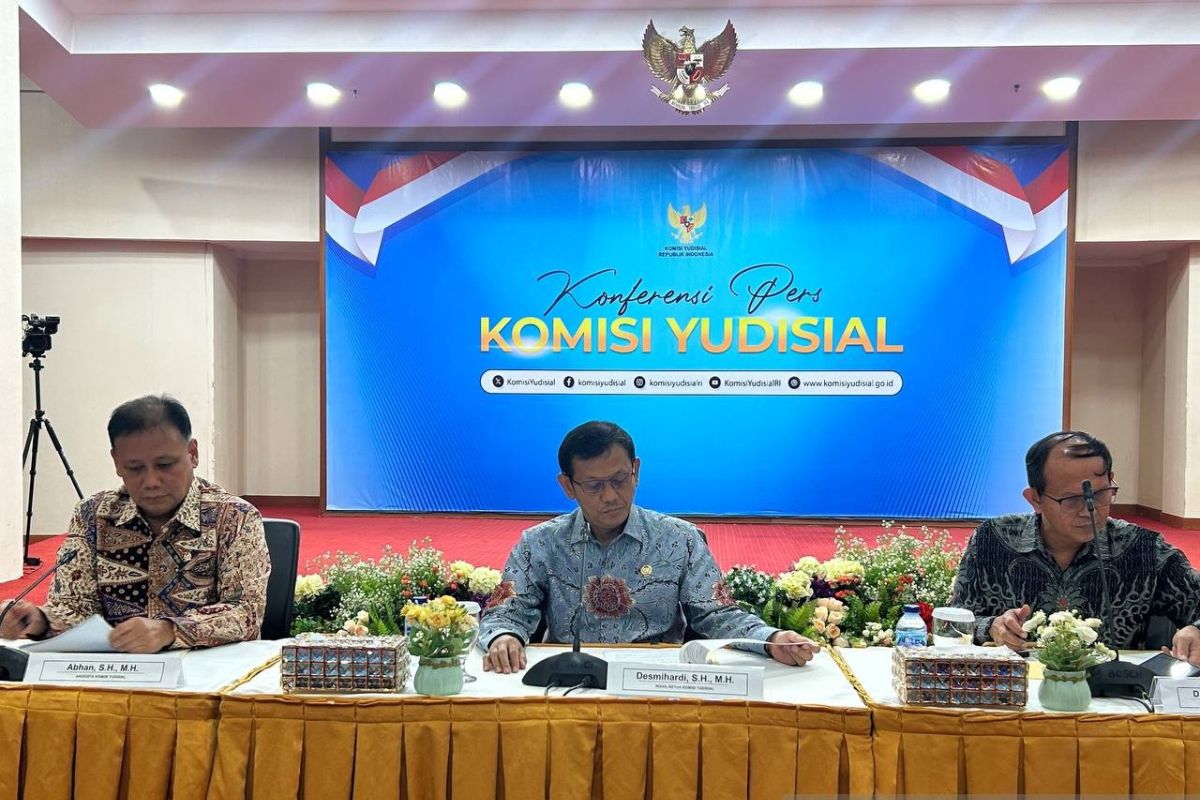
The Judicial Commission (KY) received 1,402 public reports regarding the conduct of judges during the first semester of 2026, marking a 10.3 percent increase compared to the 1,271 reports filed in the same period in 2025.
KY Deputy Chairperson Desmihardi stated during a press conference at the KY Building in Jakarta on Thursday that the high volume of public reports reflects significant attention and hope placed in the KY to oversee the Code of Ethics and Code of Conduct for Judges (KEPPH).
“We see that the high level of reports to the KY regarding KEPPH demonstrates the public’s hope that the KY can be more effective in supervising and enforcing the KEPPH,” Desmihardi said.
He explained that the incoming public reports undergo verification to check the completeness of administrative and substantive requirements. A total of 676 reports, or 87.37 percent, were accepted by the KY, while the remainder are still in the verification process. “Reports that met the administrative and substantive requirements for registration amounted to 88 reports,” he said, noting this figure increased from 79 reports during the January to June 2025 period.
According to Desmihardi, the number of registered public reports is smaller because most complaints concern the substance of legal considerations, namely the content of rulings, rather than the conduct of judges.
An analysis of the 740 KEPPH-related reports by case type revealed 439 related to civil cases, 158 to criminal cases, 29 to state administrative cases, 25 to religious cases, 20 to industrial relations cases, 17 to commercial cases, 8 to corruption cases, 5 to military cases, 2 to tax cases, and 37 to other cases.
Based on the location of complaints, KEPPH-related reports were predominantly from major Indonesian cities. DKI Jakarta led with 145 reports, followed by West Java with 91, North Sumatra with 73, East Java with 62, Riau with 34, Banten with 30, East Kalimantan with 22, and South Sumatra with 20.
In terms of the judiciary bodies involved, reports were distributed across general courts with 64 complaints, religious courts with 64, the Supreme Court with 63, state administrative courts with 27, military courts with 6, corruption courts with 4, the Sharia Court with 1, and others with 17.
KY official Abhan further explained the handling process, which includes face-to-face examinations of parties, including complainants and witnesses, resulting in official examination reports, as well as the collection of detailed evidence before examining the reported judges.
The KY summoned 418 individuals from 119 reports to provide testimony or clarification. Summonses were issued to 91 complainants or their legal representatives, of whom 69 attended and 22 did not. Meanwhile, 243 witnesses or experts were summoned, with 222 attending and 21 absent. Summonses were also issued to 84 reported judges, with 65 attending and 19 failing to appear. “The purpose of these summonses is to seek clarification regarding alleged violations of the KEPPH,” Abhan stated.
The KY also held plenary sessions on 207 reports, concluding that 73 reports were proven, resulting in recommended sanctions for 121 judges.