
Judges Accuse Andrie Yunus of Undermining Court Authority for Skipping Trial
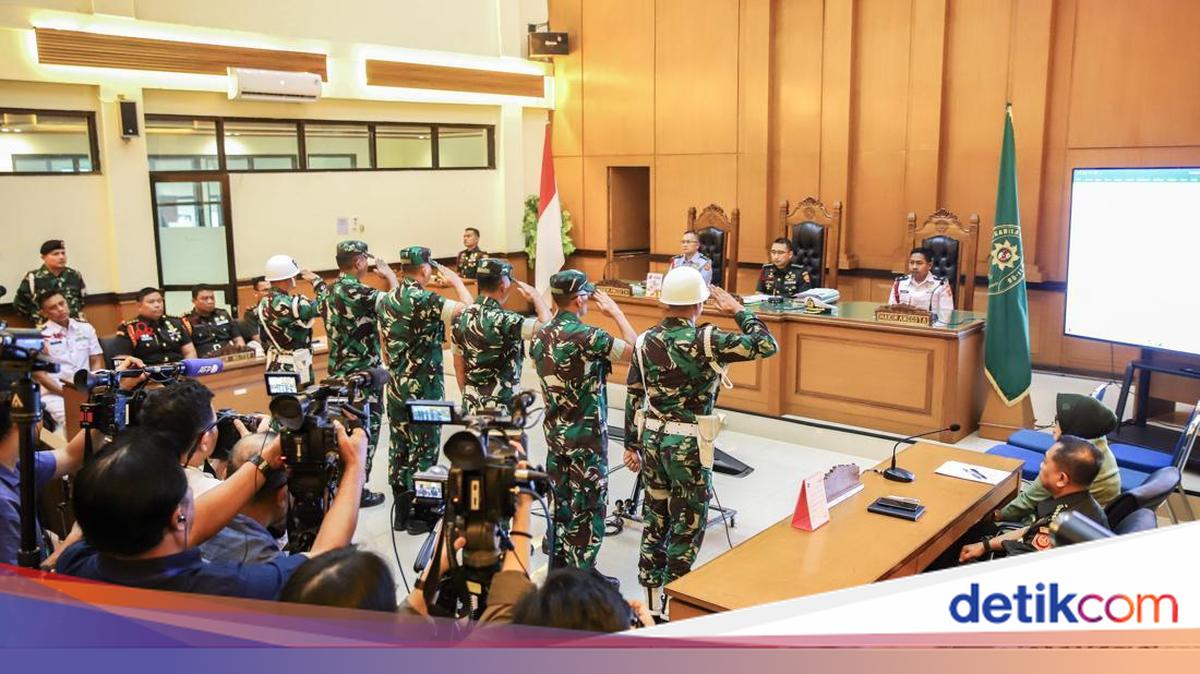
A panel of judges at Military Court II-08 Jakarta assessed that KontraS Deputy External Coordinator Andrie Yunus was uncooperative and undermined the authority of the court. The judge stated that their goodwill in wanting to hear Andrie’s testimony at trial was not matched by Andrie. “The panel initially hoped that Mr Andrie Yunus could attend in person to give testimony in a public trial so that comprehensive legal facts could be explored and obtained,” the judge said while reading the verdict against the defendants at Military Court II-08 Jakarta, on Wednesday (10/6/2026). The judge stated the panel wished to explore the victim’s condition before, during, and after the incident, which according to the judge was a matter only known to Andrie. The judge opined that this wish was not reciprocated with goodwill from Andrie. “Considering that the panel’s goodwill was not reciprocated with goodwill from Mr Andrie Yunus,” the judge remarked.
The judge said they had provided the option for Andrie’s testimony to be heard online if he could not be physically present in court because he was still receiving medical treatment. The judge stated they were guided by a doctor’s statement indicating Andrie was fit to give testimony online. “In his statement when examined as an expert during the trial, he stated that Mr Andrie Yunus’s condition was outpatient-based and allowed him to provide testimony online via Zoom Meeting,” the judge said.
The judge assessed that the online option was also not fulfilled by Andrie. The judge opined that Andrie ignored his obligation and gave the impression of opposing the trial process at the Jakarta Military Court. “Considering that the panel initially assessed and understood this situation, but in this matter, Mr Andrie Yunus, aside from ignoring his obligation, also gave a contrary impression to the trial process and cast a negative stigma by showing distrust towards the judicial process at the Military Court,” the judge said. “It even gave the impression of belittling the legitimate process provided by the state. The panel in this matter assessed Andrie Yunus’s attitude as having demeaned the authority of the court,” the judge continued.
The judge assessed that Andrie was uncooperative in seeking justice for the deprivation of his rights by the defendants. “Considering that the uncooperativeness of Mr Andrie Yunus in seeking justice for his rights that were violated by the defendants was ignored by the individual concerned himself,” the judge stated.
The judge also declared there was no military intelligence operation in the case of the acid attack on Andrie Yunus. The judge stated that the defendants carried out the acid attack out of resentment and a grudge against Andrie. The judge said the defendants did not know Andrie. The judge said the defendants wanted to teach Andrie a lesson and provide a deterrent effect. The judge stated the defendants harboured resentment because Andrie forced his way in and staged an interruption during the TNI Law Revision meeting at the Hotel Fairmont Jakarta on 16 March 2025. Additionally, the judge said the defendants believed that Andrie accused the TNI of intimidation and terror at the KontraS office, accused the TNI of being the mastermind or actor in the riots in late August 2025, and because Andrie actively propagated anti-militarism narratives.
“It is true that for these perpetrators, who emotionally did not know the victim but harboured a grudge and resentment towards the victim, this falls under the theory of vicarious trauma,” the judge said. The judge stated that an intelligence operation is not a spontaneous act, but is designed systematically, and is not built on personal anger. “It is true that in military intelligence doctrine, an intelligence operation is not a spontaneous or emotional act, let alone one carried out individually without a command structure. A military intelligence operation is an activity designed systematically, in a tiered manner, measurably, and based on the state’s strategic objectives,” the judge said.
The judge assessed that to label an action as an intelligence operation, it must be provable through the state’s strategic objectives, an order or authorisation, command structure, operational planning, operational system support, execution control, evaluation mechanism, and accountability. The judge said if these elements are not met, it is difficult to call an act an intelligence operation. “The Panel in this matter, basing its view on the expert’s opinion, affirms and is convinced that the defendants’ actions had no connection with involvement from the command structure,” the judge remarked.
The full verdicts for the 4 defendants are as follows: Defendant I, Second Sergeant Edi Sudarko, was sentenced to 3 years in prison and dismissed from military service. Defendant II, First Lieutenant Budhi Hariyanto Widhi, was sentenced to 2.5 years in prison and dismissed from military service. Defendant III, Captain Nandala Dwi Prasetyo, was sentenced to 2 years in prison. Defendant IV, First Lieutenant Sami Lakka, was sentenced to 1.5 years in prison. The judge declared the defendants guilty of violating Article 467 paragraph 1 in conjunction with paragraph 2 in conjunction with Article 20 letter C of Law Number 1 of 2023 concerning the Criminal Code.