
Judge prays that applicants challenging Constitutional Court Law "remain a match until the end"
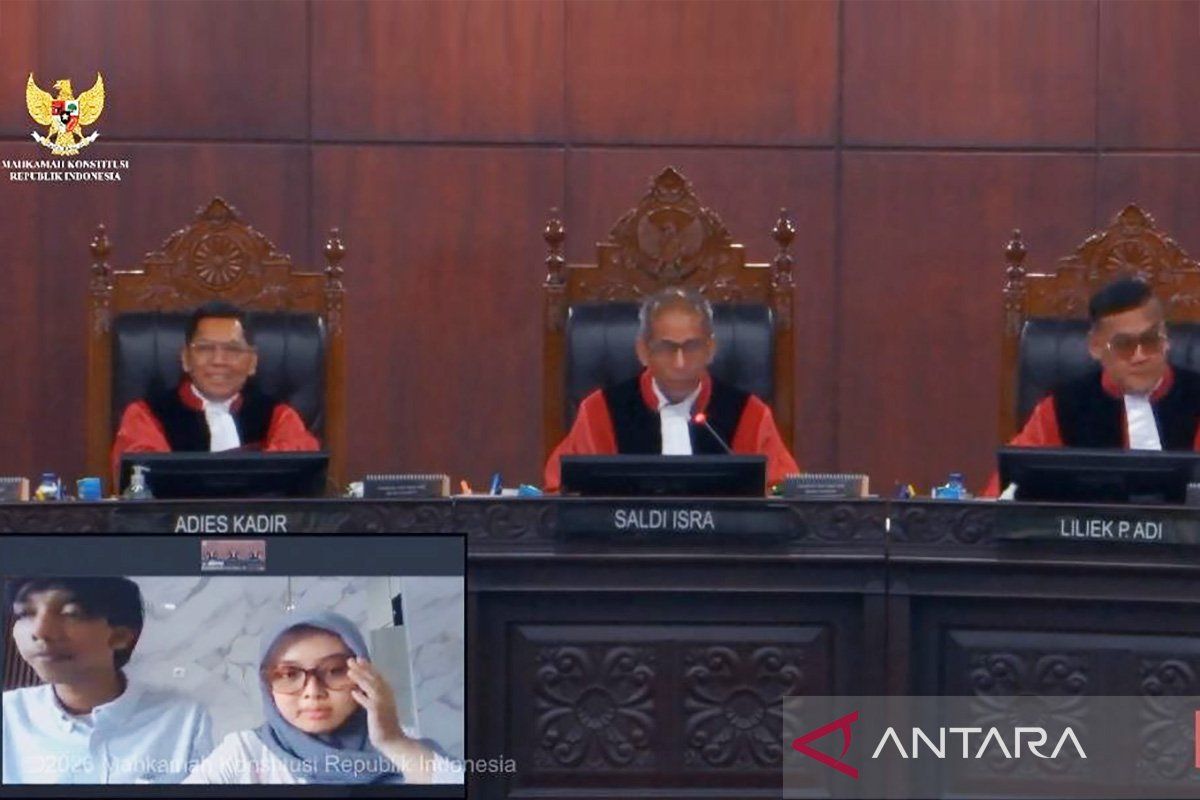
Jakarta (ANTARA) - Deputy Chief Justice of the Constitutional Court Saldi Isra prayed that two students from UIN Sayyid Ali Rahmatullah Tulungagung, namely Adam Imam Hamdana and Wianda Julita Maharani, would “remain a match until the end,” during an interesting moment in the preliminary hearing of the judicial review of the Constitutional Court Law (UU MK) filed by the two applicants.
Saldi expressed this hope, noting that the pair are from the same campus, once interned together at the MK, and filed the lawsuit jointly.
“I pray that you two stay together until the end, yes,” said Saldi during the virtual hearing at the Constitutional Court in Jakarta on Monday.
The two applicants, Adam Imam Hamdana and Wianda Julita Maharani, are pursuing higher education in the Constitutional Law Study Programme at UIN Sayyid Ali Rahmatullah Tulungagung campus.
Imam and Wianda are challenging the substance of Law No. 8 of 2011 on Amendments to Law No. 24 of 2003 on the Constitutional Court and Law No. 24 of 2003 on the Constitutional Court (UU MK).
The two applicants are questioning the absence of a time limit for resolving judicial review applications (PUU). According to them, the lack of a firm time limit for hearings or case handling creates legal uncertainty for applicants.
“We argue that without clear limitations, the phrasing of the aforementioned articles causes legal uncertainty because there is no firm time limit for applicants,” said Adam.
“Thus, applicants are seemingly left hanging with full uncertainty regarding their submitted application,” Adam added.
Through the hearing chaired by the constitutional justice panel led by Deputy Chief Justice Saldi Isra, the applicants also assessed that the provisions requested for review result in non-transparent conditions.
In their application, the applicants also provided comparisons with constitutional courts in several countries that provide clear hearing schedules.
With their arguments, the applicants asked the MK to provide a constitutional interpretation regarding the examination hearing deadline, which essentially states that if a hearing is postponed, the MK must notify the applicants of the reasons for the postponement.
The preliminary hearing, besides presenting the main points of the lawsuit, also saw the constitutional justices providing advice to the applicants.
That advice was given by panel members Adies Kadir, Liliek P. Adi, and Saldi Isra.
Constitutional Justice Adies Kadir, in his advice, asked the applicants to specify which article creates the phrase “examination hearing.”
“So the question is, is what is being challenged Article 41 of Law No. 24/2003 or Article 41 of Law No. 8/2011? Please clarify this,” said Adies.
Meanwhile, Constitutional Justice Liliek P. Adi asked the applicants to explain two things related to their application: first, regarding the title of the sixth part of their petitum which mentions it is not a norm from an article. Second, regarding transparency, what is its connection to transparency and the absence of rules on case resolution timeframes.
“And the data that the applicants have about decisions where, according to the applicants, there were delays causing uncertainty, thus providing strength to the applicants’ posit arguments that this must be regulated,” said Liliek.
Deputy Chief Justice Saldi Isra, as the panel justice, also gave advice to first read the details of the Law and MK Regulations to distinguish between MK Decisions and MK Determinations.
“Well, you have read that there are two types of MK decisions: decided and pronounced. Well, which one are you asking for, because decided and pronounced are different,” said Saldi.
Saldi also advised the applicants to understand the sequence in MK hearings, where some hearings are decided quickly, while others take longer due to the need for comprehensive deepening.
According to him, the applicants are incorrect in comparing the MK’s hearing authority with other authorities. Because some MK authorities overlap with state agenda items, such as legislative elections, presidential elections, and regional head elections, which require inaugurations.
“But judicial review of laws does not create a legal vacuum; the norm still applies. Well, that is what your application has not elaborated,” said Saldi.
Finally, the panel chief justice gave three options for their application: to proceed without amendments, to withdraw the application if they feel the legal standing is not strong, or to proceed after making amendments first.
Source: jawawa.id (https://jawawa.id/newsitem/judge-prays-that-applicants-challenging-constitutional-court-law-remain-a-match-until-the-end-1777312284)
Originally published by Antara (Indonesian) (https://www.antaranews.com/berita/5544745/hakim-doakan-pemohon-uji-materi-uu-mk-berjodoh-sampai-akhir), translated from Indonesian