
Journalist Impacted by Pandemic Transforms Idle Land into Banana Plantation
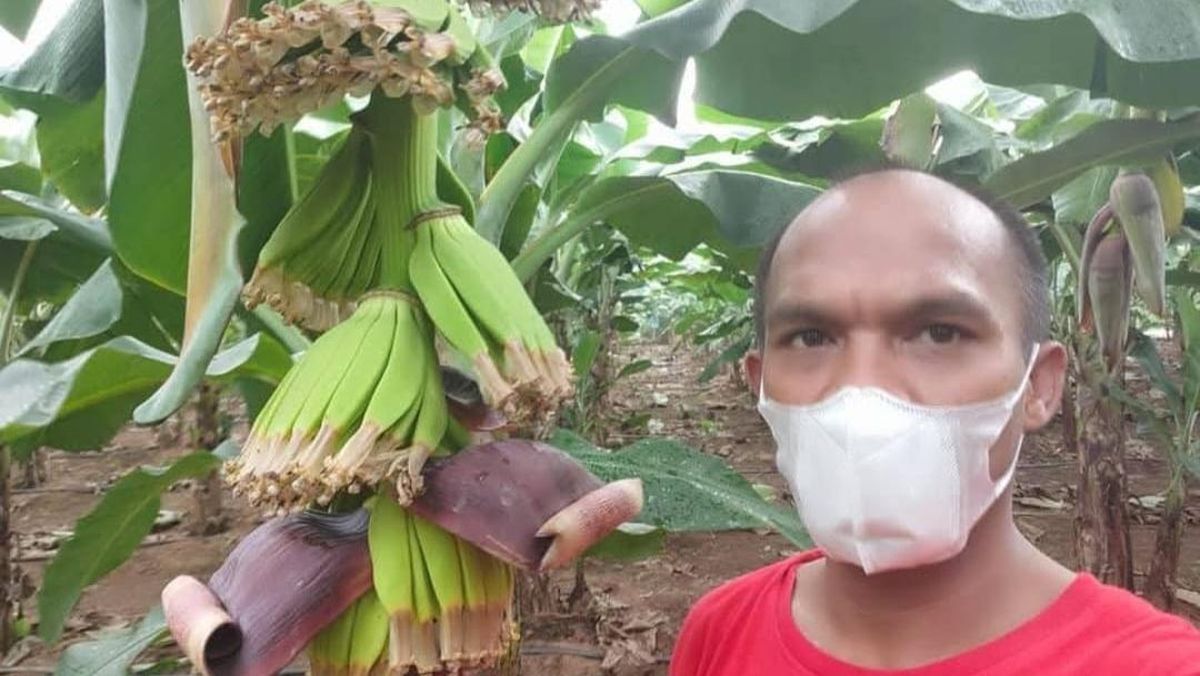
The Covid-19 pandemic in 2020 changed many aspects of life for Kusnaedi (46), a journalist based in Tangerang, Banten. At the time, Kusnaedi—who worked as a contributor for a private television station headquartered in Jakarta—felt the impact of the pandemic when the journalism industry implemented staff reductions.
Amidst this situation, the man, who had just turned 40, noticed idle land in his hometown in Cileles Village, Cileles District, Lebak Regency, Banten. He then decided to attempt to utilise this idle land in his hometown for banana farming.
Recalling his experience, he admitted that the idea stemmed from his concern seeing farmers in his village struggling to market their agricultural produce. “Many farmers in the village were confused about how to distribute their agricultural products. That was initially my dream,” said the man, affectionately known as Bang Badumn, on Monday (14/9).
Equipped with the experience and networks gained during his journalistic career, Kusnaedi subsequently studied the agricultural distribution chain in Banten. Furthermore, he attended various training sessions and seminars regarding banana cultivation. As time passed, alongside the Jatanras (Jawara Tani Rangkas) farmer group, Kusnaedi obtained a Business Cultivation Right (HGU) from Perhutani to manage five hectares of idle land for 35 years.
The land was established as a pilot project and is expected to benefit the surrounding community. Kusnaedi subsequently invited nine local residents to work the newly authorised idle land together.
As a commodity, they chose to plant the Cavendish variety, also known as white Ambon or dessert bananas. He stated that this variety was chosen due to several factors. Firstly, it was deemed suitable for the local environmental conditions. Most importantly, these bananas have a better market value compared to other varieties.
By utilising superior shoots as seedlings, the Perhutani-owned idle land was gradually transformed into a productive banana plantation. However, according to Bang Baduy, the initial land clearing process was not easy. As it was idle land, opening the area required significant operational costs. They strategised by partnering with several relevant agencies. “In addition to the cost of buying superior banana shoots, the operational cost for land clearing is quite high, approximately Rp100 million per hectare is required until harvest,” he said.
For seedlings, Kusnaedi purchased banana shoots from the Bogor Agricultural Institute (IPB). These seedlings were then planted at a distance of about two to three metres, adjusting to the land’s contour. In one hectare of land, approximately 2,000 banana trees can be planted. The planting period to harvest ranges from seven to 12 months.
“Currently, the harvest process is usually carried out every two weeks, with an average of five tonnes per harvest,” said Kusnaedi. The harvesting process is still conducted traditionally. After being picked, the bananas are cleaned and sorted before being packaged and sent to ripening locations.
The first harvest took place in 2021. For marketing, Kusnaedi initially collaborated with an agribusiness company for two years. Additionally, he established partnerships with various parties to supply banana needs to traditional markets.
Kusnaedi’s journey as a farmer has since expanded. In 2025, he became a supplier of bananas for the Free Nutritious Meal (MBG) programme at several Nutrition Fulfilment Service Units (SPPG) in various regions across Banten. “Alhamdulillah, after a fairly long process, I have been entrusted to supply the requirements for the MBG programme,” said the father of three.
Due to the increasing demand for bananas, Kusnaedi hopes for support from both central and regional governments, particularly in the provision of agricultural tools, fertiliser, and the improvement of road access to the plantation sites. According to him, road access is one of the main obstacles in the distribution process, especially during the rainy season. “The obstacle is that during the rainy season, the distribution process is disrupted because the plantation area is located in the interior,” he revealed.
Currently, the efforts of Kusnaedi and the Jatanras farmer group continue to grow. By 2026, the idle land successfully cultivated by the group is expected to reach approximately 30 hectares, with around 80 members. From this venture, Kusnaedi claims he is now able to achieve a monthly turnover of approximately Rp30 million.
Not wanting to limit the effort to his personal business, the father of three is also active in educating the community and farmer groups regarding Cavendish banana cultivation. He assists community members interested in working idle land, from the land clearing process to the provision of banana seedlings.
For Kusnaedi, farming is more than just an alternative after the pandemic hit his journalism career. More than that, this activity is his effort to open new economic opportunities while helping local farmers gain better market access.
On the other hand, amidst his gardening activities, as the pandemic began to subside, Kusnaedi—or Bang Baduy—was eventually trusted to return to journalism as a contributor for a private television station based in Jakarta. Furthermore, he is a member of the Indonesian Television Journalism Association (IJTI) in Banten.
Source: jawawa.id (https://jawawa.id/newsitem/journalist-impacted-by-pandemic-transforms-idle-land-into-banana-plantation-1790222441)
Originally published by CNN Indonesia (https://www.cnnindonesia.com/nasional/20260922050017-20-1406570/jurnalis-terdampak-pandemi-sulap-lahan-tidur-jadi-kebun-pisang), translated from Indonesian