
Jokowi Says He Is Now Self-Employed: His Business Story Before Becoming President
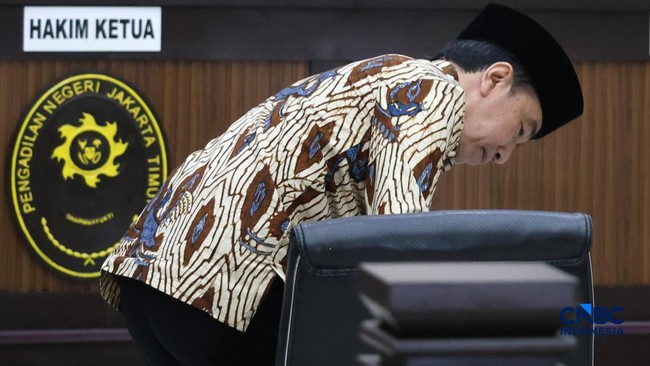
Former Indonesian president Joko Widodo, known as Jokowi, said his current occupation is self-employed. He made the statement during a hearing in the alleged diploma-defamation case in which Roy Suryo is the defendant.
“Occupation?” a judge at the East Jakarta District Court asked, according to detikfinance on Thursday (5 November 2026).
“Self-employed, Your Honour,” Jokowi replied.
Jokowi’s career before becoming head of state is an interesting one. Before entering politics, he was a furniture entrepreneur in the city of Solo, Central Java.
Jokowi’s furniture company, PT Rakabu Sejahtra, has attracted attention as a source of wealth for the former Jakarta governor. Its LinkedIn page describes the company as a manufacturer of furniture and household equipment.
“We are a furniture manufacturing and export company. Our vision is to become a professional and trustworthy company, always prioritising our commitment to working with our clients,” the company’s LinkedIn page states.
PT Rakabu Sejahtra says its mission is to keep developing products and markets to satisfy customers and strengthen its clients’ credibility. The page lists the company as having between 201 and 500 employees.
However, the company’s official website, as listed, cannot be accessed. It appears to be inactive, displaying the message “address not found”.
So how did Jokowi establish PT Rakabu Sejahtra?
Jokowi began his career at paper company PT Kraft Aceh after graduating in 1985. He said things did not go smoothly and he stayed for only two years, as he could not tolerate what he considered an authoritarian workplace culture.
“Orders were given in a very authoritarian way, even though the work was going quite well. That made me uncomfortable,” Jokowi said, as recounted by Alberthiene Endah in Jokowi: Memimpin Kota, Menyentuh Jakarta (2012), and cited on Wednesday (31 January 2023).
Jokowi returned to Solo in 1987 and tried to start a timber and furniture business using savings from his salary.
But he went back to working as an employee because starting a business required substantial capital. He joined his relative Miyono, who owned a timber company dealing in furniture, wooden flooring and various household products.
Despite working for a relative, Jokowi received no special treatment. He sawed and planed wood, painted, and helped load goods into containers.
After a year, he moved into an office role, handling design, marketing and human resources.
“I enjoyed it all. I learnt a lot,” Jokowi said.
Having gained experience, Jokowi eventually found the courage to start his own business.
With his experience and a bank loan of Rp30 million, Jokowi, born on 21 June 1961, established a company on 21 February 1988. Named CV Rakabu, it started out in a small kiosk in Kadipiro, Solo, Central Java.
At the time, Indonesia was regarded as an Asian Tiger, with rapid economic growth. That outlook convinced Jokowi that becoming an entrepreneur was the right move.
In its early years, Jokowi’s business had only three employees, all working in production. Jokowi often brought work home, filling the house with airborne sawdust.
The process was difficult, as was marketing the products. Rakabu was a small, little-known player, so Jokowi had to go out and find customers.
He visited houses under construction to offer furniture. Some deals succeeded, but many did not. Gradually, however, his efforts began to pay off.
His workshop became a constant source of the sound of buzzing saws. After building up enough capital, Jokowi took the risk of expanding to Jakarta in 1990. There, he secured the biggest order Rakabu had received since it was founded, worth Rp60 million.
Jokowi hurried back to Solo to fulfil the order, but was defrauded and lost the Rp60 million. The customer disappeared after the goods had been completed and delivered.
His mother, Sudjiatmi, recalled that the fraud left Jokowi devastated. The business he had built from scratch went bankrupt because of his own negligence. He was out of work and took on odd jobs for months.
“Jokowi often came home looking gloomy. He was always listless,” Sudjiatmi said in Saya Sujiatmi, Ibunda Jokowi (2014), by Fransisca Ria Susanti and Kristin.
To help him recover, Sudjiatmi used all her savings and took out a Rp30 million bank loan to provide business capital. Rakabu began to revive.
Demand for furniture grew. This time, Jokowi was determined not to repeat the same mistake: he insisted on receiving a deposit before beginning production.
At the same time, Jokowi received Rp500 million in funding from state-owned gas company Perusahaan Gas Negara (PGN). The capital enabled him to expand and venture into exports. Over time, his factory operations and workforce grew.
From 1991, Jokowi frequently travelled between Solo, Jakarta and Singapore to market Rakabu’s furniture. He often secured orders from Singapore for a dozen or more containers of wooden goods. This marked the beginning of his success.
Between 1994 and 1996, Jokowi’s furniture production surged. He had eight factories and hundreds of employees. His wealth grew, and after years of renting, he was able to buy his own home in Solo.
During the 1997–98 crisis, when many businesses collapsed, Rakabu instead performed strongly. The company began reaching markets in Australia, the United States, the Middle East and Asia. It was then that Jokowi began to see the rewards of his entrepreneurial efforts.
It is therefore unsurprising that Jokowi, the entrepreneur who later became president, accumulated substantial assets, including land, vehicles and other holdings. According to his 2023 State Officials’ Wealth Report (LHKPN), his total wealth stood at Rp82 billion.
Source: jawawa.id (https://jawawa.id/newsitem/jokowi-says-he-is-now-self-employed-his-business-story-before-becoming-president-1793854261)
Originally published by CNBC Indonesia (https://www.cnbcindonesia.com/market/20261105111449-17-782548/jokowi-mengaku-kini-wiraswasta-ini-kisah-bisnis-sebelum-jadi-presiden), translated from Indonesian