
Joko Widodo Leads BRIN Team in Collaborative Project with Japan
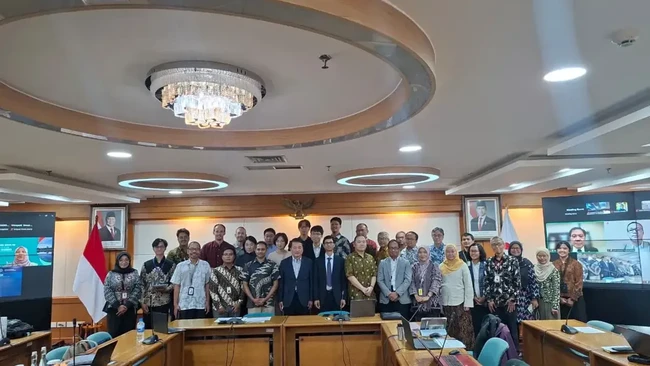
The National Research and Innovation Agency (BRIN), in partnership with Japan’s National Research Institute for Earth Science and Disaster Resilience (NIED), is strengthening research cooperation in the field of disaster risk reduction through the 1st BRIN-NIED Annual Disaster Risk Reduction (DRR) Workshop, held at the B.J. Habibie Building, Jakarta, on Thursday (4/9).
This inaugural annual workshop marks the commencement of a joint research project between BRIN and NIED covering various aspects of disaster management. The research focus includes multi-hazard disasters, seismic resilience and engineering, disaster information systems, water and sediment disasters, and seismic observation.
Joko Widodo, Head of the BRIN Disaster Response Task Force, stated that the cooperation between Indonesia and Japan is of vital importance given that both nations face various natural disaster threats. “Indonesia and Japan share many similar disaster challenges, including earthquakes, tsunamis, volcanic eruptions, floods, landslides, and extreme weather,” he said.
He noted that the shared characteristics of these threats demonstrate that disaster risk reduction requires cross-border collaboration. Mitigation efforts and the enhancement of community resilience, he added, cannot rely on a single party but require the support of science, research, technology, and international cooperation.
The BRIN-NIED workshop brought together researchers and experts from various fields to exchange knowledge and discuss opportunities for developing disaster research. Topics discussed included meteorology and heat hazards, landslides, earthquakes, tsunamis, volcanoes, remote sensing, disaster information, and community resilience.
Joko expressed hope that the collaboration between the two institutions could expand through joint research, technology exchange, scientific publications, and more concrete collaborative programmes. The results of this cooperation are expected to not only strengthen the scientific capacity of both nations but also provide direct benefits to the public, such as strengthening early warning systems, improving preparedness, and building more resilient communities.
President of NIED Japan, Prof. Kaoru Takara, stated that the BRIN-NIED annual workshop serves as a new platform to strengthen knowledge exchange and research collaboration between Indonesia and Japan. According to Takara, Japan and ASEAN nations share high levels of vulnerability to various natural disasters, such as earthquakes, tsunamis, heavy rain, floods, and climate change-related disasters.
While Japan possesses extensive experience in disaster management, Takara noted that the experiences of ASEAN nations also hold significant value for Japan to learn from. “I believe we can exchange experiences from Japan to ASEAN, and vice versa, as well as between ASEAN countries,” he said.
Takara explained that previous discussions between BRIN and NIED have covered various fields, ranging from natural hazard research, observation technology, and data analysis to disaster information sharing. He hopes this collaboration will not be limited to bilateral Indonesia-Japan relations but can expand into a broader disaster research network within the ASEAN region.
According to Takara, organising the first BRIN-NIED workshop is a crucial step in translating previous discussions into concrete research projects. The cooperation is also expected to establish a long-term collaborative framework between BRIN and NIED for disaster risk reduction.
Takara also welcomed the establishment of a BRIN centre of excellence within the Integrated Research on Disaster Risk (IRDR) network. He noted that the presence of such a centre could strengthen the international disaster risk reduction research network. Currently, the IRDR network includes various centres of excellence in several countries, with NIED serving as a host for an IRDR centre in Japan.
He expressed hope that the centres of excellence in Indonesia and Japan could build closer ties so that the exchange of knowledge, data, experience, and research findings can be further strengthened within the IRDR community. Moving forward, the BRIN-NIED workshop is expected to serve not only as an annual scientific exchange forum but also as a foundation for joint research that produces concrete solutions for facing various disaster threats. This Indonesia-Japan collaboration is expected to contribute to increased disaster resilience, not only in both countries but also across the Asia-Pacific region and globally.