
Joint Efforts to Manage Jakarta's Waste
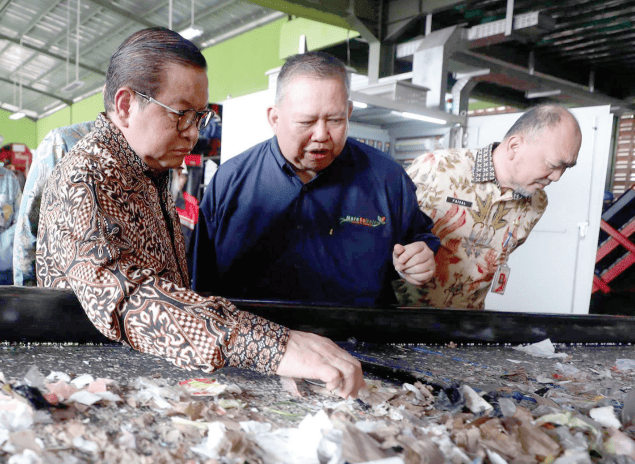
The transformation of waste management in the capital requires the active involvement of all elements of society, the private sector, and local governments in the Greater Jakarta area. Changing the management pattern from collect-transport-dispose to sort-transport-process cannot run optimally if it relies solely on the government.
From 1 August 2026, waste will no longer be collected for disposal at the Bantargebang Integrated Waste Treatment Plant in Bekasi, West Java, but must instead be sorted and processed at the source. Gradually, only residue that can no longer be processed will be sent to Bantargebang.
This transformation is being strengthened by the DKI Jakarta Provincial Government through the optimisation of waste processing facilities at the regional level. One such facility is the Reduce, Reuse, Recycle Waste Processing Site in Menteng Atas, Setiabudi District, South Jakarta.
“This policy is a concrete step to gradually stop the practice of open dumping towards the target of zero open dumping by 2029,” said DKI Jakarta Governor Pramono Anung.
According to the roadmap, by 2027, 50 per cent of the waste entering Bantargebang is targeted to be residue. In 2028, the target increases to 75 per cent, and by 2029, all waste entering Bantargebang will have undergone processing, leaving only residue. Thus, the practice of open dumping can be completely halted.
The DKI Jakarta Provincial Government is encouraging residents to get into the habit of sorting waste from home. Meanwhile, commercial areas, offices, hotels, restaurants, and cafés are required to manage their own waste independently.
As a transitional measure before the Waste-to-Energy Power Plant and refuse-derived fuel facilities become fully operational, the DKI Jakarta Provincial Government is optimising all 3R Waste Processing Sites spread across various areas. There are currently 29 such sites in Jakarta.
Head of the DKI Jakarta Environmental Agency, Dudi Gardesi, stated that sorting waste at the source is an important step to strengthen waste management. This is because the majority of waste generation comes from households, with almost half being organic waste and the remainder still having the potential to be recycled.
“Through DKI Jakarta Governor Instruction Number 5 of 2026 concerning the Movement for Sorting and Processing Waste from the Source, we want to invite the public to understand that sorting waste is no longer just an option, but a shared necessity to save Jakarta from a waste emergency,” Dudi explained.
If sorting is carried out from home, most of the waste burden can be resolved at the upstream level. Organic waste can be processed into compost, while inorganic waste can be recycled or saved. That way, only residual waste is sent to final processing facilities. Therefore, changing residents’ behaviour is an important part of building a more sustainable waste management system.
Urban planning observer Yayat Supriyatna assessed that the DKI Jakarta Provincial Government’s breakthrough needs to be replicated by the supporting cities in Greater Jakarta. This is because the surrounding areas still face limitations in infrastructure and the capacity of final processing sites.
He highlighted that Bekasi, Depok, Bogor, and Tangerang still need fundamental strengthening of their waste management systems. “Not all supporting areas have imitated the same movement. Landfill management is still weak, as is the supporting service infrastructure,” he said.
The sorting movement at the community level will not last long if it is not supported by the readiness of the government’s service system, such as door-to-door collection of sorted waste. Waste management must also be transformed into a community movement that positions residents as active subjects, not merely service recipients.
“If there is a waste-to-energy power plant later, it can generate economic added value. So, waste is not just waste, but can be converted into energy,” Yayat concluded.