
Jobseekers’ Hopes at Jakarta Job Fair
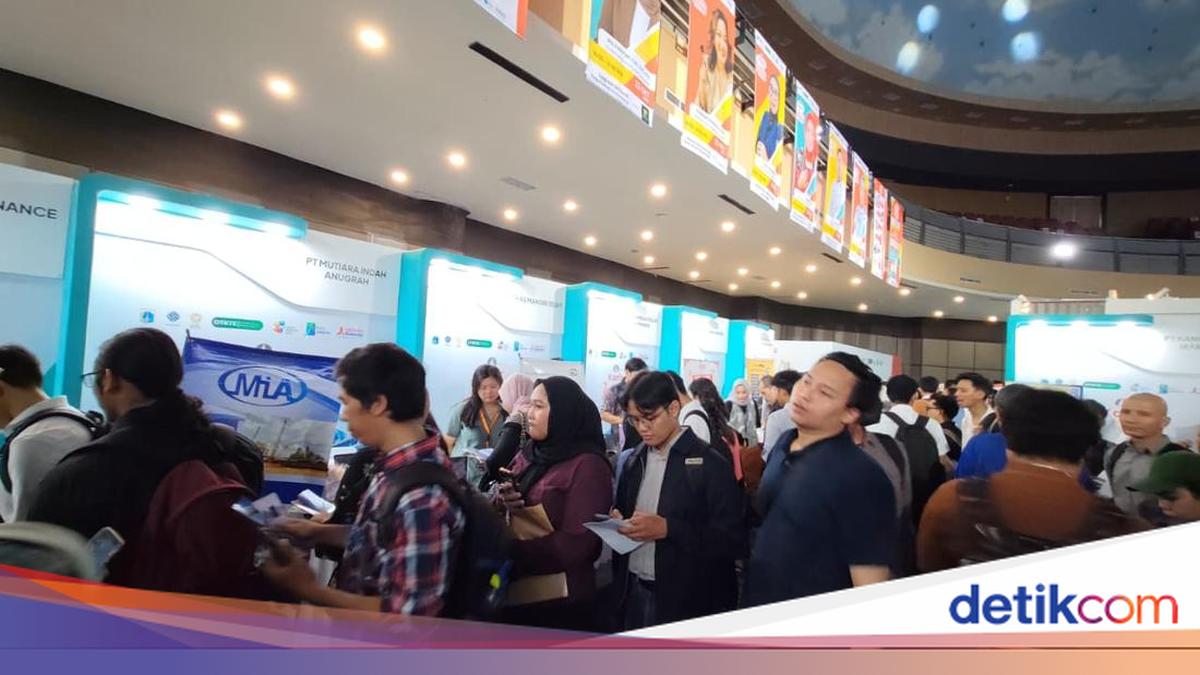
Jobseekers flocked to a job fair organised by the Jakarta provincial government, hoping their efforts to attend would lead to employment.
The Karir Jakarta and Independent Workforce (TKM) Expo 2026 was opened by Jakarta Governor Pramono Anung on Thursday (22 October 2026). It offers 12,000 vacancies from 100 national and international companies.
“There are around 100 companies and 12,000 vacancies. Hopefully, although we obviously cannot meet everyone’s expectations, given that it only opened today, I have already been told that around 28,484 applications have been submitted online,” Pramono said at the venue.
Hoping age will not be a factor
Syarif, a 47-year-old jobseeker from Bogor, set off at 6am. He has 20 years’ experience in information technology (IT) and has been unemployed for two months after being laid off.
“As for my age, I’m not confident competing with the younger ones—I’m 47. I was only laid off two months ago,” Syarif said when met at Smesco in South Jakarta on Thursday (22 October 2026).
In his IT work, Syarif was responsible for monitoring and maintaining servers. After losing his job, he tried to find new opportunities in various ways, including through his personal network and online job-search platforms such as LinkedIn.
This time, he attended the job fair to widen his chances of finding work. Syarif said he was not only looking for vacancies that matched his IT experience.
“Anything, really. In circumstances like these, we can’t focus on just one field. Whatever will take us, we’ll take,” he said.
Syarif acknowledged that the current competition for jobs posed a particular challenge, especially as he had to compete with younger applicants. Nevertheless, he remained optimistic and was willing to try the opportunities available.
He said work experience should be one of the factors companies consider when recruiting, and that age should not be the main limitation.
“I’d like organisers to look beyond age when hiring. If you look overseas, many places don’t set an age limit; what matters is the person’s skills. If they have the skills, don’t look at their age,” he said.
Syarif hoped that he and the other jobseekers at the fair would find work. He also hoped that opportunities would remain open to applicants of different ages and with varied work histories.
“God willing, everyone here will be able to find a job,” he said.
Parent hopes daughter with a disability can find work
Nur Aini, 21, a graduate of a special-needs school, attended with her mother, Maryam.
Maryam hopes her daughter will be able to find a job through the fair. Nur Aini completed her education in 2025.
“I want her to gain work experience. She’s at home, and she’s already graduated,” Maryam said when met at Smesco in South Jakarta.
Nur Aini graduated from Jakarta State Special School 02. She has skills in catering, including preparing food and drinks, and took related training while at school.
Maryam said her daughter had learnt to make dishes such as grilled chicken, as well as coffee. Those skills give Nur Aini a foundation as she tries to enter the workforce.
“She learnt to make grilled chicken and coffee—everything,” Maryam said.
Maryam hopes companies will give her daughter and other people with disabilities the opportunity to work in roles suited to their abilities.
“She really does want to work,” she said.
Maryam also hopes the government will make it easier for people with disabilities to access employment. In her view, more open opportunities would help them develop their potential and gain experience.
“I hope it can be made easier for them,” she said.
Generation Z hopes to find work
Young people are also hoping to find jobs soon. One of them is Haekal, 23.
The pharmacy graduate, who is qualified as a pharmacist, said he had attended several interviews but had yet to find a job.
“Honestly, it’s really difficult at the moment because many companies are still hiring fresh graduates, so I’m still struggling with interviews. My biggest difficulty is that when we communicate directly, but then have to explain ourselves verbally, I find it harder to tell my story in the interview,” Haekal said.
He said companies often failed to follow up after job interviews. He was frequently “ghosted”—left waiting without any update by the companies he had applied to.
“The difficulty is that after we’ve applied and everything, HR or the company doesn’t give us any information. That’s the hardest part for me. They leave us hanging—that’s what Gen Z calls being ‘ghosted’, I suppose,” he said.
Another member of Generation Z, 23-year-old Ayu, said she was also looking for work after graduating. She wants to switch careers from marketing to data analysis.
“Yes, I’m switching careers from marketing to data analyst,” Ayu said.
Ayu said changing careers meant building her skills and portfolio of projects. A lack of work experience was another obstacle.
“Yes, I have to change my CV, build my skills and add more projects. Some vacancies also require two or five years’ experience to become a data analyst. That’s where the struggle is, so I have to attend a lot of boot camps,” she said.
Ayu said the number of available places for applicants was limited, and vacancies were not keeping pace with the number of people applying.
“From what I can see, the number of applicants is a factor, and the chances of getting hired are very, very low. In Indonesia, many vacancies seem to be in sales, while fresh graduates come from all sorts of fields. There’s a gap between the jobs on offer and the people applying for them,” she said.